Iasguru's blog

Free Online Test Series For CSAT 2013 "Subject - Science"

Free Online Test Series For CSAT 2013

  • First Time in India, 100% Free Online Test Series for All IAS Aspirants
  • Specially Designed for Rural & Remote Area Students
  • Test Based on CSAT LATEST Pattern
  • Regular Free Study Materials
  • Regular Online Tests
  • Students Report Card
  • Live CHAT
  • Connect With Other Aspirants.
  • Downloads
  • SMS Alerts
  • and much more....

(Voice Notes) Current Affairs Daily & Weekly Update: 05 MAY 2013 "Topic: Measures To Boost Tourism"

Current Affairs Daily Voice Notes

Daily Voice Notes

Spotlight/News Analysis (5 May):

  • Topic of Discussion: Measures to Boost Tourism
  • Expert Panel: Sushil Saxena - (Senior Chief Manager Delhi Tourism) , Atul Mathur - (Hindustan Times)

(Final Result) UPSC: Civil Services (Main) Examination 2012

https://iasexamportal.com/images/upsc.JPG

Union Public Service Commission

Final Result-Civil Services (Main) Examination 2012

Based on the results of the written part of Civil Services (Main)  Examination, 2012 held by the Union Public Service Commission in October,  2012 and the interviews for Personality Test held in March-April, 2013,  following is the list, in order of merit, of candidates who have been  recommended for appointment to: - 

[i] Indian Administrative Service;
[ii] Indian Foreign Service;
[iii] Indian Police Service; and
[iv] Central Services, Group ‘A’ and Group ‘B’.

A total number of 998 candidates have been recommended for  appointment including 457 General (including 23 Physically challenged  candidates), 295 Other Backward Classes (including 09 Physically challenged  candidates), 169 Scheduled Castes (including 02 Physically challenged  candidate) and 77 Scheduled Tribes candidates against 1091 vacancies  ( 550 General, 295 Other Backward Classes, 169 Scheduled Castes and  77 Scheduled Tribes).

(Voice Notes) Current Affairs Daily & Weekly Update: 03 MAY 2013 "Topic: Securing freedom of Expression in all media"

Current Affairs Daily Voice Notes

Daily Voice Notes

Spotlight/News Analysis (3 May):

  • Topic of Discussion: Securing freedom of Expression in all media
  • Expert Panel: Sachchida Nand murthy (Member Press Council of India), Sumit Chakrawarty (Editor - The Main Stream)

Free Online Test Series For CSAT 2013 "Subject - Economy"

Free Online Test Series For CSAT 2013

  • First Time in India, 100% Free Online Test Series for All IAS Aspirants
  • Specially Designed for Rural & Remote Area Students
  • Test Based on CSAT LATEST Pattern
  • Regular Free Study Materials
  • Regular Online Tests
  • Students Report Card
  • Live CHAT
  • Connect With Other Aspirants.
  • Downloads
  • SMS Alerts
  • and much more....

(Sample Materials) Economic Survey & Government’s Plan, Programme & Policies - "Housing"


Contents of the Chapter:

  • Introduction
  • Key statistics
  • Estimation of Urban Housing Shortage (201)
  • Govt. Policies for affordable housing
  • International Scenario
  • Indices related with housing Sector

INTRODUCTION

The paradox of Indian economic growth manifests itself in several ways. On one hand Urban India has high housing shortage, on the other hand there is a massive and rapidly growing stock of vacant houses. In case we adapt business as usual scenario, with no major change in the interventions envisioned by public agencies, we may take trends in the growth in number of households (HHs) and housing stock and consider the difference of the second from the first as the shortage. This approach was adopted partially by the Ministry of Housing & Urban Poverty Alleviation (HUPA).Interestingly, despite the rapid growth in number of urban households, there will be no housing shortage by the middle of Twelfth Plan period, as per this approach. This is because the growth in the housing stock has been high in recent years, despite the speculation of the bubble bursting all the time.

Housing shortage would not be a major problem if there is no mismatch between the people for whom the houses are being built and those who need them. It would, however, be unrealistic to assume that those living in ‘housing poverty’ would have affordability and access to the burgeoning supply in the market. Within the urban population, there is a rapidly growing informal sector whose ability to borrow from the formal market is not adequately recognized. This is also posing a new challenge to the Policymakers and financiers. Although there has been continued deepening and broadening of the financial system, through a series of comprehensive financial reforms, the outstanding housing loans account for only 7.25 per cent of India's GDP, when compared with China (12 per cent), Thailand (17 per cent), and Malaysia (29 per cent).

India is a part of Global trend that is advancing towards an increasing urbanization, according to which more than half of the world’s population is living in towns and cities. According to Census 2011, India has a total population of 1.21 billion out of which 31.1 % live in urban areas. Therefore, the urgent need of the national policy makers, at present, is authentic data on Housing viz, the housing stock, addition to housing stock, investment in housing, housing conditions and needs (Structure, Congestion, obsolesce) role of public and private sector in the housing, prices of building materials etc. An idea about the size of shortage is essential so that the interventions may be scaled up accordingly.

Dear Candidate, This Material is from Economic Survey & Government Plan Programme and Policies. For Details Click Here

(Voice Notes) Current Affairs Daily & Weekly Update: 02 MAY 2013 "Topic: Prevention of corruption among Public Servants"

Current Affairs Daily Voice Notes

Daily Voice Notes

Spotlight/News Analysis (2 May):

  • Topic of Discussion: Prevention of corruption among Public Servants
  • Expert Panel: Arun Bhagat (Former Chief Intelligence Bureau - I.B.), Aditi Phadnis (Business Stendard)

Free Online Test Series For CSAT 2013 "Subject - Geography"

Free Online Test Series For CSAT 2013

  • First Time in India, 100% Free Online Test Series for All IAS Aspirants
  • Specially Designed for Rural & Remote Area Students
  • Test Based on CSAT LATEST Pattern
  • Regular Free Study Materials
  • Regular Online Tests
  • Students Report Card
  • Live CHAT
  • Connect With Other Aspirants.
  • Downloads
  • SMS Alerts
  • and much more....

(Sample Materials) Economic Survey & Government’s Plan, Programme & Policies - "Insurance"


Contents of the Chapter:

  • Global Insurance Industry
  • Genesis & Development of Insurance in India - Acts & Regulations
  • Origin of Insurance

GLOBAL INSURANCE INDUSTRY

The insurance industry faced a difficult economic environment in 2011. While global life insurance premiums fell, non life insurance prices began to harden in some markets and premiums grew. Overall direct premiums declined 0.8 % in real terms. However, direct premiums reached a record high of USD 4597 billion in nominal terms, increasing 6% over 2010 as the US Dollar depreciated against major international currencies. Historically low interest rates and extraordinarily costly natural catastrophe (earthquake in Japan, Flood in Thailand etc) events affected insurers overall results. Yet the industry was able to maintain its capital strength because falling interest rates increased insurers asset values but not their liabilities.

India’s ranking in the world insurance market dropped by four places to 15th in 2011 as its share in world insurance market declined to 1.58 % in 2011( from 1.8 % in 2010).This was largely on account of drop in life insurance premiums. Countries like Brazil & Spain now rank higher.

Dear Candidate, This Material is from Economic Survey & Government Plan Programme and Policies. For Details Click Here

(Voice Notes) Current Affairs Daily & Weekly Update: 01 MAY 2013 "Interview with K. Suresh (Minister of State for Labour)"

Current Affairs Daily Voice Notes

Daily Voice Notes

Spotlight/News Analysis (1 May):

  • Interview with K. Suresh (Minister of State for Labour)
    Interview Topic: On Problems of Unorganized Sector Workers
  • Interviewer K. V. Prasad (Associate Editor - The Tribune)

Free Online Test Series For CSAT 2013 "Subject - History"

Free Online Test Series For CSAT 2013

  • First Time in India, 100% Free Online Test Series for All IAS Aspirants
  • Specially Designed for Rural & Remote Area Students
  • Test Based on CSAT LATEST Pattern
  • Regular Free Study Materials
  • Regular Online Tests
  • Students Report Card
  • Live CHAT
  • Connect With Other Aspirants.
  • Downloads
  • SMS Alerts
  • and much more....

The Gist of Science Reporter Magazine: April 2013

The Gist of Science Reporter: April 2013

Contents

  • Indigenous Cryogenic Engine Must Be Developed Fast
  • Brids Could Boost Agricultural Prospects
  • Drug Dose
  • Phases of Clinical Trial
  • Soil in the Sunderban
  • Mangrove Vegetation

INDIGENOUS CRYOGENIC ENGINE MUST BE DEVELOPED FAST

With the launch of GSAT-10 ASSISTED BY THE Ariane -5 rocket from French Guyana, ISRO completed its 101st mission on 29 September 2012. This geosynchronous satellite is the heaviest of all the satellites launched by ISRO,weighing 3,400 kilograms. Prior to this, ISRO ,  completed its hundredth mission on 9September 2012 with the help of PSLV-C21-the launch of the French satellite Spot -6 weighing 712 kilograms and the Japanese microsatellite Proiteres weighing 15 kilograms.

(Sample Materials) Gist of India Year Book 2013 - "States and Union Territories"


Contents of the Chapter:

  • Andhra Pradesh
  • Karnataka
  • Bihar
  • Kerala
  • Chhattisgarh
  • Manipur
  • Himachal Pradesh
  • Meghalaya
  • Jammu & Kashmir
  • MCQs for Final Practice

STATES

Andhra Pradesh

  • The earliest mention of the Andhras is said to be in Aitereya Brahmana (2000 BC).
  • Forests cover 23 per cent of the State's area. Important forest products are teak, eucalyptus, cashew, casurina, bamboo, softwood, etc.

  • Andhra Pradesh is well known globally for variety of rocks and minerals and is called Ratna Grabha. Andhra Pradesh has the largest deposits of quality chrysolite asbestos in the country. Other important minerals found in the state are copper ore, manganese, mica, coal and limestone.

  • AP ranks 4th at National level in IT performance.

  • Andhra Pradesh is historically called the Rice Bowl of India. The state has a large river system which supplements the rainfall in the state.lt is one of the few states in the country blessed with riverine geography.

  • Agriculture is the main occupation of about 62 per cent of the people in Andhra Pradesh. Rice is a major food crop and staple food of the State contributing about 77 per cent of the foodgrain production. Other important crops are jowar, bajra, maize.

  • Important power projects in the State are : the Nagarjunasagar and Neelam Sanjiva Reddy Sagar (Srisailam Hydel Project), Upper Sileru, Lower Sileru, Tungabhadra Hydel projects and Nellore, Ramagundam, Kothagudem, Vijayawada and Muddanur thermal power projects.

  • Andhra Pradesh is well known globally for variety of rocks and minerals and is called Ratna Garbha. Andhra Pradesh has the largest deposits of quality chrysolite asbestos in the country. Other important minerals found in the state are copper ore, manganese, mica, coal and limestone. The Singareni Coal Mines supply coal to the entire South India. The mineral consumption is increasing due to promotion of various industries and manufacture of mineral based products.

Arunachal Pradesh

  • Arunachal Pradesh, became a full-fledged State on February 20, 1987. Till 1972, it was known as the North-East Frontier Agency (NEFA). It gained the Union Territory status on January 20, 1972 and renamed as Arunachal Pradesh. Animal sacrifice is a common ritual in most festivals.

  • Arunachal Pradesh finds mention in the literature of Kalika Purana and Mahabharata. This place is the Prabhu Mountains of the Puranas.

  • For conservation and exploration of the vast minerals the Arunachal Pradesh Mineral Development and Trading Corporation Limited (APMDTCL) was set up in 1991. Namchik-Namphukcoal fields are taken up by APMDTCL.

  • To provide training to craftsmen in different trades there are two Industrial Training Institutes at Roing and Daporijo.
Dear Candidate, This Material is from Gist of India Year Book 2013. For Details Click Here

(Sample Materials) Economic Survey & Government’s Plan, Programme & Policies - "Banks"


Contents of the Chapter:

  • Global Scenario & Indian Banking
  • Challenges & Opportunities before the Banking Sector
  • Development of Banking in India - Historical Prospective
  • Scheduled Commercial Banks
  • Performance of Banking Sector
  • Changing Face of Indian Banking

GLOBAL SCENARIO & INDIAN BANKING

Since the Lehman Brothers declared bankruptcy in 2008, incidences, every now & then, have sustained the concerns over global financial stability. While most emerging market economies (EMEs), including India, have recovered from global financial crisis, advanced countries continue to be plagued with growth figures looking dismal. Euro zone crisis seems to be spreading across the EU countries following ripple effect, political turmoil persists in Middle East & North African (MENA) region, economic stagnation in US augurs no imminent respite from the worsening global situation. Indian banks, however, not only emerged unscathed from the global financial crisis but continued to manage growth with resilience during 2010-11.

Presently, domestic demand stays constrained on account of slower pace of growth & high level of commodity prices but favorable demographics & growth potential of Indian economy are expected to mitigate the dampening effect in the long run. As per Census 2011, about 40 % of households still do not avail banking facilities. Banks with their forward looking strategies, improved customer relationship, diversification of revenue sources etc are expected to continue their impressive performance.

Dear Candidate, This Material is from Economic Survey & Government Plan Programme and Policies. For Details Click Here
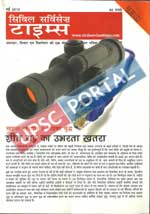
Important Magazines for IAS Exam: Civil Services Times (English & Hindi), Civil Services Chronicle (English & Hindi) -May 2013

Important Magazines for IAS Exam
Civil Services Times (English & Hindi), Civil Services Chronicle (English & Hindi) - May 2013


(Voice Notes) Current Affairs Daily & Weekly Update: 30 APRIL 2013 "Topic: Assault on Minor Girls"

Current Affairs Daily Voice Notes

Daily Voice Notes

Spotlight/News Analysis (30 Apr):

  • Topic of Discussion: Assault on Minor Girls
  • Expert Panel: Dr. V. Mohini Giri (Former Chairperson - National Commission for Women)

The Gist of Kurukshetra Magazine: April 2013

The Gist of Kurukshetra Magazine: April 2013


Contents

  • New Areas in Rural Employment
  • Need to Strengthen Mahatma Gandhi National Rural Employment Guarantee Act
  • Need to Strengthen Vocational Institutes in Rural Areas
  • Demand Registration
  • Asset Quality
  • Concluding Remarks
  • Lack of Social Security
  • Need for New Plan Strategy
  • MSME Sector through Cluster Development
  • District Rural Industries Project
  • Maharatna Status to BHEL and GAIL

NEW AREAS IN RURAL EMPLOYMENT

In India, 69 per cent of our population lives in the rural areas and majority of people in rural areas depend on agriculture for their livelihood. But, according to the data of the National Sample Survey (NSS), the growth rate of employment has declined from 69 to 55 per cent in agriculture. Consequently, the share of agriculture and allied sectors in the Gross Domestic Product (GDP) has been reduced to 14 per cent. Unemployment which was 7.2 per cent in the year 2000, increased to 8.1 per cent in 2010 in comparison to urban unemployment rate which increased from 7.7 to 7.9 per cent during the same period. The higher unemployment and low income per capita in the rural areas result in low purchasing power of the rural people and it also affects the spending on important sectors like health and education. Overall, the youth in the rural areas feel disillusioned to continue with this profession. As per the data of NSS, 40 per cent of people in the rural areas want to leave agriculture as a profession if they get better option of occupation. This is certainly is not a good sign for food security of our country which is of paramount importance and backbone for our all development initiatives. The aspirations of the people are same in the rural and urban areas which result to migration from rural to urban areas in the hope of better living standards. In 2009-10, according to the NSS survey, average monthly per capita expenditure stood at Rs 1,053.64 in rural areas and Rs 1,984.46 in urban India, there remained a huge gap between the incomes of the top and bottom segments of the population. It also found that food items accounted for the bulk of the expenditure, with the share of food in total household spending at 57 per cent and 44 per cent in rural and urban areas, respectively. Somehow, conomic reforms have bypassed agriculture and rural development prospects. Thus, rural economy and agricultural sector has shown a very low rate of growth.

(Sample Materials) Gist of India Year Book 2013 - "Transport"


Contents of the Chapter:

  • Intoduction National Waterways
  • Railways
  • Civil Aviation
  • Roads
  • Shipping
  • Coastal Shipping
  • Maritime Training
  • MCQs for Final Practice

Introduction

Transportation plays an important role in the development of country. The Ministry of Shipping, Ministry of Road Transport and Highways is responsible for the formation and implementation of policies and programmes for the development of various modes of transport save the railways and the civil aviation.

Dear Candidate, This Material is from Gist of India Year Book 2013. For Details Click Here

(Sample Materials) Economic Survey & Government’s Plan, Programme & Policies - "Industry"


Contents of the Chapter:

  • Significance of Industrial Sector
  • State wise Comparison : Employment & GVA
  • Index of Industrial Protection
  • Industry wise Comparison : Employment & GVA
  • Annual Surveys of Industries
  • Micro, Small and Medium Enterprises (MSMEs)

SIGNIFICANCE OF INDUSTRIAL SECTOR

Industrial growth in the country has, in terms of long run trend, remained aligned with the growth rate of gross domestic product (GDP). The long-term average annual growth of industries comprising mining, manufacturing, and electricity, during the post-reform period between 1991-2 and 2011-12, averaged 6.7 per cent as against GDP growth of 6.9 per cent. Inclusion of construction in industry raises this growth to 7.0 per cent. The share of industry, including construction, in GDP remained generally stable at around 28 per cent in the post-reform period. Standard deviation of the average share was very small and the coefficient of variation under 5 per cent validates this stability. The share of manufacturing, which is the most dominant sector within industry, also remained in the 14-16 per cent range during this period. The share is modest when compared to that of China (above 40 per cent) and some of the East Asian countries (above 30 per cent).

Employment in the industrial sector increased from 64.6 million persons in 1999-2000 to 100.7 million persons in 2009-10. The share of industry in total employment increased from 16.2 per cent in 1999- 2000 to 21.9 per cent in 2009-10. However, the increase was largely on account of expansion of employment opportunities in the construction sector, from 17.5 million in 1999-2000 to 44.2 million in 2009-10.

Dear Candidate, This Material is from Economic Survey & Government Plan Programme and Policies. For Details Click Here

Pages

Subscribe to RSS - Iasguru's blog

Civil Services Times (English)
Buy Online

सिविल सर्विसेज टाइम्स (हिन्दी)
Buy Online