Iasguru's blog

(News) To Ensure Gender Parity, UPSC Boosts Women Candidates to Apply for Civil Services


To Ensure Gender Parity, UPSC Boosts Women Candidates to Apply for Civil Services


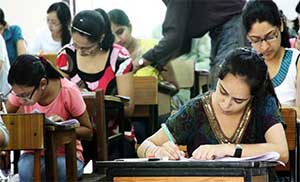
https://iasexamportal.com/sites/default/files/UPSC-Encourages-Women-Candidates-to-Apply-for-Civil-Services.jpg(1) In order to ensure gender balance in workforce, the Union Public Service Commission (UPSC) has encouraged women candidates to apply for the prestigious civil services examination to select IAS and IPS officers.

  • “Government strives to have a workforce which reflects gender balance and women candidates are encouraged to apply,” the UPSC said in the notification issued for civil services preliminary examination 2015.

(2) Women had bagged the top slots in the 2010, 2011 and 2012 civil services examinations. Whereas, a male candidate topped in the 2013 exam.

  • There were 15 males and 10 females in top 25 positions in 2013 civil services exam results.

  • The final result of civil services examination 2014 is yet to be declared.

(3) The civil services examination is conducted by the UPSC annually in three stages – preliminary, main and interview – to select candidates for prestigious Indian Administrative Service (IAS), Indian Foreign Service (IFoS) and Indian Police Service (IPS), among others.

  • This year, the preliminary examination will be held on August 23 in 71 centres at about 3,000 venues.

  • This time the candidates are required to apply only through online mode for the civil services and Indian Forest Service examinations and “no other mode for submission of applications is allowed,” it said.

(Answer Key's) UPSC: CISF (AC) Ltd. Deptl. Examination, 2015

UPSC

Union Public Service Commission

(Answer Key's) UPSC: CISF (AC) Ltd. Deptl. Examination, 2015

Exam Name: CISF (AC) Ltd. Deptl. Examination

Subject: GAI & Professional Skills

Year: 2015

(Download) UPSC: Combined CBRT for 5 Posts of SAO Gr I and 23 Posts of SAO Gr II in DRDO Exam Paper - 2015

UPSC

Union Public Service Commission

(Download) UPSC: Combined CBRT for 5 Posts of SAO Gr I and 23 Posts of SAO Gr II in DRDO Exam Paper - 2015

Exam Name: Combined CBRT for 5 Posts of SAO Gr I and 23 Posts of SAO Gr II in DRDO

Subject: General Ability Test

Exam Date: 10.05.2015 (1ST SHIFT)

Year: 2015

(Download) UPSC: 14 Posts of Assistant Labor Commissioner in JTS of CLS, M/o Labour & Employment Exam Paper - 2015

UPSC

Union Public Service Commission

(Download) UPSC: 14 Posts of Assistant Labor Commissioner in JTS of CLS, M/o Labour & Employment Exam Paper - 2015

Exam Name: 14 Posts of Assistant Labor Commissioner in JTS of CLS, M/o Labour & Employment

Subject: General Ability Test

Exam Date: 10.05.2015 (1ST SHIFT)

Year: 2015

(News) Govt. unlikley to roll back UPSC aptitude test


Govt. unlikley to roll back UPSC aptitude test


https://iasexamportal.com/sites/default/files/Govt-unlikley-to-roll-back-UPSC-aptitude-test.jpgThe government is unlikely to roll back the aptitude test — introduced in 2011 — from the civil services preliminary examination and would stick to the 2014 format that kept English comprehension out of the first stage of the three-phased exam.

Faced with protests on the streets and disruption in Parliament in 2014, the Modi government had promised to review the changes carried out in the format of the exam, conducted to pick India’s top police, civil and foreign services officers, by the Congress-led UPA ruling combine in 2011.

But the government is coming around to the view that tinkering with the examination process would not just be counter-productive but also unfair to hundreds of thousands of aspirants.

Late in April, the Union Public Service Commission (UPSC), which conducts the three-stage recruitment process, also told a parliamentary standing committee that the government was expected to maintain status quo on the examination.

“The committee did not make any recommendations to the UPSC on this issue since it was indicated that status quo was being maintained,” EM Sudarsana Natchiappan, who heads the panel, said.

The Natchiappan committee — which had asked the UPSC to introduce the reforms several years back — only advised the commission on reducing the time that it takes to complete the process, which goes on for more than a year. The commission was also asked to explore moving the exam online.

Till 2010, the preliminary objective-style screening test comprised two papers. The first was a general studies paper and the second, an optional subject, selected by the candidate from a list of 23.

From 2011, the second paper was replaced by a second general studies paper that tests the aptitude and assess candidates’ understanding rather than memory. This paper is commonly referred to as the civil services aptitude test, or CSAT paper.

The Gist of Yojana: May 2015


The Gist of Yojana: May 2015


Fiscal Federalism, Local Governments

Fedration Refers to a multi-level system of government. Fiscal federalism deals with the division of expenditure responsibilities, fiscal assignments, inter-governmental transfer arrangements and encompasses fiscal relations within a federation. The objective of any good fiscal fedeal arrangement is to facilitate effective, efficient and equitable allocation of resources and responsibilities among the different tiers of government and work towards, a stable federal system. Originally, the Indian federation was a dual system comprising the union and the states. The 73rd/74th Constitutional Amendments (CAs) have added part IX and Part IXA to the Indian constitution creating a third stratum of government with a three- tier system for the Panchayati Raj Institutions (PRIs). This virtually turned the Indian federation into a multi-level federal system with a multi-level public finance. Over twenty years have passed since these amendments and the conformity legislations apertaining to that enacted in 1994 by all the states. Indeed, it was a major effort towards fiscal decentralization creating democratic space for people’s participation and working towards local democratic governance at the cutting edge level.

Now that the Planning Commission, which was a non-constitutional body was scrapped and a new institution called NITI (National Institute for Transforming India) Aayog has been put in place from Januray 1, 2015, a question that immediately arises is : new role being envisaged or a renewed one for the constitutional body called the District Planning Committee (DPC) created as per Article 243 ZD? What reforms are needed to rationalize the transfer arrangements? Several such fiscal federalism issues vis-a-vis LGs require a renewed and closer look.

Cooperative federalism of India to which the new government has affirmed its faith and commitment has no parallel among the federations of the world. For example, it does not resemble Germany or South Africa where the federal governments decide major policies and where the different levels of governments function as implementing agencies. It is also different from the Brazilian model where all the three tiers of government enjoy autonomous and equal status and coordinate their policies horizontally and vertically. India cannot also be called the ‘marble cake model’ of cooperative federalism where the various levels of government have shared and overlapping responsibilities and are treated as equal partners.

An important necessary condition for shaping a viable and vibrant fiscal federalism is to have a division of labour of the functions, responsibilities and regulatory role of the various levels of a government by asking two vital questions: Who should do what? and who should tax where and what?

A simple but extremely relevant principle to guide the division of expenditure responsibilities, revenue raising assignments and of regulatory functions is to follow the principle of subsidiarity which says: What can be done best of course with minimum transaction and coordination costs at a particular level should be done at that level and not at a higher level. In other words, a convincing case will have to be made for assigning a task to each higher level of government.

The Government of India Act, 1935 and the inauguration of provincial autonomy had led to the creation of several steps to carry forward the process of democratization at the level of municipalities and village panchayats. We all know that the village panchayat was central to the ideological underpinning of India’s Independence movement and Gandhiji, the father of the nation, declared his vision of gram swaraj (village-self-rule) as the centre of social life for future India. Even so, in the Indian constitution, village panchayats were mentioned only under Article 40, that is, to create ‘units of self- government’· as part of the directive principles and therefore, did not form part of the legally enforceable part of the Constitution. The Constitution did not even accept the concept of local self-government envisaged in the Lord Rippon Resolution of 1884. It was left to the 73rd/74,h CAs to rectify this historical deficit and give local governments a constitutional status.

(Notification) UPSC IFoS Exam - 2015

UPSC IFOS

Union Public Service Commission

(Notification) UPSC Indian Forest Service Examination (IFoS), 2015

F.No.13/1/2015-EI(B): The Union Public Service Commission will hold a Screening Test for selection to Indian Forest Service (Main) Examination, 2015 through Civil Services (Preliminary) Examination, 2015 which will be held on 23rd August, 2015, in accordance with the Rules published by the Ministry of Environment, Forests and Climate Change in the Gazette of India dated the 23rd May 2015.

MINIMUM EDUCATIONAL QUALIFICATIONS:

The candidate must hold a Bachelor's degree with at least one of the subjects namely Animal Husbandry & Veterinary Science, Botany, Chemistry, Geology, Mathematics, Physics, Statistics and Zoology or a Bachelor's degree in Agriculture, Forestry or in Engineering of any of Universities incorporated by an Act of the Central or State Legislature in India or other educational institutions established by an Act of Parliament or declared
to be deemed as a University Under Section 3 of the University Grants Commission Act, 1956, or possess an equivalent qualification.

Note I :

Candidates who have appeared at an examination the passing of which would render them educationally qualified for the Commission's examination but have not been informed of the results as also the candidates who intend to appear at such a qualifying examination will also be eligible for admission to the Preliminary Examination. All candidates who are declared qualified by the Commission for taking the Indian Forest Service (Main) Examination will be required to produce proof of passing the requisite examination with their application for the Main Examination failing which such candidates will not be admitted to the Indian Forest Service Main
Examination. The applications for the Main Examination will be called sometime in the month of September/October, 2015 through on-line mode.

AGE LIMITS :

(a) A candidate must have attained the age of 21 years and must not have attained the age of 32 years on 1st August, 2015, i.e. he must have been born not earlier than 2nd August, 1983 and not later than 1st August, 1994.

Selected Articles from Various News Paper: Civil Services Mentor Magazine - May 2015


Selected Articles from Various Newspapers & Journals


Not measure for measure

Purchasing Power Parity or PPP has validated a long held surmise that the poorer countries are not as badly off as they are made out to be nor the richer ones as well off as they seem. A nominal GDP ranking puts India at tenth place while a PPP one pushes it up to third, behind the United States and China. The Big Mac Index of The Economist loosely corroborates. Travelling to expensive parts of the world from our country brings this home to us tellingly.

We would be wise to guardedly settle for PPP. The world too has done likewise. India, like those of several other similarly placed countries, does have an economy worth several times larger than its nominal GDP indicates. This fact has not gone unnoticed where it matters, especially in the boardrooms of multinationals or corporate India which indefatigably seek to “add an inch to every Indiaman’s shirt tail”. Some strong endorsement for this comes from the management guru, the late C.K. Prahalad. Unsurprisingly, for companies like Suzuki and Honda, India has emerged as their largest market for cars and two-wheelers and Vodafone, despite an unresolved retrospective tax issue, is very much here to stay. India of course enjoys the sheer strength of numbers.

After China, India has more mobile owners than any other country. The smartphone revolution has just hit us big and India is more likely than not to emerge as the second largest market for that too. India is also one of two largest motorcycle manufacturers. The country continues its run as one of two largest producers of rice and a third of wheat as well as fruits and milk. Of course we know that in per capita in agro and dairy products, we are still way behind much smaller producers but are likely to get “there” thanks to developments in science technology. In all these segments India is sitting on the cusp of an opportunity. If the green revolution surprised us, managed right, the future growth in agriculture will astound the world. E-commerce is another area we mistakenly thought we had lost out on. Just as we were despairing at the success of Alibaba in China, we now see serious investment coming into e-retailing. Meanwhile, Amazon, even as it threatens to leave, is expanding its footprint here. India, it turns out, is a glass half full and filling rather than half-empty and emptying.

But before we start rejoicing we need to reconcile flattering national economic indicators with some very odious social ones. India’s ranking in the UNDP’s Human Development Report (2011) is 134. In gender inequality, it comes out marginally better but still a rotten 129th out of 187 countries. Then on the ease of doing business, India is a miserable 134th, pretty much at the bottom of the heap. So things are that horrible. Or are they only being made out to be terrible? Given the scale of poverty in India, it is very difficult not to make these rankings stick and lot of visual evidence exists. Mukesh Ambani’s massive residence in Mumbai coexists with a sea of slums nearby. Get out of many of India’s airports, and most especially Mumbai, and one is confronted with every kind of misery one can think of. Stop at the traffic lights and the poor of India come knocking on your car window. The better off in our country live in sanitised islands of relative calm defended by the very kind drawn from the ranks of those it seeks to keep out. But as we all know, visuals, even powerful ones, do not so much reflect reality as point out the shocking that we tend to ignore or deliberately disregard.

Russia-India-China Foreign Minister level talk: Civil Services Mentor Magazine - May - 2015


Russia-India-China Foreign Minister level talk


The first ever foreign ministers level meeting of the three countries held in June 2005 in Vladivostok, Russia. Since then, the foreign ministers of the three countries have met many a times for issues ranging from international as well as trilateral. This trilateral grouping is extremely important as influence of these countries over international politics is increasing rapidly. This group can make great contributions to global peace, security and stability. The three countries together make close to 40 per cent of the world’s 7 billion population. Importance of this group increases by the fact that it is aimed only at promoting international harmony and facilitating mutual cooperation in a multi-polar world. India, Russia and China are also increasing their economic influence. China is the second largest economy in the world, while India is the fastest growing major economy in the world and Russia controls the major chunk of oil and gas production. Three countries can help in the development of each other and also help in making the truly multipolar.

All the three countries consider that peace and security of this region will help in the development of these countries and also the world. Three countries are also increasing their cooperation in new fields like science and technology etc. Trade and commerce between three countries is also flourishing in last few years. Trilateral meeting between the foreign ministers of three countries holds great importance for the development and the security of the region as well as the world and it holds greater importance for the common people of this region. The Russia India China (RIC) summit 2015 was held in Beijing and was attended by Chinese foreign minister Wang Yi, his Russian counterpart Sergey Lavrov and Sushma Swaraj. This was thirteenth such meeting between the foreign ministers of three nations. Joint communique was issued after summit, highlights of the communiqué are:

(Final Result) UPSC: Combined Defence Services Exam. (II), 2014

UPSC

Union Public Service Commission

(Final Result) UPSC: Combined Defence Services Exam. (II), 2014

1. The following are the lists, in order of merit of 235 (136 +85+14) candidates who have qualified on the basis of the results of the Combined Defence Services Examination (II), 2014 conducted by the Union Public Service Commission in October, 2014 and SSB interviews held by the Services Selection Board of the Ministry of Defence for admission to the 139th Course of Indian Military Academy, Dehradun; Indian Naval Academy, Ezhimala, Kerala and Air Force Academy, Hyderabad (Pre-Flying) Training Course i.e. 198th F (P) Course.

2. There are some common candidates in the three lists for various courses.

3. The number of vacancies, as intimated by the Government is 200 for Indian Military Academy [including 25 vacancies reserved for NCC ‘C’ certificates (Army Wing) holders], 45 for Naval Academy, Ezhimala, Kerala Executive(General Service) (including 06 vacancies reserved for NCC ‘C’ Certificate (Naval Wing) holders] and 32 for Air Force Academy, Hyderabad.

4. The Commission had recommended 4570, 2837 and 531 as qualified in the written test for admission to the Indian Military Academy, Indian Naval Academy and Air Force Academy respectively. The number of candidates finally qualified are those after SSB testing conducted by Army Head Quarters.

5. The results of Medical examination have not been taken into account in preparing these lists.

Swine Flu: Civil Services Mentor Magazine - May - 2015


Swine Flu


Swine influenza is a virus which causes respiratory problems in pigs like nasal secretions, decreased appetite etc like human flu. Occasionally, pigs transmit influenza viruses to people, when they are closely associated with pigs mainly to hog farmers and veterinarians, pork processors. Swine influenza, also called pig influenza, swine flu, hog flu and pig flu. During the 1918 flu pandemic Swine influenza was first proposed to be a disease related to human flu. In 1930, Swine influenza virus was first isolated from pigs in the U.S. and has been recognized by pork producers and veterinarians to cause infections in pigs worldwide. It was supposed that the cross-species infection remained to local areas but in 2009 it was found that this cross species situation with influenza viruses had the potential to change. It was first seen in Mexico and was termed as H1N1 (H1-hemagglutinin type 1 and N1 -neuraminidase type1) which is an influenza A virus type.

Symptoms

If a person is suffering from fever (100 F or greater), cough, sore throat, runny or stuffy nose, body aches, chills, fatigue, diarrhea, vomiting. In few people it may develop to severe respiratory symptoms and need respiratory support. Patients can get pneumonia (bacterial secondary infection) if the viral infection persists, and some can develop seizures. Death often occurs from secondary bacterial infection of the lungs; appropriate antibiotics need to be used in these patients. The incubation period from exposure to first symptoms is about one to four days, with an average of two days.

FCI & PDS: Civil Services Mentor Magazine - May - 2015


FCI & PDS


The Food Corporation of India came into existence in 1965 under the Food Corporation’s Act of 1964. It came in a situation where food production in India was extremely low and India was not self-dependent for food grains. In 1964 -65, India’s wheat production was 12.26 million metric tonnes (MMT) and India had to import 6.57 MMT of wheat that year. Imports of wheat amounted to almost 54 percent of domestic production and on top of that India had a extremely low total foreign exchange reserve of only US $524 million and the price of wheat in the international market was $66.81/MT. That foreign exchange reserve was only enough for the import of wheat at this year. India started importing low quality PL480 from US at low cost, mostly as an aid. In order to make the situation better in 1965, the Agricultural Prices Commission was rolled out to give a boost to positive price policy, recommending minimum support prices (MSPs) for basic staples, especially wheat and paddy (rice). The FCI was to ensure that farmer’s get this MSP so that they are encouraged to increase the production of basic staples.

Situation in India regarding food production and foreign exchange is far better now as compare to the time when FCI was formed. During the Financial Year 2012-13 (FY 2013) and 2013-14 (FY 2014), India has emerged as the largest exporter of rice in the world, with more than 10 MMT of exports each year. Total cereal exports (basically rice, wheat and corn) amounted to 22 MMT in FY 2013 and another 21 MMT in FY 2014, thereby amounting to 43 MMT of cereal exports in two years, which India has never done in its entire recorded history. Grain Stocks with the public agencies is far more than the legislative requirement. Public stock of grains and cereals is more than 80 MMT while the legal requirement is only 32MMT. The foreign exchange reserves in the country are safely beyond the 300$ Bln, and foreign reserve can easily handle any shock in production and situation of imports.

(Download) Civil Services Mentor Magazine, May 2015 - FREE PDF

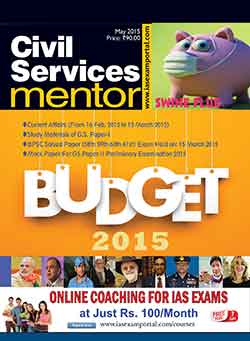
https://iasexamportal.com/sites/default/files/CSM-Title-May-2015.jpg

Click Here to Buy Hard Copy of This Magazine from Our Online Sotre
 

Click Here to Buy Hard Copy of This Magazine from Amazon

Free Digital Magazine: Civil Services Mentor, May 2015

Issue : May 2015
Size: 5.60 MB
File Type: PDF
Publisher : IASEXAMPORTAL.COM 

Table of Contents:

Articles:

  • Budget 2015
  • Finance Commission
  • FCI & PDS
  • Swine Flu
  • Russia-India-China Foreign Minister level talk
  • Study Materials of G.S. Paper–I
  • Solved Paper Bihar Public Service Commission Held On: 15-03-2015
  • Mock Paper For GS Paper-II Preliminary Exam 2015

Current Affairs:

  • National Issues
  • International Issues
  • Economy
  • India & The World
  • Science & Technology
  • Sports
  • Awards & Prizes
  • Persons in News

Gist of The Hindu: May 2015


Gist of The Hindu: May 2015


Not measure for measure

Purchasing Power Parity or PPP has validated a long held surmise that the poorer countries are not as badly off as they are made out to be nor the richer ones as well off as they seem. A nominal GDP ranking puts India at tenth place while a PPP one pushes it up to third, behind the United States and China. The Big Mac Index of The Economist loosely corroborates. Travelling to expensive parts of the world from our country brings this home to us tellingly.

We would be wise to guardedly settle for PPP. The world too has done likewise. India, like those of several other similarly placed countries, does have an economy worth several times larger than its nominal GDP indicates. This fact has not gone unnoticed where it matters, especially in the boardrooms of multinationals or corporate India which indefatigably seek to “add an inch to every Indiaman’s shirt tail”. Some strong endorsement for this comes from the management guru, the late C.K. Prahalad. Unsurprisingly, for companies like Suzuki and Honda, India has emerged as their largest market for cars and two-wheelers and Vodafone, despite an unresolved retrospective tax issue, is very much here to stay. India of course enjoys the sheer strength of numbers.

After China, India has more mobile owners than any other country. The smartphone revolution has just hit us big and India is more likely than not to emerge as the second largest market for that too. India is also one of two largest motorcycle manufacturers. The country continues its run as one of two largest producers of rice and a third of wheat as well as fruits and milk. Of course we know that in per capita in agro and dairy products, we are still way behind much smaller producers but are likely to get “there” thanks to developments in science technology. In all these segments India is sitting on the cusp of an opportunity. If the green revolution surprised us, managed right, the future growth in agriculture will astound the world. E-commerce is another area we mistakenly thought we had lost out on. Just as we were despairing at the success of Alibaba in China, we now see serious investment coming into e-retailing. Meanwhile, Amazon, even as it threatens to leave, is expanding its footprint here. India, it turns out, is a glass half full and filling rather than half-empty and emptying.

But before we start rejoicing we need to reconcile flattering national economic indicators with some very odious social ones. India’s ranking in the UNDP’s Human Development Report (2011) is 134. In gender inequality, it comes out marginally better but still a rotten 129th out of 187 countries. Then on the ease of doing business, India is a miserable 134th, pretty much at the bottom of the heap. So things are that horrible. Or are they only being made out to be terrible? Given the scale of poverty in India, it is very difficult not to make these rankings stick and lot of visual evidence exists. Mukesh Ambani’s massive residence in Mumbai coexists with a sea of slums nearby. Get out of many of India’s airports, and most especially Mumbai, and one is confronted with every kind of misery one can think of. Stop at the traffic lights and the poor of India come knocking on your car window. The better off in our country live in sanitised islands of relative calm defended by the very kind drawn from the ranks of those it seeks to keep out. But as we all know, visuals, even powerful ones, do not so much reflect reality as point out the shocking that we tend to ignore or deliberately disregard.

The country as a whole is nowhere as bad as these indices show but together they do bring out that India is a poor bet only because we have been inept at better stating our strengths while unfailingly adept at inviting attention to our weaknesses. The question to ask is “should India be taken as a country at all for such indicators to stick”? India is more populous than the whole of Africa and roughly equal to Europe and the Americas combined on that count. We need a better way of being compared — clearly, it is absurd to rank the country alongside say Lesotho or Guinea Bissau — the first has a population of less than three million and the other two. Internal rankings of States, as what a leading Indian magazine brings out annually, is so much like water off a duck’s back, that the game changer will be when the country configures the rankings for global consumption. This will become particularly important now when States are competing with each other for investments. This should also make State governments sit up and take note that governance matters. Chhattisgarh is an early mover here.

Millions are spilling out of India’s poorer States to run services in the better off ones. Mumbai would not run for a day without migrant workers and Kerala — the entire State — would come to a grinding halt if the near three million from Assam and Bengal as well as U.P., Odisha and Bihar were to en-masse go elsewhere. The Government of India would therefore do well to bring out an annual State-wise status report on migrant labour detailing where they come from and the jobs they do and how much they contribute to State economies rather than ungratefully treat them as parasites. This should cool rampant xenophobia of the kind the Shiva Sena promotes and make us grateful for a borderless India.

Finance Commission: Civil Services Mentor Magazine - May - 2015


Finance Commission


Article 280 of the constitution of India gives President of India the power to constitute the finance commission every five years. If the President thinks it is required earlier it can give the order to constitute it even earlier as well. The Finance Commission is required to recommend the distribution of the net proceeds of taxes of the Union between the Union and the States (commonly referred to as vertical devolution); and the allocation between the States of the respective shares of such proceeds (commonly known as horizontal devolution). Though recommendations of finance commission are non-binding, the Centre generally accepts the recommendation of the expert body. Fourteenth finance commission under the chairmanship of former RBI governor Y.V.Reddy has submitted its report for the period of 2015-2020. Report was submitted to central government with a dissent note from Abhijit sen and central government has accepted the recommendation.

Highlights of the Recommendation

  • States share from the net proceeds from the central tax collection to be 42 percentage, which is a huge jump of 10 percent from the 32 percent recommended by the 13th finance commission. As compared to the total devolutions in 2014-15 the total devolution of the States in 2015-16 will increase by over 45%. This change in share has become possible because planning commission has been abolished and its funds have been transferred to finance commission and ministries.

Budget 2015: Civil Services Mentor Magazine - May - 2015


Budget 2015


Union government presented its first full budget in the parliament on 28th feb 2015. This year’s budget was aimed at high growth, providing investment friendly conditions and improving the physical infrastructure. Along with above objectives budget has also focused on improving the fiscal discipline and making legislative and tax reforms. This was the first budget presented after Centre accepted the Finance commission recommendation. Union government accepted the recommendation of Finance commission to increase the state’s tax pool to 42 percent from central taxes, earlier this used to be 32 percent. Taking all transfers together, about 62% of the money available (including non-plan grants and loans, central assistance to states and UTs and centrally sponsored schemes) to be spent now in India will be with the states. Increase in the size of the states revenue reduces the financial space of the Centre. Several key sectors like education, health etc. will not have a one size fits all policy from central government rather states will have the resources and the policy according to their needs.
Some important facts and policies presented in the budget:-

Headline Numbers

In the interim budget presented last year government set the target to contain the fiscal deficit below 4.1 percent. While the target for 2015-16 was set at 3.5 percent and for the next fiscal year target was reduced to 3 percent. In this years budget government has achieved the target for this year but it has increased the fiscal deficit target to 3.9 percent next year and 3.5 and 3 percent in following years. In this way government will get to the Finance Commission recommendation of 3% fiscal deficit a year later than planned. This has been done to provide adequate public spending in the infrastructure sector and not for the subsidization. Budget document expects consumer inflation to remain close to 5 percent by March, opening room for more monetary policy easing. The GDP growth projections are higher at 8%-8.5% for the next year. But these numbers are also due to change in method of calculating GDP along with change in base year for calculating GDP.

(News) Andhra Pradesh government will soon offer free coaching to SC/ST IAS Aspirants


Andhra Pradesh government will soon offer free coaching to SC/ST IAS Aspirants


https://iasexamportal.com/sites/default/files/Change-in-UPSC-prelims-to-benefit-rural-aspirants.jpgThe Andhra Pradesh government on Saturday set up a committee to shortlist top IAS academies to conduct coaching classes for SC/ST students for the civil services examinations in the academic year 2015-16, under the newly launched scheme of ‘NTR Vidyonnathi’.

In a GO issued here, the state government said that it had recently introduced the ‘NTR Vidyonnathi’ scheme to provide professional guidance to SC/ST students for civil services exams. The scheme will come into operation from the academic year 2015-16.

“As per the guidelines issued under the scheme, the social welfare and tribal welfare departments will invite Expression of Interest from competent coaching institutions with an excellent track record for imparting coaching for the above programmes,” the GO said.

Online filing of applications for civil services exam begins


Online filing of applications for civil services exam begins


The online filing of applications for this year’s civil services preliminary examination to select IAS and IPS officers has begun.

This time the candidates will have the option to choose either the civil services or the Indian Forest Service or both, the Union Public Service Commission (UPSC) has said.

The civil services examination is conducted by the UPSC annually in three stages — preliminary, main and interview — to select candidates for prestigious Indian Administrative Service (IAS), Indian Foreign Service (IFS) and Indian Police Service (IPS), among others.

This year, the preliminary examination will be held on August 23 in 71 centres at about 3,000 venues.

Candidates are required to apply through online mode on the Commission’s website — www.upsconline.nic.in. No other mode is allowed for submission of application.

Filing of online applications started on May 23 and will conclude on June 19 (till 11.59 p.m.), according to the notification.

Eligible candidates shall be issued an e-admission certificate three weeks before the commencement of the examination. The e-admission certificate will be made available in the UPSC website. No admission certificate will be sent by post, the UPSC said.

Every candidate appearing at the examination who is otherwise eligible, shall be permitted six attempts at the examination, it said.

(How to Apply) UPSC: Civil Services Examination - 2015

UPSC

Union Public Service Commission

::  How to Apply ::

(a) Candidates are required to apply online using the website http://www.upsconline.nic.in Detailed instructions for filling up online applications are available on the abovementioned website.

The applicants are advised to submit only single application; however, if due to any unavoidable situation, if he/she submits another/multiple applications, then he/she must ensure that application with the higher RID is complete in all respects like applicants’ details, examination centre, photograph, signature, fee etc. The applicants who are submitting multiple applications should note that only the applications with higher RID
(Registration ID) shall be entertained by the Commission and fee paid against one RID shall not be adjusted against any other RID.

(b) All candidates, whether already in Government Service, Government owned industrial undertakings or other similar organisations or in private employment should submit their applications direct to the Commission. Persons already in Government Service, whether in a permanent or temporary capacity or as workcharged employees other than casual or daily rated employees or those serving under the Public Enterprises are however, required to submit an undertaking that they have informed in writing to their Head of Office/Department that they have applied for the Examination.

Candidates should note that in case a communication is received from their employer by the Commission withholding permission to the candidates applying for/appearing at the examination, their application will be liable to be rejected/candidature will be liable to be cancelled.

NOTE 1 :

While filling in his/her Application Form, the candidate should carefully decide about his/her choice of centre for the Examination. If any candidate appears at a centre other than the one indicated by the Commission in his/her Admission Certificate, the papers of such a candidate will not be evaluated and his/her candidature will be liable to cancellation.

NOTE-2:

Suitable provisions for information regarding use of scribes by the blind candidates and candidates with Locomotor Disability and Cerebral Palsy where dominant (writing) extremity is affected to the extent of slowing the performance of function (minimum of 40% impairment) have been made in the online application at the time of the initial online application itself.

NOTE-3:

Candidates appearing in CS(P) Examination, 2015 will be required to indicate information such as (a) detail of centres for Civil Services (Main) Examination and Indian Forest Service (Main) Examination (b)Optional subject to be selected for the examination, (c) medium of examination for Civil Services (Main) Examination and (d) compulsory Indian Language for Civil Services (Main) Examination at the time of the filling up online application itself.

NOTE 4 :

Candidates are not required to submit alongwith their applications any certificate in support of their claims regarding Age, Educational Qualifications, Scheduled Castes/ Scheduled Tribes/Other Backward Classes and Physically disabled etc. which will be verified at the time of the Main examination only. The candidates applying for the examination should ensure that they fulfil all the eligibility conditions for admission to the Examination. Their admission at all the stages of examination for which they are admitted by the Commission viz. Preliminary Examination, Main (Written) Examination and Interview Test will be purely provisional, subject to their satisfying the prescribed eligibility conditions. If on verification at any time before or after the Preliminary Examination, Main (written) Examination and Interview Test, it is found that they do not fulfil any of the eligibility conditions, their candidature for the examination will be cancelled by the Commission.

(Number of attempts) UPSC: Civil Services Examination - 2015

UPSC

Union Public Service Commission

:: Number of attempts ::

(a) Every candidate appearing at the examination who is otherwise eligible, shall be permitted six attempts at the examination.

Provided that this restriction on the number of attempts will not apply in the case of Scheduled Castes and Scheduled Tribes candidates who are otherwise eligible.

Provided further that the number of attempts permissible to candidates belonging to Other Backward Classes, who are otherwise eligible shall be nine. The relaxation will be available to the candidates who are eligible to avail of reservation applicable to such candidates.

Provided further that a physically handicapped will get as many attempts as are available to other non-physically handicapped candidates of his or her community, subject to the condition that a physically handicapped candidate belonging to the General Category shall be eligible for nine attempts. Necessary action to make Corresponding Changes in respective Rules/Regulations Pertaining to various services is being taken separately. The relaxation will be available to the physically handicapped candidates who are eligible to avail of reservation applicable to such candidates.

(b) Notwithstanding anything contained in this rule, any candidate who appeared in the Civil Services Examination, 2011 but is otherwise ineligible for Civil Services Examination, 2015 due to completion of the number of attempts available for examination under this rule, shall be permitted an additional attempt in the Civil Services Examination, 2015.

Pages

Subscribe to RSS - Iasguru's blog