Iasguru's blog

(Interview Schedule) UPSC SCRA Exam - 2015

https://iasexamportal.com/sites/default/files/UPSC-SCRA-LOGO.gif

(Interview Schedule) UPSC SCRA Exam - 2015

Exam Name: SCRA

Year: 2015

(Current Affairs) Awards and Prizes | June: 2015

Awards and Prizes

Paris Based Poet Wins Kumar Asan World Prize

  • Paris- based Syrian-Lebanese Arab poet Adonis has been chosen for this year’s Kumaran Asan World Prize for poetry, instituted by the Kumaran Asan Memorial Association to honour poets of international stature and introduce them to Indian readers. The award consists of a cash prize of Rs 3 lakh, memento and a citation.
  • Some of his important works include If Only the Sea Could Sleep, Pages of Day and Night, Songs of Mihyar the Damascene, Not A Star, A Voice, A King is Miyhar, The Adoring Rock, and Take me to God.
    Susanta Lahiri Wins

Hevesy Medal Award 2015

  • Professor Susanta Lahiri, Chemical Sciences Division, Saha Institute of Nuclear Physics, Kolkata, won the Hevesy Medal Award 2015, at the Tenth International Conference on Methods and Applications of Radio-analytical Chemistry for his outstanding contributions to heavy ion induced radioisotope production, tracer packet technique, converter targets, and green chemistry.

  • The other person to also win the award this year is Professor Kattesh V. Katti of the Cedntre for Radiological Research, University of Missouri, Columia.

  • This premier international award named after George de HEVESY, the 1943- Chemistry Nobel Laureate, is given to “an individual in recognition of excellence through outstanding, sustained career achievements in the fields of pure as well as applied nuclear and radiochemistry, in particular applications to nuclear analytical chemistry.”

UP Government to Honours Gopal Das Neeraj

  • Uttar Pradesh government has conferred its Sahitya Shiromani Samman and a cash prize of 21 lakh Rupees upon noted Hindi poet Gopal Das Neeraj. Along with Gopal Das Neeraj, veteran Hindi litterateur Uday Pratap Singh was also conferred with Sahitya Shiromani award and cash prize of 21 lakh Rupees.

(Current Affairs) Science & Technology, Defence, Environment | June: 2015

Science & Technology, Defense, Environment

PSLV-C27 Successfully Launches India’s Fourth Navigation Satellite IRNSS-1D

  • ISRO’s Polar Satellite Launch Vehicle, PSLV-C27, successfully launched the 1425 kg IRNSS-1D, the fourth satellite in the Indian Regional Navigation Satellite System (IRNSS) from Satish Dhawan Space Centre SHAR, Sriharikota. This is the twenty eighth consecutively successful mission of the PSLV. The ‘XL’ configuration of PSLV was used for this mission. Previously, the same configuration of the vehicle was successfully used seven times.

  • IRNSS-1D is the fourth of the seven satellites constituting the space segment of the Indian Regional Navigation Satellite System. IRNSS-1A, 1B and 1C, the first three satellites of the constellation, were successfully launched by PSLV on July 02, 2013, April 04, 2014 and October 16, 2014 respectively. All the three satellites are functioning satisfactorily from their designated orbital positions.

  • IRNSS is an independent regional navigation satellite system designed to provide position information in the Indian region and 1500 km around the Indian mainland. IRNSS would provide two types of services, namely, Standard Positioning Services (SPS) - provided to all users - and Restricted Services (RS), provided to authorised users.

  • In the coming months, the next satellite of this constellation, namely,IRNSS-1E, is scheduled to be launched by PSLV. The entire IRNSS constellation of seven satellites is planned to be completed by 2016.
    Researchers Discovers Rare Huntsman and Jumping Spider in the Western Ghats

  • Researchers have discovered rare huntsman and jumping spider in the Western Ghats belong to the Sparassidae and Salticidae families. They were discovered by the research team of arachnologists led by Dr. P.A. Sebastian, Director of the Division of Arachnology in Sacred Heart College, Kochi in Kerala.

  • Huntsman spider- It was sighted at Ponmudi, Thiruvananthapuram district of Kerala. These spiders are known for their speed and unique hunting mode. Sometimes they hide in the ambush and surprise the prey. Some of these spiders make a substrate-borne sound when they detect a chemical left by a nearby female of their species.

  • Jumping spider- It was sighted at the Malayattoor and Bhoothathankettu reserve forest. These spiders jump from one place to another like a grasshopper. The jumping spider was given the name Stenaelurillus albus due to the presence of a unique whitish area on the copulatory organ of the male spider. The discovery is considered unique as only 17 species of jumping spider having mating plugs have been reported of the approximate 5,800 jumping spiders recorded.

The Gist of Science Reporter: June 2015


The Gist of Science Reporter: June 2015


Closing Eyes To Boost Memory

In a study published in the journal Legal and Criminology Psychology, researchers from the University of Surrey have found further evidence to suggest that eyewitnesses to crimes remember more accurate details when they close their eyes. The team also discovered that building a rapport with witnesses also helped them to remember more. 178 participants took part across two studies. In the first experiment, participants watched a film depicting an electrician entering a property, carrying out jobs and stealing items. Each participant was then randomly assigned one of four conditions, either eyes closed or open, and having built up a rapport with the interviewer or not. They were then asked a series of questions about the film, such as ‘what was written on the front of the van?’ The team found that closing their eyes led participants to answer 23 percent more of the questions correctly. Building rapport also increased the number of correct answers, however, closing their eyes was effective regardless of whether rapport had been built or not.

(Current Affairs) India and The World | June: 2015

India & The World

  • Bangladesh Government Approves Trade Deal with India
  • PM Modi Visits to France
  • India Contributes US $ 100,000 to The International Trade Centre Trust Fund
  • India Elected to Four Key Bodies of UN
  • US and India Sign MoC on Transportation
  • India and Qatar Sign Six Agreements
  • India and Japan sign Rs 1800 cr Loan for Rengali Irrigation Project

Bangladesh Government Approves Trade Deal with India

  • Bangladesh’s cabinet has approved a revised trade agreement with India allowing for the trans-shipment of goods through each other’s territories across land and water routes through a third country in the neighbourhood in a bid to remove a long-standing barrier to smoothening regional trade.

Key facts of the deal

  • The revised agreement will facilitate both countries to use each other’s land and water routes for trade with a third country and remove long standing barrier in regional trade.

  • With this Bangladesh will be able to use Indian railways, roads and waterways in transshipment of goods to Bhutan and Nepal. While, India will be able to send goods to Myanmar through Bangladesh.

  • Under the modified deal both countries will be able to use transport networks for transporting the goods for a fee. These fees and charges for transporting goods will be the same for both the countries and will be fixed through bilateral discussions.

  • The deal will be in force for 5 years instead of the existing tenure of 3 years, and further can amended through mutual agreement.

  • At present, India has similar agreement with Nepal and Bhutan but Bangladesh’s trade with Nepal and Bhutan was hindered for want of such a treaty with India. Previously, trucks from Nepal and Bhutan entering from Bangladesh along the Indian border were required to park at a specific point near border. But under the revised deal, trucks from Nepal and Bhutan will enter Bangladesh through the Indian corridors.

  • Dhaka and New Delhi signed their original trade agreement in 1972 soon after the emergence of an independent Bangladesh. Under the terms of the deal, which had crucial Indian support but expired on March 31, trade could only be done between the two neighbours while India could transport goods to its seven north-eastern states.

(Current Affairs) Economy & Energy | June: 2015

Economy

BHEL & INTMA Ink MoU to set Up Power Plant in Kazakhstan

  • State-owned power equipment maker Bharat Heavy Electricals Limited (BHEL) has signed a Memorandum of Understanding (MoU) with a Russian company INTMA, to set up a gas-based power project in Kazakhstan.

  • The MoU aims set combined path to execute projects of mutual interest in Russia and Kazakhstan. In this regard, BHEL’s competence in design and manufacturing of power plants will play important role and INTMA’s strength in handling engineering procurement and construction contractors (EPC) contracts will implement the projects.

  • The MoU will further help BHEL in consolidating its presence in the Commonwealth Independent States countries.

  • INTMA is one of the leading general Engineering Procurement and Construction contractors (EPC) in Russia and Kazakhstan, with wide experience in industrial construction, renovation of facilities, automation and other energy related sectors.

The Gist of Press Information Bureau (PIB): June 2015


The Gist of Press Information Bureau: June 2015


Digitalisation of Universities

MHRD is presently implementing the National Mission on Education through Information and Communication Technology (NMEICT) to leverage the potential of ICT, in teaching and learning process for the benefit of all the learners in Higher Education Institutions in any time any where mode. Under the Mission, more than 810 courses in various disciplines in engineering and science are available on-line under National Programme on Technology Enhanced Learning (NPTEL).

E-content for eight undergraduate subjects has also been generated by the Consortium of Educational Communication (CEC) in collaboration with its Media Centers. Over 126 Virtual Labs in nine Engineering & Science disciplines, comprising more than 770 experiments are currently ready for use and available. 1500 Spoken Tutorials are available on line.
A large number of courses for design have also been created. Under the NMEICT scheme, 1 Gbps Optical Fibre connectivity to 403 universities/ university level institutions in the country including Maharashtra State has also been provided.

Rising Unemployment: Steps by Government

The Reliable estimates of employment and unemployment are obtained through labour force surveys on employment and unemployment conducted by National Sample Survey (NSS) Office, Ministry of Statistics and Programme Implementation. Last such survey was conducted during 2011-12. According to the last 3 such surveys, the workforce grew from 45.91 crore in 2004-05 to 47.41 crore persons in 2011-12. The unemployment level decreased from 1.08 crore to 1.06 crore during the corresponding period.

Government has taken various steps for generating employment in the country like encouraging private sector of economy, fast tracking various projects involving substantial investment and increasing public expenditure on schemes like Prime Minister’s Employment Generation Programme (PMEGP) run by Ministry of Micro, Small & Medium Enterprises, Mahatma Gandhi National Rural Employment Guarantee Scheme (MGNREGS), Pt. Deen Dayal Upadhyaya Grameen Kaushalya Yojana (DDU-GKY) scheme run by Ministry of Rural Development and National Urban Livelihoods Mission (NULM) run by Ministry of Housing & Urban Poverty Alleviation. Government has also decided to strategically promote labour-intensive manufacturing and expand employment opportunities by promoting tourism and agro-based industries. The 12th Five Year Plan projects five crore new work opportunities to be generated in the non-farm sector and provide skill certification to equivalent numbers. The National Manufacturing Policy of the Government targets to create 10 crore jobs by the year 2022.

(Current Affairs) International Events | June: 2015

International Events

  • China Releases Details of Silk Road Plans (Free Available)
  • Finland Opposition Party Wins Parliamentary Election (Free Available)
  • Saudi Arabia along with GCC Launches Military Campaign Against Houthi (Free Available)
  • Pakistan and Russia to Hold Joint Military Exercise (Free Available)
  • Philippine and U. S. Begins Military Exercise (Free Available)
  • India Joins Group of War Against Terrorism (Free Available)
  • Palestinian Becomes 123 Member of International Criminal Court (Only for Online Coaching Members)
  • Amnesty International Reports on Death Sentences in 2014 (Only for Online Coaching Members)
  • Israel Develops Anti-Ballistic Missile- David’s Sling (Only for Online Coaching Members)
  • UNCTAD Report on e-Commerce Biz (Only for Online Coaching Members)

China Releases Details of Silk Road Plans

  • China has provided details about its proposed Silk Road initiatives, which would impact 4.4 billion people and, within a decade, could generate trade above 2.5 trillion dollars.

  • A vision document jointly prepared by a composite team from the Ministries of Commerce, Foreign Affairs and the National Development and Reform Commission (NDRC) — a top organisation that steers the Chinese economy — has with precision revealed the geographic parameters of China’s “One belt One Road” initiative.

  • The “belt and road” have two components — the Silk Road Economic Belt (SREB) that would be established along the Eurasian land corridor from the Pacific coast to the Baltic Sea, and the 21st century Maritime Silk Road (MSR).

  • The “belt and road” run through the continents of Asia, Europe and Africa, connecting the vibrant East Asia economic circle at one end and developed European economic circle at the other, says the government report.

  • Specifically, the SREB focuses on bringing together China, Central Asia, Russia and Europe (the Baltic); linking China with the Persian Gulf and the Mediterranean Sea through Central Asia and West Asia; and connecting China with Southeast Asia, South Asia and the Indian Ocean.

Finland Opposition Party Wins Parliamentary Election

  • Finland’s opposition Centre Party has won the General Election 2015 by defeating the left-right coalition National Coalition party of incumbent Prime Minister Alexander Stubb. With this win, Centre Party’s leader Juha Sipila, an IT millionaire and newcomer to country’s politics, is set to become Finland’s next prime minister. In this election, Juha Sipila’s Centre Party has won 42 seats in the 200 seats of Parliament and Finns Party (formerly known as True Finns) was runner-up by winning 38 seats in parliament. While the ruling Coalition Party has won 37 seats and the Social Democratic Party got 34 seats

  • The Centre Party leader Juha Sipla, who entered politics four years ago, said the main problem in conservative Prime Minister Alexander Stubb’s coalition had been a lack of trust among the ruling parties. He warned that Finland, in the midst of a three-year recession, was in a “difficult” situation.

(Current Affairs) National Events | June: 2015

National Events

Foreign Airlines Come Under Sexual Harassment Act: Delhi HC

  • The Delhi High Court has said that any foreign airline having even one office in the country is bound by the Sexual Harassment of Women at Workplace (Prevention, Prohibition and Redressal) Act, 2013.

  • The Court has made this verdict while it was hearing public interest litigation on seeking the implementation of the Vishakha guidelines on sexual harassment against women at the workplace in the aviation industry.

  • This issue came to light when an Indian woman who was employed with Sri Lankan Airlines had sought action against the carrier and its officials for sexual harassment and thus this matter was transferred as a PIL to the bench by another court which was dealing with the plea. This application was moved by the woman’s advocate Ajay Verma to enquire into the complaint of the petitioner and has pleaded the court to constitute the committee in the SriLankan Airlines as per Vishaka guidelines.

  • High Court stated that as Sexual Harassment of Women at Workplace (Prevention, Prohibition and Redressal) Act 2013, is in force there is no need for the court to issue any direction to comply with the law. Court said that when the law has come into force, every airlines including foreign airlines who are having a place of work in India and to all such airlines Indian law may be applicable should and are required to comply with the law and there is no need for the court to issue any direction to any airlines to abide by the law.

  • High Court further stated that the present public interest litigation which was brought before it was being pursued without regard to the law which is in existence already and its provision thereof and so court does not feel it necessary to entertain this petition and thus dismissed it.

Union Government extended prepaid mobile service for two years in J&K, North-East

  • Pre-paid mobile services in Jammu and Kashmir and the northeastern States will be allowed to continue for two more years. The licence of the telecom operators for providing pre-paid services in these areas expires. The existing service license was about to expire on March 31st.
  • The decision came after, a high-level committee headed by Union Home Secretary L.C. Goyal discussed the matter and decided to give the nod for continuance of these pre-paid services. The Home Ministry also directed to the service providers that they have to maintain utmost precaution in issuing SIM cards and ensure proper verification.

The Gist of Kurukshetra: June 2015


The Gist of Kurukshetra: June 2015


The Daughter Disadvantage

The last two censuses of India in 2001 and 2011, registered a declining Child Sex Ratio (CSR) in India. CSR is defined as ‘the number of females per 1000 males in 0-6 years of human population’. The rate of decline in CSR was 13 and 18 points respectively. According to a UN data, CSR dropped from 964 in 1971 to 918 in 2011. There was a steady decline of CSR in two thirds of India’s 664 districts as shown in Table 1. A 2011 study in Lancet conclusively proved that between 1980 and 2010, 12 million girls were selectively aborted in India. The girl child faces persistent threats to life and security due to the socioeconomic structure of India. Despite the improvement in Matenal Mortality Rates (MMR), declining CSR continues to be a worrying problem. Absence of stringent implementation of legislations like Pre Natal Diagnostics Techniques Act 1994 (PNDT) and The Dowry Prohibition Act 1961 also lead to the persistence of the problem. Beyond sex selective abortion and female infanticide, daughters are seen as a financial liability and a social burden.

The Problem of the Missing Women

The problem of the ‘missing women’ has been analysed in the academic world in the recent decades. In an article published in the British Medical Journal in 1992, Amartya Sen analysed the neglect of the girl child in Asia and Africa. Beyond female infanticide and sex selective abortion, he identified economic status and social standing as crucial variables that contributed to the women’s survival and dignity. Nationwide reports of two female infanticide in 1986 and 1988 in Tamil Nadu in India captured the country’s attention to the survival of the girl child. Backed by the feminist movement, Maharashtra brought out the first legislation banning misuse of PNDT for sex determination. A Union law followed in 1994 and has been amended twice.

Selected Articles from Various News Paper: Civil Services Mentor Magazine - June 2015


Selected Articles from Various Newspapers & Journals (June - 2015)


Looking Beyond Nuclear Liability

A month has passed since U.S President Barack Obama was in Delhi as the chief guest at the Republic Day and had his famous “chai pe charcha” with Prime Minister Narendra Modi. An overview of the Indian commentary about the Obama visit would reveal that breaking the logjam on nuclear liability is perceived as its most significant outcome. Both leaders focussed on it at their joint press conference and Paragraph 43 of the Joint Statement states that “the Leaders welcomed the understandings reached on the issues of civil nuclear liability and administrative arrangements for civil nuclear cooperation, and looked forward to U.S.-built nuclear reactors contributing to India’s energy security at the earliest.” A lack of details initially led to considerable speculation about the nature of the breakthrough and the assurances provided. To clarify matters, the Ministry of External Affairs took the unusual step of putting out a seven page ‘Questions and Answers’ explanatory paper which sparked yet another round of debate on whether this was really a breakthrough or not. However, such a narrow focus on nuclear liability misses the larger picture; there is an underlying broader political objective which has driven the nuclear dialogue between India and the United States since the end of the Cold War, and when Mr. Modi and Mr. Obama talked of breaking the logjam, they clearly had the larger political objective in view.

The Asian Infrastructure Investment Bank: Civil Services Mentor Magazine - June - 2015


THE ASIAN INFRASTRUCTURE INVESTMENT BANK


The Asian Infrastructure Investment Bank (AIIB) is a multilateral development banks (MDB’s) started by the China. The purpose of the multilateral development bank is to provide finance to infrastructure projects in the Asia region. Almost all Asian countries have joined the bank and major economies except the US, Japan have also joined AIIB. The Bank’s foundation is built on the lessons of experience of existing multilateral development banks such as IMF, WB etc. and also from the experiences of private sector.

AIIB website says its mode of operating would be “lean, clean and green: lean, with a small efficient management team and highly skilled staff; clean, an ethical organization with zero tolerance for corruption; and green, an institution built on respect for the environment”. The AIIB will focus on the development of infrastructure and other productive sectors in Asia, including energy and power, transportation and telecommunications, rural infrastructure and agriculture development, water supply and sanitation, environmental protection, urban development and logistics, etc.

The Gist of Yojana: June 2015


The Gist of Yojana: June 2015


Budget 2015-16: Impact on Growth, Employment and Welfare

Budget 2015-16 of the central government sets out ambitious short and long term targets relating to growth and welfare. There is a direct link between growth, employment and people’s welfare. Growth creates employment opportunities, which lead to increased earnings and therefore to improved welfare. In this context, the budget of the central government for 2015-16, can be examined for its impact on employment through growth as well as through more direct employment-promoting policy initiatives.

For growth, the target for 2015-16 is achieving an 8 to 8.5 per cent growth. The longer term target is to achieve a double digit growth, the minimum of which would be 10 percent. On welfare, the budget wishes to achieve by 2022, that is, by the 75th anniversary of our independence, 13 specific objectives as indicated below:

1. Ensuring housing for all by completing 2 crore houses in urban areas and 4 crore in rural areas;
2. Ensuring that each house has basic facilities of 24-hour power supply, clean drinking water, a toilet, and road connectivity;
3. Making sure that each family has at least one earning member;
4. Substantially reducing poverty;
5. Electrification of all villages;
6. Connecting all habitations by all weather roads;
7. Providing medical services in each village and city;
8. Educating and skilling youth;
9. Increasing agricultural productivity;
10. Ensuring communication connectivity to all villages.
11. Skilling young population and making in India;
12. Encouraging entrepreneurship in India; and
13. Developing India’s Eastern and North Eastern regions.

In achieving both the growth and welfare objectives, the central and state governments as well as the public sector enterprises and departmental enterprises and the private sector will have to play a critical role.

According to the revised GDP numbers brought out by the Central Statistical Organisation, GDP growth in 2014-15 is estimated to be 7.4 per cent. For 20 15-16, the budget states a growth target in the range of8.0 to 8.5 per cent. This implies an increase in the growth rate of about 1 percentage point. This requires an increase in the investment rate of about 4 to 5 percentage points, given the incremental capital-output ratio of 4 to 1.
The central government plays a critical role in the growth endeavor directly by public investment and indirectly by facilitating private investment. As per the 2015-16 budget, the direct increase in public investment by the central government is going to be limited. This is because of a considerable pressure on central government revenues. The budget for 2015-16 has provided only for an increase in the capital expenditure to GDP ratio of 0.2 percentage points from l.5 per cent in the 2014-15 revised estimates to l. 7 per cent in 2015-16 budget estimates. Clearly this increase is too inadequate to meaningfully uplift the growth rate directly from the central budget. This limited additional fiscal space for investment by the central government has been forced on the Finance Minister because of the need to adhere to fiscal deficit path as committed under the Fiscal Responsibility and Budget Management Act. The Finance Minister has adhered to the fiscal deficit target of 4.1 per cent of GDP in the revised estimates for 2014-15. He has created a narrow additional fiscal space of 0.3 per cent points of GDP compared to the consolidation path envisaged earlier, which had envisaged a fiscal deficit to GDP ratio of 3.6 per cent. However, even with this adjustment, the room for additional expenditure, it has been possible to budget for an extra capital expenditure of only 0.2 percentage points of GDP.

Given the limited scope for direct additional public investment by the central government, the role of state governments becomes critical. After the recommendations of the Fourteenth Finance Commission, and in fact, beginning from the 2014-15 budget, fiscal transfers are being given to the states such that there has been an increase in the transparency of transfers and autonomy for choosing priorities for the state governments. In the 2014-15 budget, a large volume of transfers that were being given directly to local level autonomous bodies have been given to the states as state plan grants. This has increased transparency in transfers. In the 2015-16 budget, a part of this increase in plan grants is being given to the states as their share in central taxes. On these funds, states have full autonomy and no conditions can be attached as to how they spend these funds.
The remaining thrust for increasing investment can come from the departmental and public sector enterprises. The government has already planned considerable expansion of railways and services provided by the post and telegraph department. It is the right time for the other public enterprises to activate their expansion plans. If they borrow from the market to finance this investment, it will not become part of government’s fiscal deficit. The FM has increased outlays on both the roads and the gross budgetary support to the railways, by Rs.14,031 crore, and Rs.10,050 crore respectively. The CAPEX of the public sector units is expected to be Rs. 3,17,889 crore, an increase of approximately Rs. 80,844 crore over RE 2014-15. It is estimated that investment in infrastructure will go up by Rs. 70,000 crore in the year 2015-16, over the year 2014-15 from the Centre’s Funds and resources of CPSEs. Beyond this, it is the private sector that will have to playa critical role.

(News) UPSC allows blind candidates to use scribes


UPSC allows blind candidates to use scribes


https://iasexamportal.com/sites/default/files/Change-in-UPSC-prelims-to-benefit-rural-aspirants.jpgCandidates suffering from blindness, locomotor disability and cerebral palsy can use scribes to write civil services preliminary and main examination, the Union Public Service Commission (UPSC) has said.
Such candidates will also get compensatory time of twenty minutes per hour for the exam.

“Candidates must write the papers in their own hand. In no circumstances, will they be allowed the help of a scribe to write the answers for them.

“However, blind candidates and candidates with locomotor disability and cerebral palsy where dominant (writing) extremity is affected to the extent of slowing the performance of function (minimum of 40 per cent impairment) will be allowed to write the examination with the help of a scribe in both the civil services (preliminary) as well as in the civil services (main) examination,” the UPSC said.

(e-Admit Card) UPSC CAPF (ACs) Examination - 2015

https://iasexamportal.com/sites/default/files/CAPF-AC-LOGO.jpg

(e-Admit Card) UPSC CAPF (ACs) Examination - 2015

Exam Name: Central Armed Police Forces (ACs) Examination

Year: 2015

Admit Card Issue Date: 22-06-2015

Admit Card Download End Date: 12-07-2015

Make in India: Civil Services Mentor Magazine - June - 2015


Make in India


Manufacturing in India accounts for around 16 percent of GDP, which is persistent since 1990’s and is relatively low when compared to the 20-percent plus share in countries like Brazil, China, Indonesia, Korea and Malaysia. The manufacturing sector is critical for the economy’s growth as it employs 12.0 per cent of the country’s labour force as well as provides a transitional opportunity to the labour force in agriculture. In addition, the sector has a multiplier effect for job creation in the services sector. According to National Manufacturing Policy (NMP) 2011, every job created in the manufacturing sector creates two-three additional jobs in related activities. The NMP provides for promotion of clusters and aggregation, especially through the creation of national investment and manufacturing zones (NIMZ). Till 2013-14, 16 NIMZs had been announced. Of these, eight are along the Delhi-Mumbai Industrial Corridor (DMIC). Eight other NIMZs have been given in-principle approval: (i) Nagpur in Maharashtra, (ii) Chittoor in Andhra Pradesh, (iii) Medak in Andhra Pradesh (now Telengana), (iv) Prakasam in Andhra Pradesh, (v) Tumkur in Karnataka, (vi) Kolar in Karnataka, (vii) Bidar in Karnataka, and (viii) Gulbarga in Karnataka. If India’s growth has to accelerate towards its correct potential, manufacturing sector growth is a must. Country faces lot of structural constraints for manufacturing sector to grow properly. Constraints related to roads, ports, other infrastructure reduce the productivity. If basic infrastructure can be improved India’s manufacturing sector will become more competitive, which will help India to go on a higher growth path and enabling large scale job creation. According to the Update, a twice yearly report on the Indian economy and its prospects, India’s economic growth is expected to rise to 5.6 percent in FY15, followed by further acceleration to 6.4 percent and 7.0 percent in FY 2016 and FY 2017. The projections could, however, face risks from external shocks, including financial market disruptions arising out of changes in monetary policy in high income countries, slower global growth, higher oil prices, and adverse investor sentiment arising out of geo-political tensions in the Middle East and Eastern Europe. Domestically, the risks include challenges to energy supply and fiscal pressures from weak revenue collection in the short term, the Update said. However, risks could be mitigated to a large extent by focusing on reforms that help the manufacturing sector.

SEC 66(A), IT Act: Civil Services Mentor Magazine - June - 2015


SEC 66(A), IT Act


The Information Technology (IT) passed in 2000 to provide the legal validity to the transactions in electronic form. This act also helps in reducing the modern phenomena of cyber-crime. After working for nearly nine years legislature amended the act and inserted the section 66(A). This amendment was considered necessary to overcome the challenges of technology and internet. Section 66(A) of the Act criminalizes the sending of offensive messages through a computer or other communication devices. Under this section any person who sends the message in electronic form through communication device is committing a criminal offence if the message is:

  • grossly offensive;

  • false and meant for the purpose of causing annoyance, inconvenience, danger, obstruction, insult, injury, criminal intimidation, enmity, hatred or ill will;

  • meant to deceive or mislead the recipient about the origin of such messages, etc, shall be punishable with imprisonment up to three years and with fine.

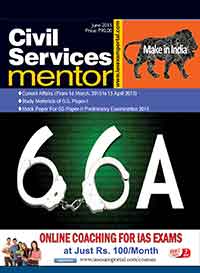
(Download) Civil Services Mentor Magazine, June 2015 - FREE PDF

https://iasexamportal.com/sites/default/files/CSM-Title-June-2015.jpg

Click Here to Buy Hard Copy of This Magazine from Our Online Sotre

Free Digital Magazine: Civil Services Mentor, June 2015

Issue : June 2015
Size: 5.60 MB
File Type: PDF
Publisher : IASEXAMPORTAL.COM 

Table of Contents:

Articles:

  • Beti Bachao, Beti Padhao Yojana
  • PRAGATI Platform
  • SEC 66(A), IT Act
  • Make in India
  • The Asian Infrastructure Investment Bank
  • Study Materials of G.S. Paper–I
  • CSAT (Paper - 2) Practice Paper
  • Mock Paper For GS Paper-I Preliminary Exam 2015

Current Affairs:

  • National Issues
  • International Issues
  • Economy
  • India & The World
  • Science & Technology
  • Sports
  • Awards & Prizes
  • Persons in News

Gist of The Hindu: June 2015


Gist of The Hindu: June 2015


Looking beyond nuclear liability

A month has passed since U.S President Barack Obama was in Delhi as the chief guest at the Republic Day and had his famous “chai pe charcha” with Prime Minister Narendra Modi. An overview of the Indian commentary about the Obama visit would reveal that breaking the logjam on nuclear liability is perceived as its most significant outcome. Both leaders focussed on it at their joint press conference and Paragraph 43 of the Joint Statement states that “the Leaders welcomed the understandings reached on the issues of civil nuclear liability and administrative arrangements for civil nuclear cooperation, and looked forward to U.S.-built nuclear reactors contributing to India’s energy security at the earliest.” A lack of details initially led to considerable speculation about the nature of the breakthrough and the assurances provided. To clarify matters, the Ministry of External Affairs took the unusual step of putting out a seven page ‘Questions and Answers’ explanatory paper which sparked yet another round of debate on whether this was really a breakthrough or not. However, such a narrow focus on nuclear liability misses the larger picture; there is an underlying broader political objective which has driven the nuclear dialogue between India and the United States since the end of the Cold War, and when Mr. Modi and Mr. Obama talked of breaking the logjam, they clearly had the larger political objective in view.

Following their meeting in Washington last September, the two leaders had “reaffirmed their commitment to implement fully the India-U.S. civil nuclear cooperation agreement”. Both leaders realised that the nuclear liability issue was a hurdle that needed to be overcome to take the relationship forward. A contact group was established and met thrice in the two months leading up to the Republic Day summit. In January, the officials had reached the limits of their respective negotiating mandates in the contact group. Mr. Modi and Mr. Obama understood that the issue was not whether Westinghouse and GE would set up nuclear power plants in India (that process was bound to take many months, even years, of complex technical and financial negotiations) but whether the two leaders could lead from the front on this issue. There were two principal sticking points in the 2010 Civil Liability for Nuclear Damage Act (CLNDA). The first was Section 17 which enables the operator of the nuclear installation (under Indian system, the Nuclear Power Corporation of India Ltd. or NPCIL), after paying compensation to the victims of nuclear damage, to have the right of recourse against the supplier, subject to certain conditions. Two of these conditions, namely when such a right is part of the written contract between supplier and operator, and second, when the nuclear accident has happened because of the intent to cause damage, are accepted as part of the international legal regime pertaining to nuclear liability. The third condition introduced in Section 17(b) was novel and gave the operator a right of recourse against the supplier if the incident had been due to ‘supply of equipment or material with patent or latent defects or substandard services’. The supplier community interpreted this provision as ambiguous and one that rendered it vulnerable to open-ended liability claims. The new explanation seeks to address it by relating Section 17(b) to ‘actions and matters such as product liability stipulations/conditions or service contracts’ between the operator and the supplier and therefore to be dealt with in the context of such contractual terms. The attempt is to remove the open-ended nature of possible liability claims by limiting these to the terms and conditions of the contract.

PRAGATI Platform: Civil Services Mentor Magazine - June - 2015


PRAGATI Platform


‘Grievance’ has been defined as indignation or resentment arising out of a feeling of being wronged. Grievance is an expression of dissatisfaction made to an organization related to its products, services, processes, etc. where a response or resolution is explicitly or implicitly expected. Government of India, State Governments as well as various organizations under them have set up grievance redressal mechanisms to look into the complaints of citizens. Besides, there are other institutional mechanisms like the CVC, and the Lokayuktas which have the mandate to look into the complaints of corruption and abuse of offi ce by public servants. India has an elaborate legal and institutional structure which povide for the welfare state and also for the grievance redressal mechanisms for the citizens. But there is a wide gap between the legal and institutional mechanisms and what is experienced at the ground level. Citizen of 21st century are demanding and governance should respond to grievances and demands of the citizen smoothly and in timely manner. Citizen centracity is necessary for any scheme to be successful at every level, whether central, state or local. Timely and proper grievance redressal is necessary for good governance which aims to provide citizen centric governance. The internal public grievance mechanism is deficient in terms of its reach as well as its functions. Second ARC suggests that reach and functions of public grievance mechanism can be improved in the following maner:

  • The Union and the State Governments should issue directions asking all public authorities to designate public grievance officers on the lines of the Public Information Officers specified under the RTI Act. These officers should be of adequate seniority and be delegated commensurate authority.

  • All grievance petitions should be satisfactorily disposed of by these officers within thirty days. Non-adherence to the time limit should invite financial penalties.

  • Each organization should also designate an appellate authority and devolve adequate powers upon them including the power to impose fi nes on the defaulting officers. Citizen Centric Administration – The Heart of Governance

Pages

Subscribe to RSS - Iasguru's blog