Iasguru's blog

(Notification) HPPSC: H.P. Administrative Combined Competitive Exam - 2016 "Advt no. 1/2016"

(Notification) HPPSC: H.P. Administrative Combined Competitive Exam - 2016
"Advt no. 1/2016"

Vacancies Detail:

1. Four vacancies of Himachal Pradesh Administrative Service, Class-I (Gazetted) in the pay scale of Rs.15600-39100 + 5400 (Grade Pay). Out of these, one vacancy is reserved for the category of Scheduled Caste (S.C.), and one vacancy is reserved for the category of Scheduled Tribe (S.T.) and remaining two vacancies are unreserved.

2. Five vacancies (unreserved) of Himachal Pradesh Police Service, ClassI (Gazetted) in the pay scale of Rs. 15600-39100+5400(Grade Pay).

3. Five vacancies of Tehsildar Class–I (Gazetted) in the pay scale of Rs.10300-34800+5000 (Grade Pay). Out of these, one vacancy is reserved for the category of Other Backward Class (OBC) Remaining four vacancies are unreserved.

4. Eight vacancies of Block Development Officers, Class –I (Gazetted) in the pay scale of Rs. 10300-34800 + 5000 (Grade Pay). Out of these, three vacancies reserved for the category of Scheduled Castes (S.C), one vacancy reserved for the category of Scheduled Tribe(S.T), one vacancy reserved for the category of Ex-serviceman (Gen.), two
vacancies reserved for category of Other Backward Class (OBC) of H.P., and remaining one vacancy is unreserved.

5. Three Vacancies of Excise and Taxation Officer, Class-1(Gazetted) in the pay scale of Rs. 10300-34800+5000 (Grade Pay). Out of these one vacancy reserved for the category of Other Backward Class (OBC) and remaining two vacancies are unreserved.

The following post(s) will also be filled up on the basis of HPAS Combined Competitive Examination-2015

1. Himachal Pradesh Administrative Services
2. Himachal Pradesh Police Services
3. Tehsildar
4. Excise & Taxation Officer
5. Block Development Officer
6. District Panchayat Officer
7. District Welfare-cum-Probation Officers
8. Assistant, Registrar Co-operative Societies
9. District Employment Officer
10. District Treasury Officer
11. District Food & Civil Supplies Controller
12. Assistant Controller, Weights & Measure

 Eligibility Criteria:

Educational Qualifications:

(a) A candidate must possess a Bachelor's Degree or its equivalent from a recognized University.

The Gist of Press Information Bureau (PIB): January 2016


The Gist of Press Information Bureau: January 2016


NSCN (K) as terrorist organization under UAPA

The Government has declared the National Socialist Council of Nagaland (Khaplang), NSCN (K), all its formations and front organizations as a terrorist organization under the Unlawful Activities (Prevention) Act, 1967. A Gazette Notification issued on November 6, 2015 mentions that the NSCN (K), a militant outfit, came into existence in 1988 and is active along the Indo-Myanmar border. NSCN (K) has resorted to terrorism by killing innocent civilians and security forces and engaged in other violent activities including the June 4, 2015 attack on the Army convoy in Chandel district of Manipur.

Qaumi Ekta Week

With a view to foster and reinforce the spirit of Communal Harmony, National Integration and pride in vibrant, composite culture and nationhood, the “Qaumi Ekta Week” (National Integration Week) was observed all over the country, from tomorrow to 25th November, 2015. The National Foundation for Communal Harmony (NFCH), an autonomous organisation with the Ministry of Home Affairs, organises Communal Harmony Campaign coinciding with the Qaumi Ekta Week and observes the Communal Harmony Flag Day on 25th November. The Foundation promotes Communal Harmony and strengthens National Integration. It also provides financial assistance for relief and rehabilitation of children rendered orphan or destitute in communal, caste, ethnic or terrorist violence.

The observation of the ‘Quami Ekta Week’ helped to highlight the inherent strength and resilience of our nation to withstand actual and potential threats to the eclectic and secular fabric of our country, and nurture a spirit of communal harmony in its widest sense. This occasion also provides an opportunity to reaffirm age old traditions and faith in the values of tolerance, co-existence and brotherhood in a multi-cultural and multi-religious society.

(Current Affairs) India and The World | January: 2016

India & The World

(Current Affairs) Economy & Energy | January: 2016

Economy

China’s yuan takes another step towards SDR basket inclusion

  • China’s currency, the yuan, took an-other step forward towards join-ing the elite group of global re-serve currencies on Saturday when the International Monetary Fund’s (IMF) staff on Saturday recommended that the Chinese currency be included in the IMF’s benchmark foreign exchange basket, a move that will indirectly benefit India as well.
  • Managing Director of the IMF Christine Lagarde also endorsed the yuan’s inclusion in the IMF’s Special Drawing Rights basket.
  • The staff of the IMF has today issued a paper to the Executive Board on the quinquennial re-view of the SDR (Special Drawing Rights). A key focus of the Board review is whether the Chinese renminbi (RMB), also meets the other existing criterion, that the currency be ‘freely usable’, which is defined as being ‘widely used’ for international transactions and ‘widely traded’ in the principal foreign exchange markets.
  • SDR are not a currency them-selves, but are a certain number of rights given by the IMF to countries who, in a crisis, can draw up-on any of the reserve currencies in the basket — currently the dollar, euro, yen and pound.
  • The inclusion of the yuan in this basket has been endorsed by almost all of the major economies of the world, including Germany, Britain, France and Italy.
  • The U.S. was historically cautious about this, but recently softened its stance in September when President Obama said the U.S. would support China’s bid for inclusion in the SDR basket as long as it met the IMF’s technical specifications, which it now has.

The Gist of Kurukshetra: January - 2016


The Gist of Kurukshetra: January 2016


Panchyati Raj in India: Eepending Grassroot Democracy

Two decades have elapsed since the enactment of the 73rd Amendment to the Constitution (hereafter referred to Central Act) and more than 15 years have passed since the enactment of the (Provisions of Panchayats (Extension to Scheduled Areas) Act 1996 (hereafter referred to Extension Act). The main purpose of these Acts was to strengthen the Panchayati Raj System (PRS) in the country. This article analysis to what extent these institutions have emerged as institutions of self-governments, enabled people’s participation-particularly vulnerable sections like Scheduled Castes (SCs), Scheduled Tribes (STs) and women in these institutions.

Emergence of Local Self -Governments

Central Act has both mandatory and enabling provisions. The state governments were supposed to devolve the functions, finance and functionaries pertaining to 29 subjects listed in the Eleventh Schedule of the Constitution to the Panchayati Raj Institutions (PRls) to enable these bodies to function as institutions of self government. In order to function, panchayats as institution of self- government (ISG), the Panchayats have to fulfil three basic conditions, namely, (a) institutional existence in the sense that the decisions are taken by the people’s representatives, (b) institutional capacity, which means that these institutions have clearly defined functions, functionaries and finances. Let us see as to what extent the Panchayats have emerged as ISG after evaluating the progress made towards empowering these bodies in last two decades.

(Current Affairs) International Events | January: 2016

International Events

Hollande vows to punish IS for attacks

  • French President Francois Hollande vowed to attack the Islamic State group without mercy as the jihadist group claimed responsibility on Saturday for orchestrating the deadliest attacks on France since World War II.
  • The Islamic State group’s claim of responsibility appeared in Arabic and French in an online statement circulated by IS sup-porters. It was not immediately possible to confirm the authenticity of the admission, which bore the group’s logo and resembled previous verified statements from the group.
  • Officials said a Syrian passport was recovered from the remains of one suicide bomber outside the stadium and that a suicide bomber at the concert hall was identified as a young Frenchman flagged in the past for links with an Islamic extremist activity.
  • Prosecutor’s office spokes-woman Agnes Thi-baultLecuivre said authorities couldn’t rule out the possibility that other militants involved in the attack remained at large.
  • The violence raised questions about security for the millions of tourists who come to Paris and for world events routinely hosted in the normally luminous capital, where 1,500 troops were deployed to support police in restoring order and re-assuring a frightened populace.

(Current Affairs) National Events | January: 2016

National Events

Terrorist attacks killed 130 in France

  • In a deadly terror strike similar to Mumbai on November 26, 2008, suspected Islamic State gunmen launched a coordinated assault on Paris late on Friday night, leaving 129 dead and 352 injured.
  • This was the worst terror attack in France’s history far bigger than the shooting inside the Charlie Hebdo newspaper office in January, which killed 12 and injured 11.
  • French President Francois Hollande announced that he held the IS responsible for the attack and France considered it “an act of war”. He announced a state of emergency, the first in France since 2005, and the deployment of 1,500 soldiers.
  • The attack was carried out on six locations, one being the French national stadium Stade de France where France and Germany football teams were playing a friendly before an 80,000-strong crowd.
  • Mr. Hollande, who was among the spectators, was evacuated immediately following security protocol. As many as 89 people were killed in the attack at the Bataclan Theatre during a concert by the band Eagles of Death Metal.
  • The gunmen entered the 1,500-seat venue and began shoot-ing without warning. The police said the assailants were killed. A Syrian passport was found on one of the attackers.

The Gist of Yojana: January 2016


The Gist of Yojana: January 2016


Transport Infrastructure: Way Forward

The trend in transport demand profile in India has been characterised by an increasing share of road transport and increasing share of personalised transport (especially the motorised two wheeler). While the road infrastructure based facilitation of road transport, especially in the 2000-2007 period (NHDP and PMGSY), would have most certainly contributed to the jump in GDP growth, the impact on energy and environment and
safety would be far from desirable. It is important to reverse the trend of increasing market share of road and personalised transport towards more environment friendly transport modes like rail and water.

Transport demand can at the first level, be categorised into international and domestic movement (including for export/import). Ports and airports are the gateways for the export/import traffic. We first examine domestic movement and then international.

At the next level, the transport demand can be categorised into freight and passenger. There are no clear estimates on the relative value, effort or environmental impact of the two domains. However, examining the data of Indian Railways from a revenue perspective, about 70 per cent of the economic value is generated from freight. Similarly, 80 per cent or interregional road movement would be accounted for by freight vehicles as per toll booth information.

The National Transport Development Policy Committee (NTDPC) has tried to estimate the overall freight traffic until

Selected Articles from Various News Paper: Civil Services Mentor Magazine - January 2016


Selected Articles from Various Newspapers & Journals


Where the mind is without fear

Prime Minister Narendra Modi, while addressing Indian-origin professionals in Silicon Valley, argued that this is brain gain, as millions of successful Indians in the U.S. bring back knowledge to India. There is truth to this assertion. India should then cherish the dramatic increase in the number of Indian students in the U.S., from 31,743 in 1995 to more than 1,02,000. The discussion of brain gain versus brain drain misses something potentially far more important, however: the issue of a domestic brain trap. Brain trap is a result of the archaic educational, social, and economic systems that stifle most young minds from blossoming into creative thinkers and highly productive citizens. One could argue that the millions of successful Indians in the U.S. would not have achieved much success if they had remained in India. This includes me. Unlocking the enormous domestic brainpower will trump any brain gain.

There are many plausible reasons for brain trap. One important reason is the process by which an individual’s inquisitiveness is repeatedly snubbed from childhood. Often this is a result of strict adherence to social norms at home and is carried over to schools and workplaces. Case in point: In a gathering that I attended, a spiritual leader said, “Indian culture is the greatest in the world.” In response, a 6-year-old child innocently asked, “Why?” Obviously stumped by the question, the leader said, “Children in Indian culture respect elders and do not disagree or talk back.” The child nodded her head in acceptance.

Unfortunately, the damage begins there. Obedience is valued more than the child’s inquisitiveness. We assume disagreeing is disrespectful and obedience is a greater trait than inquisitiveness. Deeply held beliefs are blindly transferred to children. This obedience gets amplified in schools. Fear is embedded in the psyche of the student both at home and school and the ability to think beyond the norms is curtailed from childhood. Fear manifests itself in many forms and one is that of academic stress due to hyper-competition.

Teachers play an extraordinary role in shaping students. If India wants to unlock the brain trap, then it must invest massively in teachers and teacher training. That begins by acknowledging the importance of creativity, introducing teaching and testing methods that encourage inquisitiveness, and rewarding teaching innovations. In India, professors are expected and incentivised to get PhDs. But, it is unclear if there is any greater focus on creativity or academic research in most places. Professors who emphasise research and publish papers with students should be recognised and rewarded.

The business leaders and industry associations like NASSCOM lament the lack of soft skills or critical thinking among graduating students. Often critical thinking skills are equated with math or science-related fields, while placing very little emphasis on critical thinking skills rooted in economics or the liberal arts education. Both are essential.

Uday: Civil Services Mentor Magazine - January - 2016


UDAY


Availability of power at affordable price is one of the biggest challenge which India is facing. Frequent power cuts and non availability of power is one of the major factor which India is facing. More than one lakh crore villages are like that where power lines have still not reached. One of the most important reasons for this state of our power is poor state of our discoms. DISCOMS have combined loss of more than 3 lakh crore and debt exceeds 4 lakh crore. Non availibility of power hampers the quality of life of the people of India and it also puts a break on the economic growth and development of the country. Since coming to power in 2014 new government has taken number of steps to provide the power to every household in the country at effordable price. Steps taken by new government include the power generation through non-conventional ways and signing of nuclear deal with other countries. These steps have shown great results with the sector witnessing a series of historic improvements across the entire value chain, from fuel supply (highest coal production growth in over 2 decades), to generation (highest ever capacity addition), transmission (highest ever increase in transmission lines) and consumption (over 2.3 crore LED bulbs distributed).

In line with other steps government has come up with new scheme named UDAY. The weakest link in the value chain is distribution, wherein DISCOMs in the country have accumulated losses of approximately Rs. 3.8 lakh crore and outstanding debt of approximately Rs. 4.3 lakh crore. Efforts towards 100% village electrification, 24X7 power supply and clean energy cannot be achieved without performing DISCOMs. Power outages also adversely affect national priorities like “Make in India” and “Digital India”. In addition, default on bank loans by financially stressed DISCOMs has the potential to seriously impact the banking sector and the economy at large. Due to legacy issues, DISCOMs are trapped in a vicious cycle with operational losses being funded by debt.

Telangana State Public Service Commission (TSPSC)

Telangana State Public Service Commission (TSPSC)

About TSPSC:

Telangana State Public Service Commission is the youngest Public Service Commission in the country constituted vide GO Ms No.43, GA(Ser.A) Department, dt. 8.8.2014. Hyderabad State was one of the prominent princely State in India and inherits over 400 years of rich tradition and culture with unparalleled grace and historical significance. The system of selecting young talent for public services through a process of selection was in vogue in the Hyderabad State since the period of Mir Mahaboob Ali Pasha, VI Nizam (1869-1911). Hyderabad Civil Service Committee was established by the 1919 Firman and the Hyderabad Public Service Commission was established by a Firman on 27 April 1947 emulating the model of British Provincial Public Service Commission with a Chairman and Members not exceeding four in number. The establishment of the Commission was a significant landmark during the Asaf Jahi rule and brought the entire administrative machinery of civil services of the Nizam’s State in tune with the modern times and Hyderabad Civil Service was considered a coveted and elite service in those days.

The Telangana State Public Service Commission, endowed with such rich legacy of over 150 years of recruiting young talent through selection, shall endeavour to make use of this heritage for selecting the best talents in Telangana for reconstruction and resurrecting the glorious past of Telangana.

Function:

The Telangana State Pradesh Public Service Commission was constituted under Article 315 (1) of the Constitution of India vide orders issued by Government of Telangana in G.O.Ms.No: 43 GA Department dt: 08/08/2014. The Commission discharges its duties and functions as enunciated under Article 320 of the Constitution of India and in accordance with Telangana State Public Service Commission Regulations issued vide G.O.Ms.No: 44 GA Department, dated August 8, 2014.

(Answer Key) UPSC: SOs/Stenos Grade Examination 2014

https://iasexamportal.com/sites/default/files/UPSC-SO-Stenographers-LOGO.jpg

(Answer Key) UPSC: SOs/Stenos Grade Examination 2014

Exam Name: SOs/Stenos Grade Examination

Year: 2014

Paper:

  • Paper - I
  • Category I, IV, VIII IX Paper-II
  • Category II, V Paper-II
  • Category VI Paper-II
  • Category III & VII Paper-II

Gist of The Hindu: January 2016


Gist of The Hindu: January 2016


Hope and clarity in Paris

Parisians are no strangers to violence. During the French Revolution in late 1793, the Reign of Terror swept across the city, killing more than 2,000 supposed ‘enemies of the revolution’. In 1871, the city played host to the largest European urban insurrection of the nineteenth century — the Paris Commune — in which nearly 10,000 Parisians were slaughtered. A little less than a century later, at the height of the Algerian War in 1961, terrorism returned with a vengeance. In June that year, the pro-colonial militants of the Organisation Armée Secrète planted a bomb on a Strasbourg-Paris train, killing 28. And, in October, the brutal police repression of a pro-nationalist demonstration left up to 50 dead and bodies floating in the Seine.

This violent history has continued in more recent times, with terrorist bomb attacks by Hizbollah and Lebanese Islamists in 1986 and Algerian Islamists in 1995 during the Algerian Civil War. Most recently, of course, Paris endured the massacre of Charlie Hebdo journalists, and shoppers in a Jewish superstore, in January 2015. None of this should take away from the shock that greeted the appalling coordinated attacks in Paris on November 13, 2015. The death toll and the scale make the latest events some of the bloodiest examples of terrorism in Europe, along with the Madrid bombings in 2004. For better or for worse, Paris has become another site in a global conflict that stretches from Mumbai and Peshawar to Bali and Beirut.

Nevertheless, the long history of violence in France can offer some clues into how an already fragile country might approach another shock to its social and political identity. In particular, three areas should hold our attention over the coming days and weeks: the implications of the attack for counter-terrorism in France; the impact on foreign and immigration policy; and the potential for a sharp rightward shift in French politics.
First, the question of counter-terrorism. It may come as a surprise to some, but France was long held up as a model of counter-terrorist and counter-insurgency strategy. The ruthless treatment meted out to anti-colonial activists in Indo-China and Algeria in the mid-twentieth century made the French army, police and intelligence services a model of how to root out ‘terrorism’. So much so that the torture of suspected political dissidents during the Algerian War in the 1950s and 1960s became a permanent blot on France’s reputation (and an inspiration for America’s War on Terror after 9/11).

Third India- Africa Summit: Civil Services Mentor Magazine - January - 2016


Third India- Africa Summit


India has a special relationship with Africa. India and countries from Africa face similar kind of problems like poverty, malnutrition etc. In International organisations also India and countries from Africa represent mostly similar interests. India since its independence has given high importance to African region. India fought against colonialism and also spearheaded campaign against it after the Independence. In fact, the centuries-old ties between India and Africa, especially with countries in eastern and southern Africa, were firmed up due to India’s consistent support to anti-colonial and anti-racist liberation struggles in Africa.

Now after the political problems of African nations with outside world has largely been settled, major area of coperation has shifted. Now our major area of coperation include economic, terrorism and maritine safety. India and Africa together makes one third of the world population and majority of it is youth. They both will supply the manpower to the world for years to come. After liberalisation in 1991 India has achieved an average growth rate of more than six percent for over two decades now. Strategic mineral commodities, especially oil, became essential for India’s growing and energy-hungry economy. India has good working relationship with countries which have good oil and mineral resources. Countries like South Africa, Morocco, Egypt, Sudan, Nigeria and Angola etc. all have good relationship with the India. Relationship between India and Africa has not been one way, India supplies technology and money to African countries, these are required in Africa for developmental purposes.

India and Nepal Relations: Civil Services Mentor Magazine - January - 2016


India and Nepal Relations


India and Nepal relationship is like none other, it is deeply ingrained in the history and and geographical factors. Other important connection between the two countries is that its people to people contact very high. There has been a long tradition of free movement of people across the borders. Nepal shares a border of over 1850 Kms with five Indian States - Sikkim, West Bengal, Bihar, Uttar Pradesh and Uttarakhand, north of Nepal lies the Tibet. More than six lakh Indian reside in Nepal. Most of them being the migratory workers who move to Nepal seasonally.

India and Nepal both get some special priviledges which other neighbours don’t. This special relationship derives its power from Treaty of Peace and Friendship of 1950. Under the provisions of this Treaty, the Nepalese citizens have enjoyed unparalleled advantages in India, availing facilities and opportunities at par with the Indian citizens. This treaty in a way helped Nepal to overcome of the disadvantages it faced by being a country which is land locked. Since 1950 various parties from both the side have given their opinion to change the treaty. India has maintained that it is willing to examine all bilateral arrangements with a view to further strengthening relationship with Nepal.

Exports from Nepal to India increased from IRs. 230 crores in 1995-96 to IRs. 3187.4 crores in 2012-13 and India’s exports to Nepal increased from IRs. 1,525 crores in 1995-96 to IRs. 22939.4 crores in 2012-13. Main items of exports from India to Nepal are petroleum products, vehicles and spare parts, mild-steel billets, machinery and parts, medicines, hot and cold rolled sheets, wires, rods, coils, bars, electrical equipments, cement, threads and chemicals.

(Download) SSC: Constables (GD) in CAPFs, NIA & SSF and Rifleman (GD) in Assam Rifles Exam Answer Key, 2015

(Answer Key's) SSC: Constables (GD) in CAPFs, NIA & SSF and Rifleman (GD) in Assam Rifles Examination, 2015

The written examination for recruitment of Constable(GD) in CAPFs, NIA & SSF and Rifleman(GD) in Assam Rifles Examination 2015 was held on 04-10-2015 and the re-examination was held on 22-11-2015. The answer keys for the said Examinations are being uploaded on the Website of the Commission: ssc.nic.in. Candidates may go through the answer keys corresponding to their test form and send representations, if any, by 6.00PM on 02-2-2016.

Representations received after the due date will not be entertained.

(Final Result) UPSC Combined Defence Services Exam. (I), 2015 (OTA)

(Final Result) UPSC Combined Defence Services Exam. (I), 2015 (OTA)

1. The following are the lists, in order of merit, in respect of 167 (137 Man + 30 Women) candidates who have finally qualified on the basis of the results of the Combined Defence Services Examination (I)-2015 conducted by the Union Public Service Commission and interviews held by the Services Selection Board of the Ministry of Defence for admission to the (i) Officers’ Training Academy, Chennai for 103rd Short Service Commission Course (for Men); and (ii) 17th Short Service Commission Women (Non-Technical) Course, commencing in April, 2016. The list of 103rd Short Service Commission Course (for Men) also includes the names of the  candidates who were recommended earlier on the basis of the result of the same examination for admission to the Indian Military Academy, Dehradun; Indian Naval Academy, Ezhimala and Air Force Academy, Hyderabad (Pre-Flying ) Training Course(s).

2. The number of vacancies as intimated by the Government, for (i) 103rd Short Service Commission Course (for Men) is 175; and for (ii) 17th Short Service Commission Women (Non-Technical) Course is 12.

3. The result of Medical Examination of candidates has not been taken into account in preparing the merit list. The candidature of all the candidates is Provisional. Verification of Date of Birth and Educational Qualification of these candidates will be done by AHQ.

4. Candidates can also obtain information regarding results by accessing to UPSC web-site http://www.upsc.gov.in . However, marks of the candidates will be available within 15 days from the date of declaration of final result on Commission’s web-site for 60 days.

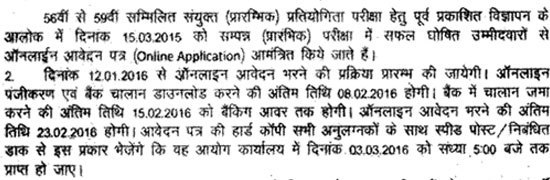
(Notification) BPSC: 56 to 59 Combine Competitive (Mains) Exam - 2016

(Notification) BPSC: 56 to 59 Combine Competitive (Mains) Exam  - 2016

Exam Details:

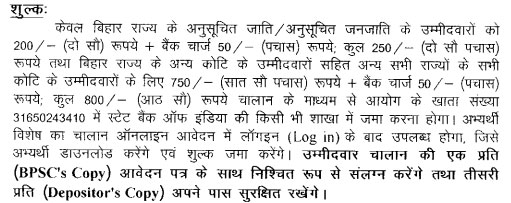
Examination Fee:

How To Apply Online:

Gold Monetisation Schemes: Civil Services Mentor Magazine - January - 2016


Gold Monetisation Schemes


Due to various traditions and habbits gold use in India is at a very high level. Gold has been used in various forms, it has been used in marriages by bride, big amount of gold is present in temples across India. Apart from this gold has been used by traders as a commodity for the purpose of making profit. Gold is also kept in households as a reserve currency. Sociological aspect also makes women in India keep more of gold. Gold historically has been the property which women could hold. In the year 2011 India imported more gold than any other country, total import was close to 1,000 tonnes, which is also a fifth of global annual supply. There has been a surge in gold consumption in India in last few decades. Until 1990 imports were all but banned so total consumption of Gold per year was below 75 tonnes till 1990. That time smuggling of bullion was at its peak and price of gold in India were much more than international market. But deregulation has seen an explosion in gold purchases. Now most gold coming into India enters legally through banks. Many loans made against gold collateral are not from shifty money lenders but registered financial firms.

This high quantity of Gold import has various negative effects on the economic health of the country. High quantity of import increases the current account deficit, which effects the monetary and fiscal policy. It puts a pressure on external account, which drives the exchange rate. If all the gold available and lying idle inside the country can be monetised, it will make good impact on the health of countries economy. In order to monetise the gold inside the country the government has come up with three new shemes.

The salient features of each of the aforesaid scheme are as follows:

Gold Monetisation Scheme (GMS), 2015

The GMS will replace the existing Gold Deposit Scheme, 1999. However, the deposits outstanding under the Gold Deposit Scheme will be allowed to run till maturity unless the depositors prematurely withdraw them. Resident Indians (Individuals, HUF, Trusts including Mutual Funds/Exchange Traded Funds registered under SEBI (Mutual Fund) Regulations and Companies) can make deposits under the scheme. The minimum deposit at any one time shall be raw gold (bars, coins, jewellery excluding stones and other metals) equivalent to 30 grams of gold. There is no maximum limit for deposit under the scheme. The gold will be accepted at the Collection and Purity Testing Centres (CPTC) certified by Bureau of Indian Standards (BIS). The designated banks will accept gold deposits under the Short Term (1-3 years) Bank Deposit (STBD) as well as Medium (5-7 years) and Long (12-15 years) Term Government Deposit Schemes (MLTGD). There will be provision for premature withdrawal subject to a minimum lock-in period. The interest rate in the STBD will be determined by the banks. The interest rate in the medium term bonds has been fixed at 2.25% and for the long term bonds is 2.5% for the bonds issued in 2015-16. The Short Term Bank Deposits will attract applicable Cash Reserve Ratio (CRR) and Statutory Liquidity Ratio (SLR). However, the stock of gold held by the banks will count towards the general SLR requirement. The opening of Gold Deposit Accounts will be subject to the same rules with regard to customer identification (KYC) as are applicable to any other deposit account.

Pages

Subscribe to RSS - Iasguru's blog