The Gist of Science Reporter: September 2015
Our Soil Our Future
“Soils don’t have a voice, and there are only a few people to
speak out for them. They are our silent ally in food production ... /r This was
Jose Graziano da Silva, Director-General of the Food and Agriculture
Organization (FAa) speaking on the occasion of the launching ceremony of the
International Year of Soils 2015.
The soils are in danger because of expanding cities,
deforestation, unsustainable land use and management practices, pollution,
overgrazing and climate change. The current rate of soil degradation threatens
the capacity to meet the needs of the future generations. The main goal of the
International Year of Soils is, therefore, to raise awareness about the
importance of healthy soils and to advocate for sustainable soil management in
order to protect this precious natural resource.
But, it is so sad and alarming that one-third of the soils
all over the world have already been degraded. If the current trend continues,
the global amount of arable and productive land per person in 2050 will be a
quarter of what it was in 1960. The world will have over 9 billion people in
2050, 2 billion more than today. Accordingly, the food production will have to
grow by 60% to feed this increased population, demanding intensive agriculture.
The pressure on soils is bound to increase and soils are not
easy to fix once they degrade: it can take up to one thousand years to form one
centimetre of topsoil. That same topsoil can be quickly washed away by erosion.
Soils are typically made up of about one-third water, one-third minerals and
one-third organic materials. But, if we take these three elements separately and
mix them together, we won’t get soil. Soil is much like a living organism. It is
a complex and dynamic system that forms habitat for an immense diversity of
species, including human beings.
It is composed of living and non-living components. The
living component includes from large creatures like earthworms, ants, etc. to
microscopic forms like bacteria, fungi, protozoa, and micro-arthropods. The
physical and chemical properties of the soil are attributed to the non-living
components of the soil. This largely includes the geological part, the solid
material, which we often call the ‘soil’.
The na ture of the soil varies across different geological
landscapes, their formation in turn affected by different climatic, physical and
chemical factors. Fertile soil remains as the base for the economic prosperity
of a nation through food, fuel and fabrics. Soil could even sustain
civilizations. It supplies nutrients for growth of plants which include
agricultural crops also.
Soils act as reservoirs of carbon and harbour dead bodies of
organisms like animals, plants and microorganisms. Soils can influence the
cycling of nutrients and energy in the ecosystems. Soil also plays a major part
in the Nitrogen and Sulphur cycles. In a forest land, the soil is always covered
by leaf litter composed of dead leaves, twigs and roots of plants. There is a
detritus food-chain going on within the soil, where the dead organic matter is
decayed by certain micro-organisms in the soil. During decomposition, the
organic matter is transformed into inorganic material such as compounds of
nitrate, ammonium, and phosphate which supply nutrients for plant growth.
For soils, quality is of prime importance. It means its
ability to maintain biological diversity and productivity. In the broader sense,
it is the ability to sustain quality of water and air and providing conditions
for plants, animals and human populations to live. Organic matter present in the
soil als determines its quality. A higher content of soil organic matter denotes
its higher cation exchange capacity, higher water-holding capacity and higher
infiltration capacity. When a soil naturally possesses better aeration and
increased soil particle aggregation, it can lessen soil erosion due to reduced
runoff of nutrients and improved moisture infiltration and retention.
Erosion is an inevitable action which implies the removal of the surface of the
earth by abrasive actions of wind, water, waves, or glaciers. Based on the
reason and factors, erosion can be of two types: Geological and Accelerated.
Geologic erosion is a slow process, typically occurring at a
rate that is much slower than the rate of soil formation. This rate would depend
on protection offered by vegetation. The roots of plants can intertwine with
each other and hold the soil particles together. The vegetation over-ground such
as grasses and certain other plants, which have even gained the name
‘sand-binders’, can protect the soil from washing away while the trees can
reduce the wind speed so that the loose soil is not flown away.
The opposite happens in the case of accelerated soil erosion.
Here the rate of soil loss is fas ter than the ra te of soil formation. When
there is a violent influx of wind or water, the individual particles of the soil
become detached from the aggregates and are washed away or blown away for great
distances. They are deposited somewhere else as dust or form new soils that are
washed into streams, rivers, and oceans. The extent of accelerated soil erosion
depends on natural conditions like climate, slope, vegetation cover, soil and
the nature of land exploitation patterns.

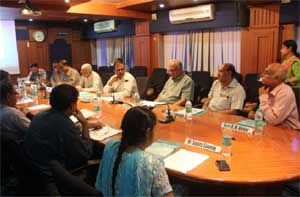 The
Union Minister of State (Independent Charge) Development of North-Eastern Region
(DoNER), MoS PMO, Personnel, Public Grievances, Pensions, Atomic Energy and
Space, Dr. Jitendra Singh disclosed that as a follow-up to the decision taken by
the government in the month of May this year, an expert committee consisting of
leading academicians, technocrats and senior bureaucrats of national repute has
been constituted to revisit the entire pattern, syllabus and eligibility
criteria for IAS / Civil Services examination. He was speaking to a group of
civil services aspirants, here today.
The
Union Minister of State (Independent Charge) Development of North-Eastern Region
(DoNER), MoS PMO, Personnel, Public Grievances, Pensions, Atomic Energy and
Space, Dr. Jitendra Singh disclosed that as a follow-up to the decision taken by
the government in the month of May this year, an expert committee consisting of
leading academicians, technocrats and senior bureaucrats of national repute has
been constituted to revisit the entire pattern, syllabus and eligibility
criteria for IAS / Civil Services examination. He was speaking to a group of
civil services aspirants, here today.