Iasguru's blog

The Gist of Science Reporter: October 2015


The Gist of Science Reporter: October 2015


Pollens to Catch Criminals

Palynology was used as one of the major tools in war crime investigations in Bosnia. In July 1995, civilians were massacred and their bodies were buried in seven mass graves, following the fall of Srebrenica. Three months later the bodies were exhumed and transported to a number of new burial sites to hide the evidence of massacre and deflect the blame. However, palynological investigations clearly showed that the pollen and spores from the original mass graves had been transferred along with the bodies to the secondary burial sites.

During the 1960s and 1970s, a noted Swiss criminalist, Max Frei, often used pollen as a forensic tool to link suspects to events or to crime scenes (Palenik, 1982). In a well-known case, a suspect claimed that his pistol could not have been used to commit a recent murder because it had not been removed from its storage box in months. However, Dr. Frei proved the suspect was lying because grease on the pistol contained alder and birch pollen, both of which were pollinating when the murder occurred, not when the suspect claimed he had last cleaned the pistol and put it away.

In a rape case Horrocks and Walsh (1999) compared the pollen collected from the rape victim’s clothing and the suspects clothing with soil samples taken from the alleged crime scene and the alibi scene. The two scenes were only 7 meters apart but could be differentiated on the basis of pollen. The rape victim’s clothing and the suspects clothing showed very close correlation with each other and the crime scene in the amounts of pollen types present. This supported strongly the presence of the suspect at the scene of crime.

Forensic botany is the study of plants and plant remains and using the results to solve crime cases. This includes the analysis of wood, leaves, twigs, flowering tops, fruit, seeds, plant hair, pollen and spores. Pollen and spores are minute, light, microscopic evidential material, carried away unknowingly by criminals from the crime scene. This helps in linking a suspect with a unique crime scene or geographical region. The study of pollen and spores is called forensic palynology, Greek meaning “the study of scattered dust”. Experts in forensic pollen analysis are called palynologists. They take into account the growing seasons of pollen and spores and their geographical specificity making them beneficial in linking a suspect, victim or object to a particular crime scene.

(Current Affairs) Economy & Energy | October: 2015

Economy

Centre eases foreign investment rules, banks likely to gain most

  • In a move that will attract more overseas inflows and improve the ease of doing business in India, the government on Thursday simplified foreign investment rules by bringing together different categories.

  • The Cabinet Committee of Economic Affairs (CCEA), chaired by Prime Minister Narendra Modi, introduced a composite cap for all kinds of overseas inflows, including foreign direct investment (FDI), foreign portfolio investment (FPI) and investments by non-resident Indians (NRIs).

  • The decision, which was first announced by finance minister Arun Jaitley in the Budget, boosted stocks of banks, which will now find it easier to attract foreign capital up to 74%. Banks are already reeling under the pressure of rising bad loans and need billions of dollars to meet capital requirements.

  • Besides banks, credit information firms, commodity and power exchanges, and defence and other retail companies among others, will also benefit from the policy.

(Current Affairs) India and The World | October: 2015

India & The World

  • ‘India, Japan and U.S. can shape China’s peaceful rise’ (Free Available)
  • Africa sees opportunities in Make-in-India (Free Available)
  • India, Bangladesh enclave residents get freedom after 68 years (Free Available)
  • Nine U.S. satellites to be flown from Sriharikota (Free Available)
  • Radar satellite (Free Available)
  • Foxconn may set up a factory in every Indian state in 10 years: Terry Gou (Free Available)
  • India received $24 billion in FDI from EU in last 3 years (Only for Online Coaching Members)
  • UN Kalam GlobalSat: Satellite named in memory of APJ Adbul Kalam (Only for Online Coaching Members)
  • Australia mine project: Adani, StanC ties (Only for Online Coaching Members)
  • US,China,Russia,oppose India,s bid for permanent seat at UN (Only for Online Coaching Members)
  • Yuan devaluation & Indian economy (Only for Online Coaching Members)

‘India, Japan and U.S. can shape China’s peaceful rise’

  • Coordination among India, Japan and the U.S. on security cooperation and economic ties are essential because they can fundamentally talk about how they can “shape China’s rise in a peaceful way”, said Nicholas Szechenyi, Deputy Director and Senior Fellow – Japan Chair at the Centre for Strategic & International Studies (CSIS).

  • “India has unique interests with China, as does Japan and as does the U.S. They may not always align completely, but fundamentally if we are going to encourage China’s rise in a way that favours regional stability, I think this element of regional coordination among likeminded states is critical. Therefore India, Japan and U.S. have an important role to play,”

  • The Japanese Cabinet on Tuesday approved a defence white paper for 2015 which sounded alarm over China’s “one sided maritime activities” in the South China Sea.

  • China’s land reclamation in South China Sea has increased tensions in the resource rich region which is contested by several nations.

(News) 15000 students qualify in UPSC Civil Services Prelims Exam 2015


15000 students qualify in UPSC Civil Services Prelims Exam 2015


Over 15,000 people have qualified in this year’s civil services preliminary examination, results of which were declared on Monday by Union Public Service Commission (UPSC).

“A total of 15,008 candidates have qualified in the preliminary examination,” UPSC Secretary Ashim Khurana told PTI.

As against a record number of 9,45,908 candidates who have applied for the exam, about 4.63 lakh had sat in the test on August 23, which is about 49 per cent of the total applicants.

“The results of the preliminary exam were declared within 50 days of conducting the exam. It is the shortest ever duration in which the results were declared,” Khurana said.

(Exam Paper) UPSC IAS Mains 2013: General Studies Paper- 3

(Exam Paper) UPSC IAS Mains 2013: General Studies

Paper – III

1. With a consideration towards the strategy of inclusive growth, the new Companies Bill, 2013 has indirectly made CSR a mandatory obligation. Discuss the challenges expected in its implementation in right earnest. Also discuss other provisions in the Bill and their implications. (200 words)

2. What were the reasons for the introduction of Fiscal Responsibility and Budget Management (FRBM) Act, 2013? Discuss critically its salient features and their effectiveness. (200 words)

3. What is the meaning of the term ‘tax expenditure’? Taking housing sector as an example, discuss how it influences the budgetary policies of the government. (200 words)\

4. Food Security Bill is expected to eliminate hunger and malnutrition in India. Critically discuss various apprehensions in its effective implementation along with the concerns it has generated in WTO. (200 words)

5. What are the different types of agriculture subsidies given to farmers at the national and at state levels? Critically analyse the agricultural subsidy regime with reference to the distortions created by it. (200 words)

6. India needs to strengthen measures to promote the pink revolution in food industry for ensuring better nutrition and health. Critically elucidate the statement. (200 words)

7. Examine the impact of liberalization on companies owned by Indians. Are they competing with the MNCs satisfactorily? Discuss. (200 words)

8. Establish relationship between land reforms, agricultural productivity and elimination of poverty in the Indian economy. Discuss the difficulties in designing and implementation of agriculture – friendly land reforms in India. (200 words)

9. (a) Discuss the impact of FDI entry into Multi-trade retail sector on supply chain management in commodity trade pattern of the economy. (100 words)

9. (b) Though India allowed Foreign Direct Investment (FDI) in what is called multibrand retail through the joint venture route in September 2012, the FDI, even after a year, has not picked up. Discuss the reasons. (100 words)

10. Discuss the rationale for introducing the Goods and Services Tax (GST) in India. Bring out critically the reasons for the delay in roll out for its regime. (200 words)

11. Write a note on India’s green energy corridor to alleviate the problem of conventional energy. (200 words)

12. Adoption of PPP model for infrastructure development of the country has not been free of criticism. Critically discuss the pros and cons of the model. (200 words)

13. Bringing out the circumstances in 2005 which forced amendment to the section 3(d) in Indian Patent Law, 1970, discuss how it has been utilized by the Supreme Court in its judgement in rejecting Novartis’ patent application for ‘Glivec’. Discuss briefly the pros and cons of the decision. (200 words)

14. What do you understand by Fixed Dose drug Combinations (FDCs)? Discuss their merits and demerits. (200 words)

15. What do you understand by Umpire Decision Review System in cricket? Discuss its various components. Explain how silicone tape on the edge of a bat may fool the system?

The Gist of Press Information Bureau (PIB): October 2015


The Gist of Press Information Bureau: October 2015


Prime Minister Launches SKILL INDIA

The Skill India logo depicts a clenched hand in which a spanner and pencil are firmly held, exemplifying the empowerment of the individual through skilling. The spanner and pencil are held together, suggesting that both skill and general education are at parity and aspirational for India’s youth. The tagline, ‘Kaushal Bharat, Kushal Bharat’ suggests that skilling Indians (‘Kaushal Bharat’) will result in a happy, healthy, prosperous and strong nation (‘Kushal Bharat.’) The Pradhan Mantri Kaushal Vikas Yojana (PMKVY), the Ministry’s flagship, demand-driven, reward-based skill training scheme will incentivise skill training by providing financial rewards to candidates who successfully complete approved skill training programmes. Over the next year, PMKVY will skill 24 lakh youth, across India. For the first time, the skills of young people who lack formal certification, such as workers in India’s vast unorganised sector, will be recognised. Through an initiative known as ‘Recognition of Prior Learning’ (RPL), 10 lakh youth will be assessed and certified for the skills that they already possess. Prime Minister also launched the Skill Loan scheme. Loans ranging from Rs 5,000-1.5 lakhs will be made available to 34 lakh youth of India seeking to attend skill development programmes over the next five years.Sanction letters for the first ever Skill Loans were handed out by the Prime Minister to aspiring trainees. During the function, Shri Narendra Modi awarded Skill Cards and Skill Certificates to trainees who had recently completed training through the Pilot Phase of PMKVY, which started in May 2015. Such Skill Cards and Skill Certificates will allow trainees to share their skill identity with employers. Each Skill Card and Skill Certificate features a Quick Response Code (QR Code), which can be read through a QR reader on mobile devices. Trainees can use these to share their skill qualifications with employers in a quick and reliable way during the job search process.

Across the country, 2,33,000 youth were awarded certificates from ITIs, and 18,000 plus graduating students received job offer letters on the occasion of World Youth Skills Day. The Prime Minister personally presented industry job offer letters to five female ITI graduates at the event. The Minister of State (Independent Charge) of Skill Development and Entrepreneurship welcomed the audience at the outset of the event. He outlined the steps the Ministry of Skill Development and Entrepreneurship is taking to turn the Prime Minister’s vision of a skilled India into reality. He also underscored the importance of strategic partnerships in achieving the Skill India vision, showcasing inter-Ministerial initiatives to scale up skill development efforts.

(Current Affairs) International Events | October: 2015

International Events

Facebook in defensive mode on Internet.org

  • Facebook has defended its Internet.org initiative as a “gateway” to provide low cost access to the internet after a government panel on net neutrality opposed it saying that the social networking giant was playing the role of a gatekeeper.

  • “Internet.org acts as a gateway, as opposed to a gatekeeper, to internet access by breaking down the cost, infrastructure and social barriers that exist today,” Facebook vice president for Mobile and Global Access Policy Kevin Martin said in a statement.

  • The government panel discussed Facebook’s Internet.org while preparing the report and found that it provided free access for only a few websites until April 2015.

  • Net neutrality implies that equal treatment be accorded to all internet traffic and no priority be given to an entity or company based on payment to content or service providers such as telecom companies, which is seen as discriminatory.

  • The neutrality debate gained momentum in India after telecom operator Airtel launched a platform, Airtel Zero, that would allow free access of some websites on it network. The companies were asked to pay Airtel for joining the platform.

  • Internet.org, on the other hand, is a Facebook-led initiative which aims to bring 5 billion people online in partnership with tech giants like Samsung and Qualcomm as well as mobile operators.

Taiwan to elect first woman President

  • Taiwan’s top two political parties have each nominated a woman for President in 2016, a historic first signalling acceptance of female leadership.
  • The ruling Nationalist Party on Sunday picked as its candidate Hung Hsiu-chu (in picture), a former teacher and the current deputy legislative speaker.
  • Ms. Hung, who supports friendly relations with China, will run against Tsai Ing-wen, the opposition Democratic Progressive Party chairwoman.Tsai leads in opinion polls.

(Current Affairs) National Events | October: 2015

National Events

Arvind Panagariya to head panel on caste data

  • Amid the delay in release of caste data collected by the states under the Socio-Economic and Caste Census (SECC), 2011, the Cabinet on Thursday approved setting up of an expert group headed by Niti Aayog vice-chairman Arvind Panagariya to classify the data and publicise it.
  • However, no time line has been set for release of the data on caste/tribe as most of the states are yet to submit their report to the Centre on clubbing of various sub-groups of castes.
  • States have yet to complete the consolidation of 46 lakh castes,sub- castes,sub-caste names, synonyms, surnames, clan and gothra names enumerated by the census.
  • Other members of the Panagariya committee would be nominated by the ministries of social justice & empowerment and tribal affairs.
  • The Centre’s move comes after opposition parties demanded release of the caste data immediately.
  • The government has already released the socio-economic data generated by SECC on rural areas on July 3. It showed that almost 75% of households earn less than R5,000 per month; nearly 60% of them are deprived in some way or the other; 56% are landless and close to 36% of the rural people are illiterate even 68 years after independence.

India Working With 27 Countries on Earthquake Early-Warning System

  • Taking a lead, India is working on an ambitious project with scientists, geophysicists, and seismologists of 27 countries to develop an early-warning system for “prediction” of earthquake.
  • The warning could be the issued some seconds before the earthquake strikes. India is also planning to launch a satellite to track the changes that take place on earth’s surface before the tremors, a top official has said.
  • Before earthquakes, some chemical changes under the earth’s surface and some physical displacements on the surface occur and hoped if parameters are developed to observe, study and analyse these changes, the quakes can be predicted.
  • India has been conducting experiments in the Koyna river valley in the Western Ghats in Maharashtra.
  • In India, 22 states are prone to earthquakes of various intensities like severe, high, moderate and low, and urban explosion and densely populated cities with high-rise buildings makes the quake scenario worse.

The Gist of Kurukshetra: October 2015


The Gist of Kurukshetra: October 2015


Mission Indradhanush

The Ministry of Health & Family Welfare has launched “Mission Indradhanush”, depicting seven colours of the rainbow, to fully immunise more than 891akh children who are either unvaccinated or partially vaccinated; those that have not been covered during the rounds of routine immunisation for various reasons. They will be fully immunised against seven life-threatening but vaccine prevent-able diseases which include diphtheria, whooping cough, tetanus, polio, tuberculosis, measles and hepatitis-B. In addition, vaccination against Japanese Encephalitis and Haemophilus influenza type B will be provided in selected districts/states of the country. Pregnant women will also be immunised against tetanus.

The first round of the first phase started from 7 April 2015-World health Day- in 201 high focus districts in 28 states and carried for more than a week. This will be followed by three rounds of more than a week in the months of April, May June and July 2015, starting from 7th of each month. The 201 high focus districts account for nearly 50% of all unvaccinated or partially vaccinated children in the country. Of these, 82 districts are in just four states of UP, Bihar, Madhya Pradesh and Rajasthan and account for nearly 25% of all unvaccinated or partially vaccinated children of the country.

Within the districts, the Mission will focus on 4,00,000 high risk settlements identified as pockets with low coverage due to geographic, demographic, ethnic and other operational challenges. These include nomads and migrant labour working on roads, construction sites, riverbed mining areas, brick kilns, and those living in remote and inaccessible geographical areas and urban slums, and the underserved and hard to reach populations dwelling in forested and tribal areas.

Total of 297 districts will be targeted in the second phase to commence from September 2015. Achievements in the first round of first phase (7-16 April 20 15)

  • 2.1 lakh sessions held
  • 54.4lakh antigens administered
  • 5.8lakh pregnant women immunised
  • 2.5lakh pregnant women fully immunised
  • 20.81akh children immunised
  • 55% of these are from Uttar Pradesh
  • For approx. 20%, this was their first contact
  • Approx. 24% belong of <2 years of age
  • 4.7lakh children fully immunised

The preparation and learning during the implementation of the first round have led to health systems strengthening in terms of drawing up detailed micro plans; designing sturdy framework for stringent monitoring and evaluation of the immunisation rounds in the states (more than 3600 state and central level monitors have been deputed); training of nearly 91akh frontline workers; identification and analysis of limiting factors in different states leading to creating effective structures to mitigate them.

The children immunized under Mission Indradhanush are in addition to the children who are immunized under the Universal lmmunisation Programme.

National Health Policy-2015 A Catalyst For Sustainable Development In Primary Health Care

This National Health Policy addresses the urgent need to improve the performance of health systems. It is being formulated at the last year of the Millennium Declaration and its Goals, in the global context of all nations committed to moving towards universal health coverage. National Health Policy is a declaration of the determination of the Government to cover economic growth to achieve health outcomes and an explicit acknowledgement that better health contributes immensely to improved productivity.

Selected Articles from Various News Paper: Civil Services Mentor Magazine - October 2015


Selected Articles from Various Newspapers & Journals


A pernicious law

The Union government’s contention in the Supreme Court that the provisions in the Indian Penal Code on criminal defamation do not have a chilling effect on free speech will disappoint proponents of fundamental freedoms. The zeal to retain a law that the state can use to stifle criticism is at the heart of the government’s position. It also goes against democratic opinion in many jurisdictions that treats defamation essentially as a civil wrong, and not something to be remedied by the use of the state’s coercive police powers. The United Nations Special Rapporteur on freedom of expression, the Human Rights Committee of the International Covenant on Civil and Political Rights and other international bodies have called upon states to abolish criminal defamation, recognising that it intimidates citizens and dissuades them from exposing wrongdoing. The grounds cited by the Centre now to justify the continuance of Sections 499 and 500 of the IPC, which deal with defamation and prescribe a maximum jail term of two years, are specious: that in India, citizens are unlikely to have enough liquidity to pay damages for civil defamation; that online defamation in the Internet age can be effectively countered only by making it a criminal offence, and that the law is part of the state’s “compelling interest” to protect the dignity and reputation of citizens. What it fails to see is that the main feature of criminal defamation is its potential for harassment. It is a tool that can be easily invoked and that enables allegedly defamed persons to drag anyone to courts across the country.

Criminal defamation has a pernicious effect on society: for instance, the state uses it as a means to coerce the media and political opponents into adopting self-censorship and unwarranted self-restraint; groups or sections claiming to have been hurt or insulted, abuse the process by initiating multiple proceedings in different places; and, more importantly, the protracted process itself is a punishment. Further, magistrates tend to mechanically summon defendants without first assessing whether the allegedly offending content comes within one of the many exceptions to defamation found in the statute. Criminal defamation should not be allowed to be an instrument in the hands of the state, especially when the Code of Criminal Procedure gives public servants an unfair advantage by allowing the state’s prosecutors to stand in for them when they claim to have been defamed by the media or political opponents. Thanks to past verdicts of the Supreme Court, the government and its organs can no more file civil suits seeking damages for defamation, yet the pernicious law of criminal defamation is invoked to stifle free speech. Even as the court deliberates the matter, the government ought to reconsider its stand and come out against the criminal defamation law.

Manipur’s dilemma

The fear of every state with a predominant indigenous population was summed up thus by the Naga leader A.Z. Phizo: “Nagaland cannot accept the Indian excess population [as] our country is too small.” Many of the recent exclusivist outbursts in the northeastern States, including in Manipur, can be attributed to such a fear of losing ancestral land to “outsiders”. Manipur’s crisis intensified four months ago when its Congress-majority Legislative Assembly passed the Manipur Regulation of Visitors, Tenant and Migrant Workers’ Bill, 2015. It was opposed widely, including by women’s and students’ groups, and even by a section of the ruling party. Eventually the Opposition became more united in demanding the withdrawal of the Bill, which failed to address their key concern of protecting the land rights of the original inhabitants. On July 14, the Bill was withdrawn by the Manipur government in a nod to the protesters’ demands. The united Opposition rather underscored the long-standing demand for the imposition of an Inner Line Permit system, as in a few other northeastern States. The ILP regime, introduced by the British to protect tribal populations from encroachment into their areas, but later used to advance commercial interests, involves a system akin to the issue of visas to Indian citizens to enter a State of the Union.

Negotiable Instruments (Amendment) Bill: Civil Services Mentor Magazine - October - 2015


Negotiable Instruments (Amendment) Bill


Investopedia says “A negotiable instrument is a written order or unconditional promise to pay a fixed sum of money on demand or at a certain time. A negotiable instrument can be transferred from one person to another. Once the instrument is transferred, the holder obtains full legal title to the instrument.” While the section 13 of the Negotiable Instruments Act 1881 defines negotiable instruments as, “A negotiable instrument means a promissory note, bill of exchange or cheque payable either to order or to bearer.” This act of 1881 defines the cheque, promisory notes and other instruments in various sections of the act. Act defines cheque as a bill of exchange drawn on a specified banker and not expressed to be payable otherwise than on demand and it includes the electronic image of a truncated cheque and a cheque in the electronic form. Act also defines the bill of exchange as an instrument in writing containing an unconditional order, signed by the maker, directing a certain person to pay a certain sum of money only to, or to the order of, a certain person or to the bearer of the instrument.

The Gist of Yojana: October 2015


The Gist of Yojana: October 2015


India and its Neighbours: Renewed Thrusts, New Directions

The emergence of a strong and stable Government in New Delhi following the Parliamentary elections held in 2014 sent the right signals to international community, including its neighbourhood that the time was ripe to take India seriously. Reflecting his personal commitment to international affairs, the PM travelled during the past one year to as many as nineteen countries, besides hosting several important leaders in New Delhi. In the process, he met and interacted with almost all important world leaders either in bilateral, regional or in multilateral format.

It is abundantly clear by now from Government’s diplomatic pursuits that ‘Neighbourhood First’ figures high on the list of the new Government’s foreign policy priorities. The first initiative to reach out to the neighbours was taken even before Mr Modi formally took over as Prime Minister. An invitation was sent out to all Heads of State and Government of SAARC Members to attend the swearing in ceremony of Prime Minister on 26th May last year. The invitation, aptly described as a masterstroke as well as a bold step, sent a loud and clear message that the new political dispensation in India attached great importance to its relations with its neighbours in South Asia and in the integration of the region. The presence at the ceremony of all Heads of State and Government from the region confirmed the desire on their part to reciprocate India’s gesture. The occasion provided an excellent opportunity to establish initial contacts; these were followed up through exchange of visits or meetings on the side lines of regional and international conferences. PM’s overseas destinations during the first year of tenure included four (Bhutan, Nepal, Sri Lanka and Bangladesh) out of seven Member States of the South Asian Association for Regional Cooperation (SAARC) and China. The political, security and strategic circumstances are such that it may take some time before visits to remaining three SAARC Member States (Afghanistan, Pakistan and Maldives) could be scheduled. Meanwhile, the Afghan President visited India in April this year and the PM met his Pakistani and Maldivian counterparts in New Delhi at the time of his swearing in. In short, in course of one year, PM has met all leaders in the immediate neighbourhood at least once and in some cases even more than once.

India’s vision for the region was unveiled at SAARC Summit in Kathmandu (26th November, 2014) by the PM who said “For India, our vision for the region rests on five pillars: trade, investment, assistance, cooperation in every area, contact between our people, and all through seamless connectivity”. In an implied reference to those who were obstructing the progress, he said that there was a “new awakening” and the bonds between the SAARC member countries were bound to flow; he added: “this may happen either through SAARC or outside it, amongst all members of SAARC or between some of them”.
Relations with Bangladesh have seen phases of ups and downs, despite widespread acknowledgement of and appreciation for the role India played during the Bangladesh War of Liberation in 1971. Whereas the Awami League Party led by Sheikh Hasina is considered soft towards India, the political forces represented by Bangladesh National Party (BNP) led by Begum Khalida Zia, and Bangladesh Jamaat-E-Islami are known to have taken a hard line towards India. In recent years, Bangladesh was ruled either by BNP or Awami League Government which in turn influenced the progress or stagnation in relations. From time to time, the irritants in our relations with Bangladesh have arisen out of the anti-India activities by the Indian insurgents from the Bangladesh soil, illegal migration from Bangladesh to India, causing social tensions in North East, smuggling across the unsettled borders, sharing of water from common rivers, particularly Teesta etc.

UPSC IFoS (Pre.) Examination 2015 Written Result Released


(Written Result) UPSC: Indian Forest Service (Preliminary) Examination, 2015


Exam Name: Indian Forest Service (Preliminary) Examination

Year: 2015

Exam Date: 23-8-2015

On the basis of screening test held through C.S(P) Examination, 2015 on 23.08.2015, the candidates with the following Roll Numbers have qualified for admission to the Indian Forest Service (Main) Examination, 2015.

The candidature of these candidates is provisional. In accordance with the Rules of the Examination, all these candidates have to apply again in the Detailed Application Form (DAF) for IFoS (Main) Examination, 2015 which would be available on the website of the Union Public Service Commission www.upsc.gov.in. All the qualified candidates are advised to fill up the DAF-IFoS make the payment of Fee (Where applicable) as per the prescribed mode i.e. ONLINE and submit the same ONLINE for admission to the Indian Forest Service (Main) Examination, 2015 to be held from 21st November, 2015. The DAF will be available on the website of the Commission from 16-10-2015 to 28-10-2015 till 11.59 P.M. Important instructions regarding filling up of the DAF-IFoS and submitting the same ONLINE to the Commission would also be available on the website. The candidates who have been declared successful have to first get themselves registered on the relevant page of the website before filling up the ONLINE Detailed Application Form. Candidates should submit their DAF ONLINE within the above said closing date i.e. 28-10-2015 failing which their candidature will be cancelled and they will not be issued E-Admit Card. The qualified candidates are further advised to refer to the Rules of the Indian Forest Service (Main) Examination, 2015, published in the gazette of India (Extraordinary) of Ministry of Environment Forests and Climate Change dated 23-05-2015, which is also available on the website of the Commission.

After submitting the duly filled DAF ONLINE, the candidates are required to take out a print out of the finally submitted DAF separately and will have to send the printed copy of the DAF duly signed in ink by the candidates alongwith all relevant documents wherever applicable as enclosures addressed to the Under Secretary [(IFoS], Union Public Service Commission, Dholpur House, Shahjahan Road, New Delhi-110069, so as to reach the Commission's Office latest by 03-11- 2015 . The envelope containing the print out of the DAF submitted ONLINE should be superscribed “Application for Indian Forest Service (Main) Examination, 2015.”. It can also be delivered at Union Public Service Commission counter by hand till 03-11-2015 (05.00 P.M.). It may be noted that mere submission of application form does not, ipso facto, confer on any right for admission to the Main Examination. The admission certificate alongwith the time table of the Main Examination will be uploaded on the Commission’s website for the eligible candidates 2-3 weeks before the commencement of the examination. Changes, if any, in the postal address after submission of the DAF may be communicated to the Commission at once.

Candidates are also informed that marks, cut off marks and answer keys of screening test held through CS(P) Examination, 2015 will be uploaded on the Commission web site i.e., www.upsc.gov.in only after entire process of the IFoS Examination, 2015 is over i.e. after the declaration of final result of IFoS Examination, 2015.

(Exam Paper) UPSC IAS Mains 2013: General Studies Paper- 2

(Exam Paper) UPSC IAS Mains 2013: General Studies

Paper II

1. The role of individual MPs (Members of Parliament) has diminished over the years

Space Missions: Civil Services Mentor Magazine - October - 2015


Space Missions


Regularly missions from one or the other institute of the world try to uncover mystery associated with the planets. There are various benefits which are associated with these missions. Major benefits include the uncovering the mystery of life and solving the big question how it all started. There are various other benefits which include economic benefits, security benefits as well as various other technological benefits as well. Various missions have been sent by NASA in the past and recently ISRO also joined this list with the sending of Mars orbiter mission. Important among these missions are:

Rosetta Mission

Rosetta mission which will orbit comet 67P/Churyumov-Gerasimenko made a landmark by becoming the first man-made object to land on a comet to trace the origins of life on earth. It was launched on 2 March 2004 from the Guiana Space Centre in French Guiana on an Ariane 5 rocket and reached the comet on 6 August 2014 becoming the first spacecraft to orbit a comet. The spacecraft consists of the Rosetta orbiter, which features 12 instruments, and the Philae lander, with nine additional instruments. The Philae lander landed on the comets surface on 12 November 2014.

Advantages

It is considered that the comets delivered enormous quantities of additional water to inner planets and it was only earth which could retain large amounts of water. So studying the composition of comets significantly increases our understanding of the origins of our planet and our solar system.

Second, comets are known to include organic molecules, and meteorites have been known to contain amino acids, the building blocks of life. More detailed analysis of comets will help answer questions about the origins of life on Earth.

Another reassuring aspect of this mission that has succeeded in finding a needle in an interplanetary “haystack” is that it increases our confidence in being able to meet and divert any asteroid or comet that might collide with Earth and wipe us all out.

JUNO

NASA launched Juno in 2011 as part of its New Frontiers program. Juno’s mission is look at the material of the jupiter as well as how the planet was formed. Juno will also look for the relation between Jupiter and the solar system. Jupiter is key to understanding how this happened because it was likely the first planet to form. It is thus made of the same material as that nebula.

Skill Development: Civil Services Mentor Magazine - October - 2015


Skill Development


India is one of the youngest nations in the world with more than 62% of its population in the working age group (15-59 years), and more than 54% of its total population below 25 years of age. Skill building is absolutely necessary for such population to the increase in productivity of any nation, skill development also helps in improving the quality of products. Skill development will also lead to increase in growth rate of economy. At the individual level skill development helps in economic as well as social empowerment of the citizens. Focus on skill development in India is necessary from the very reason that it has greater proportion of working population vis-à-vis China, Western Europe, and North America. Based on data from the 68th Round of NSSO, it is estimated that only 4.69 percent of India’s total workforce has undergone formal skill training, compared with 52 percent in the USA, 68 percent in the UK, 75 percent in Germany, 80 percent in Japan and 96 percent in South Korea. This demographic profile provides unique opportunity to India for 20 to 25 years’ to reap the benefits which arre called as “demographic dividend”. The demographic dividend is essentially due to two factors

(a) declining birth rates and
(b) improvement in life expectancy.

The declining birth rate changes the age distribution and makes for a smaller proportion of population in the dependent ages and for relatively larger share in the productive labor force. The result is low dependency ratio which can provide comparative cost advantage and competitiveness to the economy. The “demographic dividend” accounts for India having world’s youngest work force with a median age way below that of China and OECD Countries.

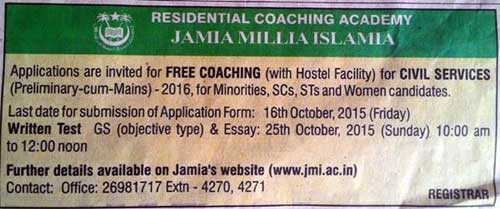
(Revised Schedule) Free Coaching For Civil Services (Pre-cum-main) 2016 By Jamia Millia Islamia

Free Coaching For Civil Services (Pre-cum-main) 2016 By Jamia Millia Islamia

Schedule for Civil Services (Preliminary-cum-Main) - 2016 Coaching Programme

1 Last date for submission of Application Form 16th October, 2015 (Friday)
2 Written Test – GS (objective type) and Essay 25th October, 2015 (Sunday)
10:00.am to 12:00 noon at Jamia Millia Islamia and University of Kashmir, Srinagar
3 Result of written test 12th November, 2015 (Thursday) 04:00 p.m
4 Interview 16-20th November, 2015 (Monday – Friday)
5 Final Result 27th November, 2015 (Friday), 05:00 p.m.
6 Last date for completion of admission 08th December, 2015 (Tuesday)
7 Registration for waiting list candidates 09th December, 2015 (Wednesday)
8 Admission for waiting list candidates 10h December, 2015 (Thursday)
9 Classes (Orientation) 011th January, 2016 (Monday) at 11.30 a.m.

1. Written test would comprise General Studies (objective type) on UPSC model and Essay writing in English/Hindi/Urdu to test candidate’s ability to express themselves in an organised and structured manner. The
total duration of examination would be of two hours.

2. Only those candidates who have already completed their Graduation need to apply.

3. Coaching will include (a) classes on General Studies, CSAT and selected optional papers - History, Public Administration, Geography, Sociology and Urdu, (b) Test series and evaluation shall be carried out by faculty
members of Jamia and professional Faculties (c) Essay writing practice shall form part of the curriculum.

4. The Academy will also conduct Mock Interview for those who qualify the main examination.

5. Test Series (Prelims) will be held during March- May 2016

6. Test Series ( Main) will be held during September-November 2016

7. Library facility is provided (24x7)

8. Scholarship to 20% admitted students @ Rs. 2000/- per month will be provided on mean-cum-merit basis

Gist of The Hindu: October 2015


Gist of The Hindu: October 2015


A pernicious law

The Union government’s contention in the Supreme Court that the provisions in the Indian Penal Code on criminal defamation do not have a chilling effect on free speech will disappoint proponents of fundamental freedoms. The zeal to retain a law that the state can use to stifle criticism is at the heart of the government’s position. It also goes against democratic opinion in many jurisdictions that treats defamation essentially as a civil wrong, and not something to be remedied by the use of the state’s coercive police powers. The United Nations Special Rapporteur on freedom of expression, the Human Rights Committee of the International Covenant on Civil and Political Rights and other international bodies have called upon states to abolish criminal defamation, recognising that it intimidates citizens and dissuades them from exposing wrongdoing. The grounds cited by the Centre now to justify the continuance of Sections 499 and 500 of the IPC, which deal with defamation and prescribe a maximum jail term of two years, are specious: that in India, citizens are unlikely to have enough liquidity to pay damages for civil defamation; that online defamation in the Internet age can be effectively countered only by making it a criminal offence, and that the law is part of the state’s “compelling interest” to protect the dignity and reputation of citizens. What it fails to see is that the main feature of criminal defamation is its potential for harassment. It is a tool that can be easily invoked and that enables allegedly defamed persons to drag anyone to courts across the country.

Criminal defamation has a pernicious effect on society: for instance, the state uses it as a means to coerce the media and political opponents into adopting self-censorship and unwarranted self-restraint; groups or sections claiming to have been hurt or insulted, abuse the process by initiating multiple proceedings in different places; and, more importantly, the protracted process itself is a punishment. Further, magistrates tend to mechanically summon defendants without first assessing whether the allegedly offending content comes within one of the many exceptions to defamation found in the statute. Criminal defamation should not be allowed to be an instrument in the hands of the state, especially when the Code of Criminal Procedure gives public servants an unfair advantage by allowing the state’s prosecutors to stand in for them when they claim to have been defamed by the media or political opponents. Thanks to past verdicts of the Supreme Court, the government and its organs can no more file civil suits seeking damages for defamation, yet the pernicious law of criminal defamation is invoked to stifle free speech. Even as the court deliberates the matter, the government ought to reconsider its stand and come out against the criminal defamation law.

(Exam Paper) UPSC IAS Mains 2013: General Studies Paper- 1

(Exam Paper) UPSC IAS Mains 2013: General Studies

Paper - I

1. Though not very useful from the point of view of a connected political

Pages

Subscribe to RSS - Iasguru's blog