Iasguru's blog

(Download) UPSC Mains 2014 Optional Exam Papers (Sociology Paper - 2)

UPSC

(Download) UPSC Mains 2014 Optional Exam Papers (Sociology Paper - 2)

Subject: Sociology Paper - 2

Exam Date: 19th December 2014

File Size: 1.42 MB

File Type: PDF

(Paper) MPPSC: Online Examination of State Engineering Service (Pre.) Exam - 2014 (1st Paper) - Morning Shift

(Paper) MPPSC: Online Examination of State Engineering Service (Pre.) Exam - 2014 (1st Paper) - Morning Shift


Q1 : In which district is Vindhyachal Thermal Power Station situated :

A Shahdol
B Sohagpur
C Singroli
D Betul

Answer Key: C

Q2 : Airport of which city is named after king Bhoj:

A Bhopal
B Indore
C Gwalior
D Dhar

Answer Key: A

Q3 : In which of the following city of Madhya Pradesh is granite cutting and polishing industry located :

A Jabalpur
B Betul
C Datia
D Singroli

Answer Key: C

Q4 : What kind of forest are the ones that are found in Chhindwara and Balaghat districts :

A sub humid hilly forest
B Tropical dry deciduous forest
C Thorny forest
D Tropical humid deciduous forest

Answer Key: D

Q5 : In which year the High Court of Madhya Pradesh is established :

A 1956 1956
B 1957 1957
C 1958 1958
D 1959 1959

Answer Key: A

Q6 : Which districts are at present the largest and the smallest in population in Madhya Pradesh:

A Indore and Harda
B Indore and Anooppur
C Indore and Burhanpur
D Indore and Agar Malwa

Answer Key: D

Q7 : In which city of Madhya Pradesh Fossil National Park is situated :

A Sidhi
B Balaghat
C Mandla
D Seoni

Answer Key: C

Q8 : In which district of Madhya Pradesh Malanpur Industrial Development centre has been established :

A Guna
B Gwalior
C Bhind
D Satna

Answer Key: C

Q9 : According to 2011 census, which three districts of Madhya Pradesh are the most literate :

A Indore, Bhopal, Gwalior
B Indore, Jabalpur, Gwalior
C Jabalpur, Indore, Bhopal
D ujjain, Indore, Gwalior

Answer Key: C

Q10 : The boundary of which one of the following district of Madhya Pradesh touches both Uttar Pradesh and Chhattishgarh States :

A Rewa
B Singroli
C Sidhi
D Shahdol

Answer Key: B

Q11 : By dividing which district Agar - Malwa district was constituted in the year 2013:

A Shajapur
B Rajgarh
C Ujjain
D Dewas

Answer Key: A

Q12 : What is the name of the place of Madhya Pradesh having least rainfall :

A Sitamau
B Jeerapur
C Morena
D Gohad

Answer Key: D

Q13 : The main district of Madhya Pradesh to produce Asbestos :

A Mandsaur
B Jhabua
C Ratlam
D Khargone

Answer Key: B

Q14 : Vansagar Dam is made On Which river

A Son
B Chambal
C Yamuna
D Ganga

Answer Key: A

Q15 : Where is the 'Agro Complex' of Madhya Pradesh situated :

A Ujjain
B Hoshangabad
C Chhindwara
D Vidisha

Answer Key: C

Q16 : Which is the largest railway junction of Madhya Pradesh :

A Itarsi
B Bhopal
C Indore
D Ratlam

Answer Key: A

Q17 : Where is the insecticide plant of Madhya Pradesh located :

A Bhopal
B Hoshangabad
C Morena
D Bina

Answer Key: D

Q18 : Which has been made the 10th Commissionary of Madhya Pradesh :

A Hoshangabad
B Shahdol
C Rewa
D Indore

Answer Key: A

Q19 : Agargaon is famous for the production of :

A Asbestos
B Tungsten
C Corundum
D Graphite

Answer Key: B

Q20 : Jantar Mantar of Madhya Pradesh is situated in :

A Seoni
B Sanchi
C Vidisha
D Ujjain

Answer Key: D

Q21 : The largest plateau of Madhya Pradesh is :

A Malwa Plateau
B Plateau of Rewa-Panna
C Baghelkhand Plateau
D None of these is correct

Answer Key: A

Q22 : What is the place of Madhya Pradesh in the production of cotton in the country in 2010-11:

A Third
B Fifth
C Seventh
D Fifteenth

Answer Key: B

Q23 What is Narmadapuram : :

A Commissionary
B Dam
C Pilgrimage
D Tourist Place

Answer Key: A

Q24 : How many district are there in Ujjain Commissionary :

A 6
B 7
C 8
D 5

Answer Key: B

Q25 : State Tree of Madhya Pradesh is :

A Mango
B Banyan
C Pipal
D Ashok

Answer Key: B

Q26 : When was Madhya Pradesh state formed :

A 1 November 1957
B 1 November 1956
C 1 November 1955
D 1 November 1958

Answer Key: B

Q27 : Folk drama of Malwa is :

A Turra-Kalangi Dangal
B Mach
C Ras lila
D Gammat

Answer Key: B

Q28 : The name of the district with highest percentage of scheduled caste population is :

A Ujjain
B Sagar
C Datia
D Shajapur

Answer Key: C

Q29 : Annual National Award of Madhya Pradesh government in the field of cinema is :

A Ashok Kumar Award
B Kishor Kumar Award
C Jaya Bachchan Award
D Lata Award

Answer Key: B

Q30 : Workplace of musician Ustad Alauddin Khan is :

A Gwalior
B Maiher
C Omkareshwar
D Chitrakoot

Answer Key: B

Q31 : 'Bhawani Prasad Mishra Puraskar' of Madhya Pradesh Sahitya Parishad is awarded for :

A Novel
B Poetry
C Story
D Criticism

Answer Key: B

Q32 : Mahamratyunjaya fair is organised at which place in Madhya Pradesh :

A Chanderi
B Ujjain
C Rewa
D Chhatarpur

Answer Key: C

Q33 : Folk song sung by young girls without using musical instruments in Malwa region is :

A Bhartari
B Pandwani
C Fag
D Sanja

Answer Key: D

Q34 : Author of 'Kahe Jan Singa' is :

A Ramshankar Gangrade
B amanarain Upadhyay
C SriRam Parihar
D Sukumar Pagare

Answer Key: C

Q35 : Where is central University in Madhya Pradesh situated :

A Ujjain
B Indore
C Bhopal
D Sagar

Answer Key: D

Q36 : Bhopal Gas Tragedy was caused due to the leakage of which gas :

A Ozone
B Carbon Mono oxide
C Methyle Isocynate
D Methane

Answer Key: C

Q37 : In Madhya Pradesh 'Sainik School' is situated in which district :

A Indore
B Rewa
C Jabalpur
D Gwalior

Answer Key: B

Q38 : The river Tapti originates at :

A Amarkantak
B Chitrakoot
C Multai
D Pachmarhi

Answer Key: C

Q39 : Famous administrative building Vallabh Bhavan Bhopal is the name of :

A State Directorate
B State Secretariat
C State Election Commission
D None of these is correct

Answer Key: B

Q40 : Where is the Indian Institute of Forest Management situated :

 A Jabalpur
B Bhopal
C Rewa
D Gwalior

Answer Key: B

Q41 : Budhhist period mara caves are located at :

A Sidhi
B Shivpuri &
C Dhar
D Mandla

Answer Key: A

Q42 : Where are Bhartrihari caves :

A Near Gwalior
B Near Ujjain
C Near Bhopal
D Near Jabalpur

Answer Key: B

Q43 : With which is Saina Nehwal associated :

A Badminton
B Tennis
C Table tennis
D Squash

Answer Key: A

Q44 :Eklavya Puraskar is given to which of the following :

A Best junior players
B Female swimmers
C Best runner
D Male swimmers

Answer Key: A

Q45 : Which writer of Hindi literature was famous as 'Ek Bhartiya Atma':

A Makhan Lal Chaturvedi
B Balkrishna Sharma 'Navin'
C Gajanan Madhav ' Muktibodh'
D Bhawani Prasad Mishra

Answer Key: A

Q46 : Which of the following ancient dynasty is related with Madhya Pradesh :

A Chauhan
B Vardhana
C Parmar
D None of these is correct

Answer Key: C

Q47 : 'Tansen Award' of Madhya Pradesh is awarded for :

A Carnatic Music
B Hindustani Music
C Western Music
D Folk Music

Answer Key: B

Q48 : 'Biosphere Reserve' of Madhya Pradesh is situated at :

A Van Vihar
B Amarkantak
C Pachmarhi
D Omkareshwar

Answer Key: C

Q49 : The fort called as 'Gibraltar of East' is situated at :

A Mandu
B Gwalior
C Maheshwar
D Mandsaur

Answer Key: B

Q50 : 'Bhagoria' is associated with which tribe :

A Bhil
B Sahariya
C Baiga
D Gond

Answer Key: A

Q51 : Find the word that best suits the meaning of the underlined word. Choose from the options given in A,B,C, and D. He relinquished the charge of this post as manager on resigning.

A Undertook
B Quit
C Accepted
D Pursued

Answer Key: B

Q52 : Find the antonym of the underlined word. Although Ramesh is experienced, he is proficient in accounts.

A Adroit
B Competent
C Clumsy
D Ingenious

Answer Key: C

Q53 : Choose the correct from of the verbs given in bracket. He (live) in this house in 2011.

A Has lived
B Had lived
C Lived
D Has been living

Answer Key: C

Q54 : Choose the modal that helps express the intended meaning given in the bracket.
We __________ aim at noble goals. (Desirability)

A Can
B May
C Should
D Must

Answer Key: C

Q55 : __________ I stay here tonight? (Polite request)

A Can
B Could
C Shall
D Will

General Knowledge for IAS Exams (World History: Important Dates)

General Knowledge for IAS Exams (History of India and World)

World History: Important Dates

BC

10000–4000: Development of settlement into cities and development of skills, such as wheel and pottery making and improved methods of cultivation.

5500–3000: Earliest recorded date of Egyptian calender; first phonetic writing appears; Sumerians develop a city-state civilization.

3000–2000: Pharaonic rule begins in Egypt; completion of the construction of the Great Pyramid at Giza.

3000–1500: The most ancient civilization on the Indian subcontinent, the sophisticated and extensive Indus Valley Civilization, flourishes in what is today Pakistan.

900–800: Phoenicians establish Carthage: The Iliad and Odyssey was composed by the Greek poet Homer.

400–300: Pentateuch-first five Books of the Old Testament evolve in final form.

300–251: Invention of Mayan calendar in Yucatan-more exact than older calenders.

101–51: Juleus Caesar (100–44 BC) invades Britain (55 BC) and conquers Gaul, France.

776: First Olympiad in Greece.

753: Rome founded.

490: Battle of Marathon, the Greeks defeated the Iranians/Persians.

327–26: Invasion of India by Alexander, Battle of Hydaspes.

221: Chin-Hung Ti ‘Universal Emperor’ in China, Great Wall of China completed.

55: Invasion of Britain by Julius Caesar, the Great Roman General.

44: Assassination of Julius Caesar by Brutus.

4: Birth of Jesus Christ.

AD

29: Crucifixation of Jesus Christ.

43: Roman conquest of Britain.

570: Birth of Prophet Muhammad at Mecca.

622: Migration of Muhammad from Mecca to Medina (“hijira”), Beginning of Hijira Era (Muhammadan calender) on July 15.

800: Charlemagne crowned Roman Emperor at St. Peter’s.

871: Accession of Alfred the Great to the throne of Britain.

901: Death of King Alfred the Great.

1066: Battle of Hastings; Norman invasion of England. William the Conqueror, Duke of Normandly, defeated the English king Harold II at Hastings.

1215: Magna Carta or the Great Charter signed by King John II at Runnymede in England on June 15.

1280: Gunpowder invented by Roger Bacon.

1338: The Hundred Years War broke out; it lasted upto 1453.

1431: Joan of Arc, a brave French peasant girl, obtained victory over the English at Orleans. She was burnt alive at the stakes.

1443: The Black death i.e., plague broke out in England.

1453: The capture of Constantinople (the home of classical learning) by the Ottoman Turks compelled the Greek scholars to flee to Italy and other West European countries, where they spread the knowledge of Greek philosophy and literature. This was the beginning of Renaissance in Europe.

1486: Bartholomew Diaz rounded the cope of Good Hope.

1492: Columbus sailed on his first expedition to the West Indies which later led to the discovery of America (the New World).

1498: Vasco da Gama, a Portuguese, discovered the seat route to India via the Cape of Good Hope.

1517: Beginning of reformation.

1529–36: Reformation in England under Henry VIII.

1564: Birth of Shakespeare.

1571: Battle of Lapanto; Turks defeated by the Christian League.

1577: Drake, the famous English Admiral; started his voyage round the world for the first time and phindered Spanish ships and ports in South America.

1588 Admiral Drake defeated the Spanish ‘Armada’; England became the ‘Mistress of the Seas’.

1600: Establishment of the British East India Company in India (31st December).

1605: Gunpowder plot in England to blow up the English parliament.

1616: Shakespeare passes away.

1649: Trial and execution of Charles I, beginning of Commonwealth.

1649–60: The Commonwealth and the Protectorate in England.

1660: Restoration of monarchy in England.

1665: The great plague in London.

1679: Habeas Corpus Act.

1688: The Glorious or Bloodless Revolution in England. Despotic rule of the Stuarts ended, and the Parliamentary rule began. Establishment of parliamentary supremacy and abolition of the Divine Rights of Kings.

1704: Battle of Blenheim; Marlborough and Eugene inflicted a crushing defeat on the French army.

1707: Union of England and Scotland.

1763: Treaty of Paris; It ended the Seven Years War (1756–63); weakened France, made England a great colonial power.

1776: Declaration of American Independence and formation of a Federal Republic of 13 states called the Union States of America (July 4).

1783: Treaty of Versailles; England recognised the independence of the United States of America.

1789: George Washington elected First President of USA. Beginning of French Revolution; Fall of the Bastille Fort (July 14).

General Knowledge for IAS Exams (Labour and Trade Union Organisations)

General Knowledge for IAS Exams (History of India and World)

LABOUR AND TRADE UNION ORGANISATIONS:

Organisation Year Founder

Bombay Mill and Millhands Association: (1880): N.M. Lokhanda

Working Men’s Club: (1870): Sasipada Banerji

Printer’s Union: (1905) —

Railway Men’s Union: (1906) —

Kamgar Hitwardhak Sabha: (1909): S.K. Bole

Social Service League: (1911) —

Madras Labour Union: (1918): G.R. Naidu and Chelvapathi

Amalgdmated Society of: (1897) —

Railway Servants of India Ahmedabad Textile Labour Association: (1920): M.K. Gandhi

All India Trade Union Congress (AITUC): (1920): N.M. Joshi and Roy Chaudhary

Bombay Textile Labour Union — N.M. Joshi

All lndia Trade Union Federation: (1929): N.M. Joshi

National Federation of Trade Union — N.M. Joshi

Hindustan Majdoor Sabha: (1938): V.B. Patel, Rajendra Prasad and J.B. Kriplani

Indian Federation of Labour: (1944): N.M. Roy

Indian National Trade Union: (1944): V.B. Patel Congress (INTUC)

(Download) UPSC Mains 2014 Optional Exam Papers (Sociology Paper - 1)

UPSC

(Download) UPSC Mains 2014 Optional Exam Papers (Sociology Paper - 1)

Subject: Sociology Paper - 1

Exam Date: 19th December 2014

File Size: 1.35 MB

File Type: PDF

Gist of The Hindu: November + December 2015


Gist of The Hindu: November + December 2015


Admirable show of restraint

In August 2013, exactly two years ago, 40 experts, comprising the most senior former diplomats, police officials and retired military officers, wrote a letter to the then Prime Minister Manmohan Singh on Pakistan. “The policy of appeasement has failed,” they said at a press conference. “A new bipartisan policy is needed that will impose costs on Pakistan for terrorism,” they added. Their letter urged the Prime Minister to cancel the planned talks with Pakistan Prime Minister Nawaz Sharif on the sidelines of the U.N. General Assembly in September 2013, and to call off dialogue with Pakistan altogether. So, it is ironic that one of the chief signatories to the letter is now the man who will lead the next round of talks with Pakistan, National Security Advisor (NSA) Ajit Doval. In his memoir Kashmir: The Vajpayee Years , former advisor to the Prime Minister on J&K, A.S. Dulat, recounts how in October 2003, Mr. Vajpayee announced that the Centre would talk to the Hurriyat leadership. As the former Intelligence Bureau Chief once posted in Pakistan and later head of Vivekananda Foundation, the right-wing think-tank, Mr. Doval’s tough views are well known. That both Mr. Modi and Mr. Doval have moved from “no talks until terror stops” to “talk about terror” is proof of the inevitability of engagement in any Indian government’s Pakistan policy.

In his new role, Mr. Doval has been protecting the talks from multiple challenges. When Pakistan began mortar shelling just days after the Ufa summit, it was the NSA who picked up the phone and called Pakistan High Commissioner Abdul Basit three times to try and lower tensions. After the Gurdaspur attack, it was the NSA and the PMO that ensured that the narrative pointed to terrorists “from Pakistan” as opposed to terrorists “sent by Pakistan.” Again, after Udhampur, the government sent the same message, with a senior official telling the media: “The Pakistani government’s endorsement is not visible in the Gurdaspur attack.” With every provocation that has followed, from the deadly shelling at the LoC that killed several civilians last week to even the Pakistani High Commissioner’s surprisingly sharp speech on Kashmir on Independence Day — the government has responded with restraint.

There is no question, however, that regardless of all that is on the agenda, it is the LoC that needs attention immediately. Casualties on both sides of the LoC have been rising at an alarming rate, and the ceasefire is practically ‘deceased’. A study by the U.S.-based Stimson Center finds that “that the Kashmir divide has become far more volatile since late 2012.” According to the study, the “rate of ceasefire violations” has more than doubled in 2014-15 over preceding years. The two NSAs would do well to hasten the Ufa agreement on holding a meet of the Director Generals of Military Operations, and perhaps include the MEA and even intelligence officials. On the main issue of terror, there is no question that Mr. Doval will have a stockpile of evidence for Mr. Aziz. However, India must focus on the ongoing 26/11 trial in Pakistan, for two reasons. First, because the trial is under way and represents the hope, however slim, that some of the perpetrators may be brought to justice. Second because it represents a unique case where Pakistani investigators have independently confirmed all that India has said about terror groups inside that country.

Smart Cities: Civil Services Mentor Magazine - November + December - 2015


Smart Cities


There is no universally accepted definition of a smart city. Its meaning changes with places and people. The conceptualisation of Smart City varies from city to city and country to country, depending on the level of development, willingness to change and reform, resources and aspirations of the city residents. Government has recently came up with smart city mission. Mission attempts to make cities a better place to live with better infrastructure and clean habitable conditions. The mission will cover 100 cities with in the period of 2015-2020. The mission may be continued after the said period after the evaluation done by Ministry of Urban development. The focus is on sustainable and inclusive development and the idea is to look at compact areas, create a replicable model which will act like a light house to other aspiring cities.

The core infrastructure elements in a smart city would include:

i. adequate water supply,
ii. assured electricity supply,
iii. sanitation, including solid waste management,
iv. efficient urban mobility and public transport,
v. affordable housing, especially for the poor,
vi. robust IT connectivity and digitalization,
vii. good governance, especially e-Governance and citizen participation,
viii. sustainable environment,
ix. safety and security of citizens, particularly women, children and the elderly,and
x. health and education.

Sustainable Development Goals: Civil Services Mentor Magazine - November + December - 2015


Sustainable Development Goals


Socio economic caste census revealed that out of 24.39 crore households in India, 17.91 crore live in villages. Agriculture is backbone of rural India and in that way majority of India’s population depend upon the agriculture. Socio economic caste census alsoputs a disturbing picture of 10.69 crore deprived households. Agriculture can also help in bringing these deprived households out of deprivation. According to World bank, agriculture raises income of poor households 2.5 times as much as growth in other sectors does. Over the years Indian agriculture sector has faced various challenges like stagnent productivity, declining profitability, insecurity, drought etc.

There are various reasons for the problems which agriculture sector is facing. Real price of agriculture commodities are not increasing in tune with the increasing cost of the inputs in agriculture like fertilizers, labour etc. Indian farmers also face the problem of poor quality seeds. This leads to poor productivity compared to other countries. Indian farm productivity for most commodities is 40-50 percent of the international average. Yield needs to be increased in order to provide food security to large population of India in the future. Other challenges include lack of mechanisation, soil erosion, degrradation in soil, poor harvest losses and inefficient agriculture marketing system. The job potential or employment opportunities and the earnings in the agriculture sector are not high. However, as per 2011 Census, nearly 54.6 per cent of the total workers are still engaged in agricultural activities, mainly in subsistence farming. This is partly due to the manufacturing and industrial sector not generating adequate employment opportunities to absorb the labour force from the agriculture sector and partly due to the lower level of education and skills of the labour force in the agriculture sector which find it difficult to migrate to other sectors.

Over the last year government has taken various steps to solve the problem of agriculture sector. Important among them include:

  • Paramparagat Krishi Vikas Yojana (PKVY);
  • Soil Health Card Scheme;
  • Pradhan Mantri Krishi Sinchayi Yojana (PMKSY) ;
  • National Agricultural Market ;
  • National Mission for Sustainable Agriculture (NMSA);
  • National Crop Insurance Programme (NCIP).

Along with the regular problems associated with agriculture last two years have seen drought across India due to the effects of el-nino. In order to solve the problem of drought this year government has taken various steps. Important among them are given below:

General Knowledge for IAS Exams (Newspapers and Journals of Freedom Struggle)

General Knowledge for IAS Exams (History of India and World)

Newspapers and Journals of Freedom Struggle:

Newspaper/Journals Founder/Editor

Tahzib-ul-Akhlaq: Sir Syyed Ahmed Khan

AI-Hilal: Abul Kalam Azad

AI-Balagh: Abul Kalam Azad

Independent: Motilal Nehru

Punjabi: Lala Lajpat Rai

New India (Daily): Annie Besant

Commonweal: Annie Besant

Pratap: Ganesh Shankar Vidyarthi

Essays in Indian Economics: M.G. Ranade

Samvad Kaumudi (Bengali): Raja Ram Mohan Roy

Mirat-ul-Akhbar: Raja Ram Mohan Roy (first Persian newspaper)

Indian Mirror: Davevendra Nath Tagore

Nav Jeevan: M.K.Gandhi

Young India: M.K.Gandhi

Harijan: M.K.Gandhi

Prabudha Bharat: Swami Vivekananda

Udbodhana: Swami Vivekananda

Indian Socialist: Shyamji Krishna Verma

Talwar (in Berlin): Birendra Nath Chattopadhyaya

Free Hindustan (in Vancouver): Tarak Nath Das

Hindustan Times: K.M Pannikar

Kranti: Mirajkhar , Joglekar , Ghate

Bengal Gazette (1780, India’s J. K. Hikki  First Newspaper): Kesari B. G. Tilak

Amrita Bazar Patrika: Sisir Kumar Ghosh and Motilal Ghosh

Vande Mataram: Aurbindo Ghosh

Yugantar: Barindra Kumar Ghosh

(Paper) MPPSC: Online Examination of State Engineering Service (Pre.) Exam - 2014 Second Paper (Mechanical Engineering)

(Paper) MPPSC: Online Examination of State Engineering Service (Pre.) Exam - 2014 Second Paper (Mechanical Engineering)

Mechanical Engineering
Q1 : A steel rod of 2 m long is heated through a temperature of 1000C . The coefficient of linear expansion is = 6.5 X 10⁻⁶/0C and E= 2 X 10⁶N/cm2. The stress induced in the bar is

A 1000 N/cm2
B 1200 N/cm2
C 1300 N/cm2
D 1400 N/cm2

Answer Key: C

Q2 : The design calculations for members subjected to fluctuating loads with the same factor of safety yield the most conservative estimates when using

A Gerber relation
B Soderberg relation
C Goodman relation
D None of these is correct

Answer Key: B

Q3 : A leaf spring 1 m long carries a central point load of 2000 N. The spring is made up of plates each 5 cm wide and 1 cmthick. The bending stress in the plate is limited to 100 N/mm2. The number of plates required will be

A 3
B 5
C 6
D 8

Answer Key: C

Q4 : The stress due to suddenly applied load as compared to the stress due to the same load gradually applied to the same rod is

A half
B same
C double
D three times

Answer Key: C

Q5 : Choose the wrong statement

A The shear force at any section of a beam is equal to the total sum of the forces acting on the beam on any one side of the section,
B The magnitude of the bending moment at any section of a beam is equal to the vector sum of the moments (about the section) due to the forces acting on the beam on any one side of the section,
C A diagram which shows the values of shear forces at various sections of structured member is called a shear force diagram,
D A simply supported beam is one which is supported on more than two supports.

Answer Key: D

Q6 : Two blocks with masses 'M' and 'm' are in contact with each other and are resting on a horizontal frictionless floor. When horizantal force (F) is applied to the heavier body mass 'M', the blocks accelerate to the right i.e. towards the application force. The force between the two blocks is
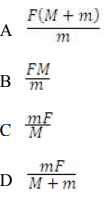
Answer Key: D

Q7 : A thick walled pressure vessel is subjected to an internal pressure of 60 MPa. If the hoop stress on the outer surface is 150 MPa, then the hoop stress on the internal surface is

A 105 MPa
B 180 MPa
C 210 MPa
D 135 MPa

Answer Key: C

Q8 : A Mohr's circle reduces to a point when the body is subjected to

A pure shear
B uniaxial stress only
C equal and opposite axial stresses on two mutually perpendicular planes, the planes being free of shear
D equal axial stresses on two mutually perpendicular planes, the planes being free of shear.

Answer Key: D

Q9 : In a close-coiled helical spring subjected to an axial load and other quantities remaining the same, if the wire diameter is doubled, then the stiffness of the spring when compared to the original one will become

A two times
B four times
C eight times
D sixteen times

Answer Key: D

Q10 : Considering centrifugal tension, the power transmitted by belt drive is maximum at velocity V equal to

Note: - T is total tension on tight side and m is mass per unit length of belt.
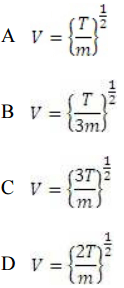
Answer Key: B

Q11 : In a hollow circular shaft of outer and inner diameters of 20 cm and 10 cm respectively, the shear stress is not to exceed 40 N/mm2. The maximum torque which the shaft can safely transmit is

A 58.9 KN-m
B 57.9 KN-m
C 56.9 KN-m
D 58.7 KN-m

Answer Key: A

Q12 : Rope brake dynamometer uses

A oil as lubricant
B water as lubricant
C grease as lubricant
D no lubricant

Answer Key: D

Q13 : Whirling speed of a shaft coincide with the natural frequency of the

A longitudinal vibration
B transverse vibration
C torsional vibration
D none of these is correct

Answer Key: A

Q14 : In slider crank mechanism, the maximum acceleration of slider is obtained when the crank is

A at the inner dead centre position
B at the outer dead centre position
C exactly midway position between the two dead centres
D slightly in advance of the midway position between the two dead centres.

Answer Key: A

Q15 : Tresca theory of failure is applicable for which of the following type of materials ?

A Elastomers
B Plastic
C Ductile
D Brittle

Answer Key: C

Q16 : A solid shaft is to transmit 20 kW at 200 rpm. The ultimate shear stress for the steel may be taken as 360 MPa and a factor of safety as 8. The diameter of solid shaft is

A 45 mm
B 46 mm
C 48 mm
D 50 mm

Answer Key: C

Q17 : A 1.5 m long column has a circular cross-section of 5 cm diameter. One end of the column is fixed and other end is free. Taking factor of safety as 3 and E= 120 GN/m2 , safe load according to Euler's theory is

A 13.00 kN
B 13.27 kN
C 13.47 kN
D 13.87 kN

Answer Key: C

Q18 : An internal gear having 60 teeth is meshing with an external gear having 20 teeth. Module is 6 mm. The centre distance of two gears is

A 120 mm
B 180 mm
C 240 mm
D 300 mm

Answer Key: C

Q19 : In a cam drive, it is essential to off-set the axis of follower to

A decrease the side thrust between the follower and cam surface
B decrease the work between the follower and cam surface
C take care of space limitation
D reduce the cost

Answer Key: C

Q20 : In equilibrium condition, fluids are not able to sustain 

A shear force
B resistance to viscosity
C surface tension
D geometric similitude

Answer Key: C

Q21 : The fluid forces considered in the Navier-Stoke's equation are

A gravity, pressure and viscous
B gravity, pressure and turbulent
C pressure, viscous and turbulent
D gravity, viscous and turbulent

Answer Key: A

Q22 : A Brayton cycle (Air standard) has a pressure ratio of 4 and inlet conditions of one standard atmospheric pressure and 270C. Estimated air flow rate for 100 kW power output (when maximum temperature in the cycle is 10000C, (γ =1.4, and Cp =1.0 kJ/kg.K) will be

A 0.24 kJ/kg
B 0.32 kJ/kg
C 0.36 kJ/kg
D 0.42 kJ/kg

Answer Key: C

Q23 : A turbine develops 8000 kW when running at 100 rpm. The head on the turbine is 36 m. If the head is reduced to 9 m, the power developed by the turbine will be

A 16000 kW
B 4000 kW
C 1414 kW
D 1000 kW

Answer Key: D

Q24 : Efficiency of steam turbine can be improved by 

A reheating of steam
B regenerative feed heating
C binary vapour plants
D all options are correct

Answer Key: D

Q25 : Free convection flow depends on all of the following except

A density
B coefficient of viscosity
C gravitational force
D velocity

Answer Key: D

Q26 : Which of the following cycle has maximum efficiency

A Rankine
B Brayton
C Carnot
D Joule

Answer Key: C

Q27 : The air standard Diesel cycle is less efficient than the Otto cycle for the

A same compression ratio and heat addition
B same pressure and heat addition
C same rpm and cylinder dimension
D same pressure and compression ratio

Answer Key: A

28 : The knock in Diesel engine occurs due to

A instantaneous and rapid burning of the first part of the charge
B instantaneous auto ignition of last part of charge
C delayed burning of the first part of the charge
D reduction of delay period

Answer Key: A

Q29 : Compensating devices are provided in carburators

A to charge the quantity of mixture depending upon load
B to provide always an economy mixture
C to modify the mixture strength depending upon requirements under various operating conditions
D to supply extra fuel during acceleration only

Answer Key: C

Q30 : Which part is not common between the petrol and Diesel engine ?

A air cleaner
B exhaust silencer
C battery
D fuel injector

Answer Key: D

Q31 : Which among the NC operations given below are continuous path operations ? Arc welding (AW), Milling (M), Punching in sheet metal (P), Drilling (D), Laser cutting of sheet metal (LC), Spot welding (SW)

A AW, LC and M
B AW, D, LC and M
C D, LC, P and SW
D D, LC, and SW

Answer Key: B

Q32 : The loss of available energy associated with the transfer of 1000 kJ of heat from a constant temperature system at 600 K to another at 400 K, when the environmental temperature is 300 K is

A 166.67 kJ
B 250.00 kJ
C 500.00 kJ
D 750.00 kJ

Answer Key: A

Q33 : If VN and α are the nozzle exit velocity and nozzle angle in an impulse turbine, the optimum blade velocity is given by

Answer Key: D

Q34 : The entropy of universe tends to

A become zero
B remain constant
C be maximum
D attain a certain finite minimum value

Answer Key: A

Q35 : A counter flow shell and tube heat exchanger is used to heat water with hot exhaust gases. The water (Cp = 4180 J/kg 0C) flows at a rate 2 kg/s while the exhaust gas (Cp = 1030 J/kg 0C) flows at the rate of 5.25 kg/s. If the heat exchanger surface area is 32.5 m2 and the over all heat transfer coefficient is 200 W/m2 0C, what is the NTU for the heat exchanger ?

A 1.2
B 2.4
C 4.5
D 8.6

Answer Key: A

Q36 : A counter flow heat exchanger is used to heat water from 200C to 800C by using hot gas entering at 1400C and leaving at 800C. The log mean temperature difference for the heat exchanger is

A 800C
B 600C
C 1100C
D not determinable

Answer Key: B

Q37 : The axis of movement of a robot may include

A elbow rotation
B wrist rotation
C X-Y coordinate motion
D all options are correct

Answer Key: D

Q38 : Automatic loading and unloading of materials can be accomplished by means of

A power push or pull device
B power roller, belt and chain
C automatic couple and uncouple
D all options are correct

Answer Key: D

Q39 : Steam turbines are classified according to

A direction of flow
B principle of action
C number of cylinder
D arrangement of pressure drop

Answer Key: D

Q40 In nuclear power plants there are three main sources of radioactive contamination of air. Out of three one of the source is :

A step-up transformer
B liquid metal
C fission of nuclei of nuclear fuels
D penstock

Answer Key: C

Q41 : Which of the following is not considered a method of input control in a CAD system ?

A programmable function box
B joystick
C plotter
D touch material

Answer Key: C

Q42 : A transmission shaft subjected to bending loads must be designed on the basis of

A maximum normal stress theory
B maximum shear stress theory
C maximum normal stress and maximum shear stress theory
D fatigue strength

Answer Key: A

Q43 : The flow of fluid through a pipe is laminar, when

A the fluid is ideal
B the fluid is viscous
C the Reynold's number is less than 2000
D the Reynold's number is more than 3000

Answer Key: C

Q44 : The radiation heat transfer rate per unit area in (W/m2) between two plane parallel grey surfaces (emissivity = 0.9) maintained at 400 K and 300 K (given Stefan Boltzmann's constant  σ= 5.67X10⁻⁸ W/m2K) is

A 992
B 812
C 464
D 567

Answer Key: B

Q45 : For forced convection, Nusselt number is a function of

A Prandtl and Grashoff number
B Reynolds and Prandtl number
C Reynolds and Grashoff number
D Reynolds number only

Answer Key: B

Q46 : The essential physical components of FMS is

A potentially independent NC machine tools
B a conveyance network to more parts and sometimes tools between machines and fixturing stations
C an overall control network that coordinates the machine tools, the part-moving elements and the workpieces
D all options are correct

Answer Key: D

Q47 : Refrigerant used in domestic refrigerators is

A ammonia
B air
C SO2
D freon-12

Answer Key: D

Q48 : The comfort conditions in air conditioning are at

A 00C DBT and 0% RH
B 200C DBT and 60% RH
C 300C DBT and 80% RH
D 400C DBT and 90% RH

Answer Key: B

Q49 : The use of refrigerant R-22 for temterature below -300C is not recommended due to its

A good miscibility with lubricating oil
B poor miscibility with lubricating oil
C low evaporating pressure
D high compressor discharge temperature

Answer Key: D

Q50 : Basic law of heat conduction is

A Fourier's law
B Newton's law
C Stefan's law
D First law of thermodynamics

Answer Key: A

Q51 : The size of weld in butt welded joint is equal to

A 0.5 times throat of weld
B Throat of weld
C times throat of weld
D Two times throat of weld

Answer Key: B

Q52 : If two pumps identical in all respects and each capable of delivering a discharge Q against a head H are connected in series, the resulting discharge is

A 2Q against a head 2H
B 2Q against a head H
C Q against a head H
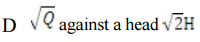
Answer Key: C

Q53 : In interferometric measurement method, the path difference between one bright band and the next is varied by

A Half wavelength
B Two half wavelength
C One quarter wavelength
D Two wavelength

Answer Key: B

Q54 : Wear allowance is provided on

A Go gauge
B Not go gauge
C Both go and not go gauge
D None of these is correct

Answer Key: A

Q55 : In ammonia vapour compression system, the temperature of ammonia after compression will be

A 0o to 40oC
B 40o to 50oC
C 50o to 70oC
D 70o to 110oC

Answer Key: D

(Final Result) UPSC: NDA & NA Examination (I), 2015

(Final Result) UPSC: NDA & NA Examination (I), 2015

1. The following is the list, in order of merit of 331candidates, who have qualified on the basis of the results of the Written Examination held by the Union Public Service Commission on 19th April, 2015 and the subsequent Interviews held by the Services Selection Board, of the Ministry of Defence for admission to the Army, Navy and Air Force wings of National Defence Academy for the 135th Course and Naval Academy for the 97th Indian Naval Academy Course (INAC) commencing from 2nd January 2016. For detailed information regarding the date of commencement of the above courses, please visit the websites of Ministry of Defence i.e., www. joinindianarmy.nic.in.,www.nausena-bharti.nic.in and www.careerairforce.nic.in.

2. The results of Medical Examination have not been taken into account in preparing these lists.

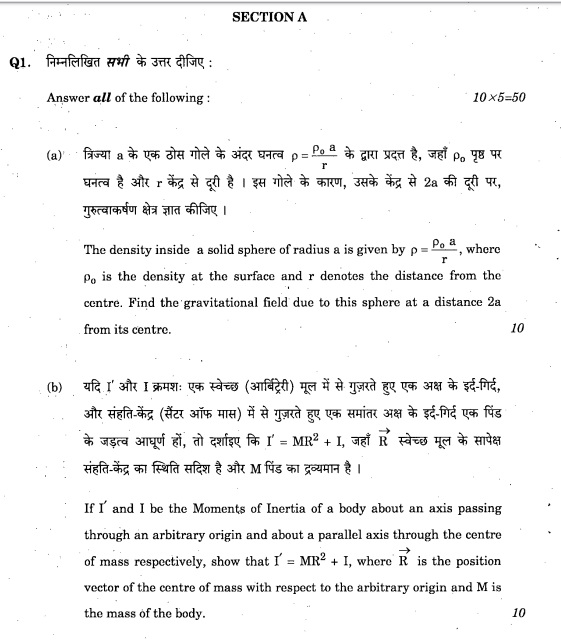
(Download) UPSC Mains 2014 Optional Exam Paper (Physics Paper - 1 & Paper - 2)

UPSC

(Download) UPSC Mains 2014 Optional Exam Papers (Physics Paper - 1 & Paper - 2)

Subject: Physics (Paper - 1 & Paper - 2)

Exam Date: 19th December 2014

File Type: PDF

(Paper) MPPSC: Online Examination of State Engineering Service (Pre.) Exam - 2014 Second Paper (Electrical Engineering)

(Paper) MPPSC: Online Examination of State Engineering Service (Pre.) Exam - 2014 Second Paper (Electrical Engineering )

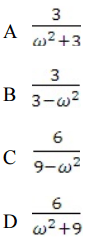
Electrical Engineering 

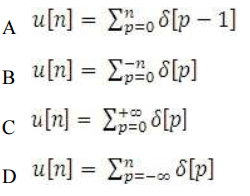
Q1 : The unit step sequence u[n] and impulse response [n] are related as -

Answer Key: D

Q2 : The system given as y(t)=x(t-8) is invertible then inverse system will be as

A y(t+8)
B y(t-8)
C y(2t+8)
D y(t-2)

Answer Key: A

Q3 :

A F(s)
B sF(s)–f(0)
C s2F(s)
D s3F(s)- f(0)

Answer Key: B

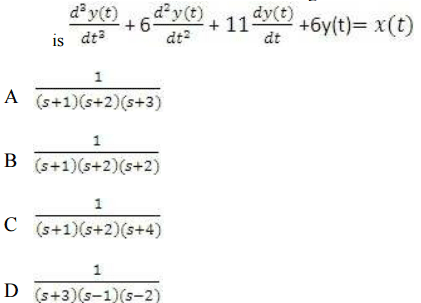
Answer Key: A

Q5 : The discrete-time system denoted by y[n]=x[n3] is

A Linear, time-varying and causal system
B Nonlinear, time-varying and causal system
C Linear, time-invariant and non-causal system
D Linear, time-variant and non-causal system

Answer Key: D

Q6 : If the voltage gain |V0/Vi| of an amplifier is 1/ , its value in dB is -

A +10 dB
B -6.93 dB
C -3 dB
D +3 dB

Answer Key: C

Q7 : The trigonometric Fourier series representation of an even signal does not have the following type of functions

ADC
B Cosine functions
C Sine functions
D Odd harmonic functions

Answer Key: C

Q8 : The impulse response of a linear time invariant system is given by h(t) = (t-2) + (t-3). The step response of this system at t=1 will be -

A 0
B 1
C 2
D 3

Answer Key: A

Q9 : The power spectral density and the autocorrelation function of an periodic signal are related by -

A The Fourier transformation
B The Laplace transformationC Both are same
D None of these is correct

Answer Key: A

Q10 : The power of a sinusoid signal x(t) = A/2 Cos(t) is given by -

A A2/4
B A2/2
C A2
D A2/8

Answer Key: D

Q11 : Assume that F1 and F2 denote the lower and upper half power frequencies of a series RLC circuit respectively and F0 denotes the resonance frequency. The selectivity of this RLC circuit is given by

Answer Key: B

Q12 : If eight resistors of 8 Ohm resistance of each are connected in parallel then the net resistance will be:

A 1
B 64
C 4
D 8

Answer Key: A

Q13 :

A 0,0
B 0,2
C 5,0
D 0,5

Answer Key: B

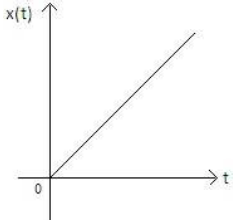
Q14 : The plot of the signal x(t) in the below figure represents:

A Energy signal
B Power signal
C Energy signal and Power signal
D None of these is correct

Answer Key: D

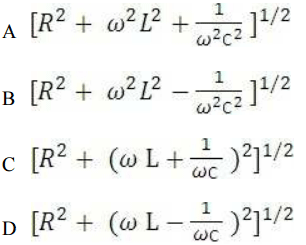
Q15 : Following is the magnitude of the impedance of the series RLC circuit running at angular frequency :

Answer Key: D

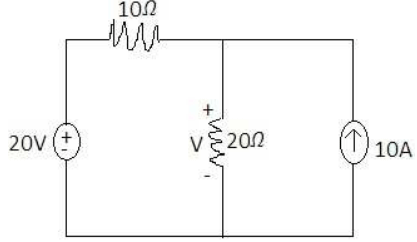
Q16 : In the given circuit in the below Figure, the value of V will be as follows:

A 80
B 70
C 20
D 10

Answer Key: A

Q17 : The superposition principle can not be applied for:

A voltage computation
B current computation
C power computation
D bilateral components

Answer Key: C

Q18 : If unit step current is applied to an initially relaxed capacitor, then the voltage across the capacitor will be- A Unit step function

B Ramp function
C Impulse function
D None of these is correct

Answer Key: B

Q19 : The mathematical expression for the velocity for travelling electromagnetic wave in free-space can be given as:

Answer Key: D

Q20 : The energy density corresponding to static magnetic field is as

Answer Key: B

Q21 : The SI unit of electrostatic field strength is

A volt-meter
B volt2
/meter
C volt/meter
D volt/meter2

Answer Key: C

Q22 : The equation is

A Maxwell’s equation
B Laplace’s equation
C Fourier equation
D Poisson’s equation

Answer Key: D

Q23 : Poynting vector represents:

A power density vector which produces electrostatic field
B current density vector which produces electrostatic field
C current density vector which produces electromagnetic field
D power density vector which produces electromagnetic field

Answer Key: D

Q24  The distance between adjacent maxima and minima in a standing wave of a transmission line is given by

/4
B /2
C /8
D

Answer Key: A

Q25 : The intrinsic impedance of free space is given by:

A 20 Ohm
B 277 Ohm
C 177 Ohm
D 377 Ohm

Answer Key: D

Q26 : The divergence of electric flux density at origin is

A 2
B 4
C -2
D 0

Answer Key: A

Q27 : The input signal for the A.C. bridges is applied from

A Oscillator system
B Amplifier system
C Regulated power supply system
D D.C. battery system

Answer Key: A

Q28 : The internal resistance of the ammeter should be very low so that

A It will have high sensitivity
B It will provide high accuracy
C It will provide maximum voltage drop across the meter
D It will provide minimum effect of the current in the circuit

Answer Key: D

Q29 : The Wien bridge can be used for the following

A Measurement of resistance
B Measurement of frequency
C Measurement of harmonic distortion
D Measurement of frequency and harmonic distortion

Answer Key: D

Q30 : The application of thermocouple transducer is

A Measurement of temperature B Measurement of velocity and vibration
C Measurement of pressure
D Measurement of gas flow

Answer Key: A

Q31 : A varactor can be defined as

A A diode which is used for variable capacitor
B A diode which is used for high speed switching
C A diode which is used for variable inductor
D A diode which is used for variable resistor

Answer Key: A

Q32 : Measurement of dielectric loss of capacitor can be performed by

A Using Wein bridge
B Using Owen bridge
C Using Schering bridge
D Using Maxwell bridge

Answer Key: C

Q33 : Siemens can be used as a unit for

A Measurement of conductance
B Measurement of resistance
C Measurement of flux density
D Measurement of electric field

Answer Key: A

Q34 : A cathode ray oscilloscope works based on the following -

A Electrostatic based focusing technique
B Electromagnetic based focusing technique
C Electrostatic and Electromagnetic based focusing technique
D None of these is correct

Answer Key: A

Q35 : Regenerative feedback means the following

A Feedback with step input
B Feedback with oscillations
C Feedback with positive sign
D Feedback with negative sign

Answer Key: C

Q36 : Laplace transform is not useful for analysis of the following control systems

A Linear systems
B Discrete- time systems
C Time- invariant systems
D Unstable continuous –time systems

Answer Key: B

Q37 : The transfer function of the following state model of an LTI system with zero initial condition is

Answer Key: A

Q38 : The time period of a square ware of frequency 1kHz is

A1 s
B 10 s
C 10-3 s
D 0.1 s

Answer Key: C

Q39 : If the state space representation of an LTI system is known then the transfer function of this system

A Can be partially determined
B Can be completely determined
C Cannot be completely determined
D None of these is correct

Answer Key: B

Q40 : What number of nybbles can make one byte

A1
B 2
C 4
D 8

Answer Key: B

Q41 : In a microprocessor, the data bus has 16 lines and address bus has 12 lines. What will be the number of bytes in the memory

A 4k
B 2k
C 8k
D 24k

Answer Key: A

Q42 : In Intel 8085 microprocessor, the address bus is 16 bit wide. The memory which can be accessed by this address bus will be

A 64 k bytes
B 2 k bytes
C 8 k bytes
D 12 k bytes

Answer Key: A

Q43 : The following memory is a permanent memory

A ROM
B RAM
C ROM AND RAM
D None of these is correct

Answer Key: A

Q44 : The assumption of ergodic process in communication system means -

A The random signals have identical time averages
B The random signals have identical ensemble averages
C The random signals have the identical time and ensemble averages
D None of these is correct

Answer Key: C

Q45 : The power spectral density of the stationary noise whose autocorrelation is R( )=e-3 | | , will be

Answer Key: D

Q46 : Entropy commonly measures :\

A The average informtion
B The rate of information
C The probability of information
D The loss of information

Answer Key: A

Q47 : The autocorrelation function of a signal at zero -lag will be :

A Mean value of signal
B Average power of signal
C Average voltage of signal
D Zero

Answer Key: B

Q48 : In DSB-SC system, at the receiver the detection process is expensive because :

A It requires synchronous detection
B Generation of local carrier is difficult at the receiver
C Power level of received signal is very low
D All options are correct

Answer Key: A

Q49 : In a PCM system, the signal to quantization error ratio for 8-bit words will be :

A 54 dB
B 30 dB
C 40 dB
D 64 dB

Answer Key: A

Q50 : Companding operation is useful because :

A It overcomes quantization noise in PCM
B It protects small signals in PCM from quantizing noise
C It reduces impulse noise in PWM receivers
D None of these is correct

Answer Key: B

Q51 : Which of the following pulse modulation technique is analog:

A Differential PCM
B PCM
C PWM
D Delta

Answer Key: C

Q52 : Frequency shift keying can be considered as a method for introducing:

A Frequency modulation
B Amplitude modulation
C Phase modulation
D None of these is correct

Answer Key: A

Q53 : In a first order passive low-pass fifteen (R-C) circuit, the input voltage square wave is fed. The output voltage, with respect to ground, is measured across :

A Supply
B Resister
C Capacitor
D Ground

Answer Key: C

General Knowledge for IAS Exams (Books of Freedom Struggle)

General Knowledge for IAS Exams (History of India and World)

Books of Freedom Struggle:

Work Author

Causes of the Indian Mutiny: Sir Syyed Ahmed Khan

Ghulam Giri: Jyotiba Phule

To all fighters of freedom, Why Socialism: J.P. Narayan

Pakhtoon: Khan Abdul Ghaffar Khan

Problems of the East: Lord Curzon

My Indian Years: Lord Hardinge II

Economic History of India: R.C. Dutt

Pather Panchali: Bibhuti Bhushan Banerjee

Precepts of Jesus: Raja Ram Mohan Roy

A Gift of Monotheists: Raja Ram Mohan Roy

Satyarth Prakash: Swami Dayanand Saraswati

Anand Math: Bankim C. Chatterjee

Devi Chaudharani: Bankim C. Chatterjee

Sitaram: Bankim C. Chatterjee

The Indian Struggle: S.C. Bose

Poverty & Un-British Rule in India: Dadabhai Naoroji

The Spirit of Islam: Syyed Ameer Ali

A Nation in the Making: S.N. Banerjee

Unhappy India: Lala Lajpat Rai

The Indian War of Independence: V. D. Savarkar

India Divided: Rajendra Prasad

The Discovery of India: Jawahar Lal Nehru

Neel Darpan: Dinbandhu Mitra

Hind Swaraj: M.K. Gandhi

General Knowledge for IAS Exams (Important Congress Session)

General Knowledge for IAS Exams (History of India and World)

Important Congress Session:

Year Place Importance

1885 Bombay At Gokuldas Tejpal Sanskrit College, 72 delegates attended the session.

1886 Calcutta 436 delegates attended the session.

1887 Madras Tayabji became first Muslim President.

1888 Allahabad George Yule became first English President.

1889 Bombay Congress represented all areas of British India.

1890 Calcutta Decision taken to organises session of congsess in London.

1895 Poona Demand of a representative body only for educated class.

1898 Madras Social reform was set as the main goal.

1907 Surat Congress split.

1908 Madras Constitution for the Congress fromed.

1916 Lucknow Congress merged. Pact with Muslim League, Gandhi attended

1917 Calcutta Annie Besant became 1st women President.

1920 Nagpur Gandhian programme was adopted. Change in congress constitution.

1921 Ahmedabad Harsat Mohani demanded for complete independence.

1922 Gaya Formation of Swaraj Party.

1923 Delhi Abul Kalam Azad became President (Youngest President) (sp. session)

1924 Belgaum Gandhi became President (Gandhi became President here first and last time).

1925 Kanpur Sarojini Naidu became 1st Indian women President.

1927 Madras Nehru and S.C. Bose moved resolution for independence and it was passed for the 1st time.

1928 Calcutta First All India Youth Congress.

1929 Lahore ‘Poorna Swaraj’ (Complete Independence) resolution and pledge for Independence day on 26 January 1930.

1931 Karachi Resolution for Fundamental Rights and National Economic Policy.

1934 Bombay Formation of Congress Socialist Party.

1936 Lucknow Support for socialism through democracy.

1937 Faizpur Demand for Constituent Assembly (First session in a village).

1938 Haripura Purna Swaraj was to cover also princely states.

1939 Tripuri S.C. Bose resigned due to difference with Gandhi. Dr. Rajendra Prasad was appointed in his place.

1940 Ramgarh Abul Kalam Azad became President.

1946. Meerut J. B. Kriplani became President.

1948 Jaipur Dr. Pattabhi Sitaramayya became President.

(Paper) MPPSC: Online Examination of State Engineering Service (Pre.) Exam - 2014 Second Paper (Civil Engineering )

(Paper) MPPSC: Online Examination of State Engineering Service (Pre.) Exam - 2014 Second Paper (Civil Engineering )


Q1 : Which of the following is not the displacement method?

A Equilibrium method
B Column analogy method
C Moment distribution method
D Kani’s method

Answer Key: B

Q2 : When a uniformly distributed load, shorter than the span of the girder, moves from left to right, then the conditions for maximum bending moment at a section is that

A The head of the load reaches the section.
B The tail of the load reaches the section.
C The load position should be such that the section divides it equally on both side.
D The load position should be such that the section divides the load in the same ratio as it divides the span

Answer Key: D

Q3 : In column analogy method, the area of an analogous column for a fixed beam of span L and flexural rigidity EI is taken as

A L/EI
B L/2EI
C L/4EI
D L/8EI

Answer Key: A

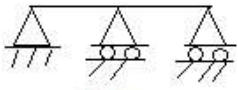
Q4 :

What is the degree of kinematic indeterminacy of the beam shown in fig.1 above

A 2
B 3
C 5
D 9

Answer Key: C

Q5 : A fixed beam AB is subjected to a triangular load varying from zero at end A to W per unit length at end B. the ratio of fix end moments at A to B will be

A 1/2
B 2/3
C 4/9
D 1/4

Answer Key: B

Q6 : A symmetrical two-hinged parabolic arch when subjected to a uniformly distributed load on the entire horizontal span, is ubject to

A Radial shear alone
B Normal thrust alone
C Normal thrust and bending moment
D Normal thrust, radial shear and bending moment

Answer Key: B

7 : A three hinged symmetric parabolic arch of span 20 meters and rise 5 meters is hinged at the crown and springing. It upports a uniformly distributed load of 2 tonnes per meter run of the span. The horizontal thrust in tonnes at each of the springing is

A 8
B 16
C 20
D Zero

Answer Key: C

Q8 : A simply supported beam of length L is subject to two point loads, each of P unit, at A and B equidistant from supports. Select the correct statement

A There will be no shear force between A and B and no bending moment between A and B.
B There will be no shear force between A and B, but there will be uniform bending moment between A and B.
C There will be uniform shear force between A and B, but bending moment will gradually increase to maximum up to mid point of A and B.
D There will be uniform shear force between A and B, with maximum bending moment at A and B with gradual decrease to zero at mid point of A and B.

Answer Key: B

Q9 : In an I-section, shear force is shared

A Mostly by web
B Mostly by flanges
C Uniformly by entire section
D Proportional to the respective areas of web and flanges.

Answer Key: A

Q10 : A member which is subjected to reversible tensile or compressive stresses may fail at stresses may fail at stresses lower than the ultimate stresses of the material. This property of metal is called

A Plasticity of the metal
B Workability of the metal
C Fatigue of the metal
D Creep of the metal

Answer Key: C

Q11 : If all the dimensions of a prismatic bar are increases in the proportion n:1, the proportion with which the maximum stress produced in the bar by its own weight will change by

A 1:n2
B 1:n
C :1
D n:1

Answer Key: D

Q12 : In limit state design, under – reinforced section is one in which

A Tensile strain in steel reaches yield value while maximum compressive strain in concrete is less than its ultimate crushing strain.
B Maximum tensile stress in steel reaches its permissible value while maximum compressive stress in concrete is less than its permissible value.
C Maximum compressive strain in concrete reaches the ultimate crushing value while tensile strain in steel is less than its yield value.
D Maximum compressive stress in concrete reaches its permissible value while tensile stress in steel is less than its permissible value.

Answer Key: A

Q13 : In reinforced concrete, pedestal is defined as a compression member, whose effective length does not exceed its least lateral dimension by

A 3 times
B 8 times
C 12 times
D 16 times

Answer Key: A

Q14 : For RCC bridges, the smallest span beyond which the impact factor is same for class A or B or AA and 70R loading (wheeled vehicles) is

A 9 m
B 12m
C 36 m
D 45 m

Answer Key: B

Q15 : The purpose of lateral ties in short RCC column is to

A Increase the load carrying capacity of the columns
B Facilitate compaction of concrete
C Maintain plumb while construction
D Avoid buckling of longitudinal bars

Answer Key: D

Q16 : The side face reinforcement, if required, in a T-beam will be

A 0.1% of the web area
B 0.15% of the web area
C 0.2% to 0.3% of the web area depending upon the breadth of the web
D 0.1% of the total longitudinal reinforcement

Answer Key: A

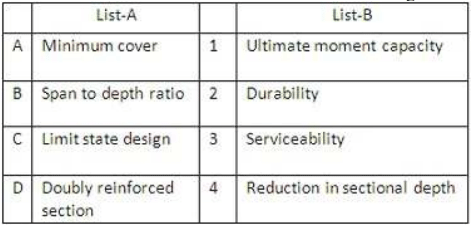
Q17 : Match list A with list B and select the correct answer using the codes given below the list.

A
.
B

C

D


Answer Key: D

Q18 : The loss of prestress due to shrinkage of concrete is the product of

A Modular ratio and percentage of steel
B Modulus of elasticity of concrete and shrinkage of concrete
C Modulus of elasticity of steel and shrinkage of concrete
D Modular ratio and modulus of elasticity of steel.

Answer Key: C

Q19 : Prestressed concrete is more desirable in case of

A Cylindrical pipes subjected to internal fluid pressure
B Cylindrical pipes subjected to external fluid pressure
C Cylindrical pipes subjected to equal internal and external fluid pressures
D Cylindrical pipes subjected to end pressures

Answer Key: A

Q20 : The applicable IS code for RCC liquid retaining structure is

A IS:456
B IS:800
C IS:1893
D IS:3370

Answer Key: D

Q21 : Drops in flat slabs are provided to resist

A Bending moment
B Thrust
C Shear
D torsion

Answer Key: C

Q22 : Increase in the fineness of cement results in

A Increase in the rate of heat of hydration without changing the total amount of heat liberated
B Decrease in the rate of heat of hydration without changing the total amount of heat liberated
C Increase in the rate of heat of hydration with an increase in the total amount of heat liberated
D Decrease in the rate of heat of hydration with a reduced amount of heat liberated

Answer Key: A

Q23 : As per IS:800, the maximum deflection in a beam should not exceed

A L/180
B L/250
C L/325
D L/360

Answer Key: C

Q24 : By providing sufficient edge distance, which of the following failures of riveted joint can be avoided

A Tension failure of the plate
B Shear failure of the rivet
C Shear failure of the plate
D Crushing failure of the rivet

Answer Key: C

Q25 : Gantry girders are designed to resist

A Lateral loads
B Longitudinal and vertical loads
C Longitudinal, lateral and vertical loads
D Longitudinal and lateral loads

Answer Key: C

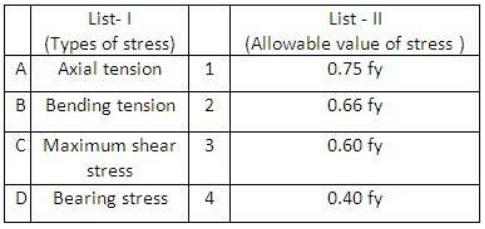
Q26 : Match list I with list II and select correct answer using the loads given below the list 


(fy=minimum field stress of steel)

A

B

C

D

Answer Key: BQ27

Q27: For an I beam the shape factor is 1.12 the factor of safety in bending is 1.5. IF the allowable stress is increased by 20% for the wind and earthquake loads, then the load factor is

A 1.10
B 1.25
C 1.35
D 1.40

Answer Key: D

Q28 : The channels or angles in the compression chords of the steel truss girder bridges are turned outward in order to increase

A Cross-sectional area
B Sectional modulus
C Torsional constant
D Radius of gyration

Answer Key: D

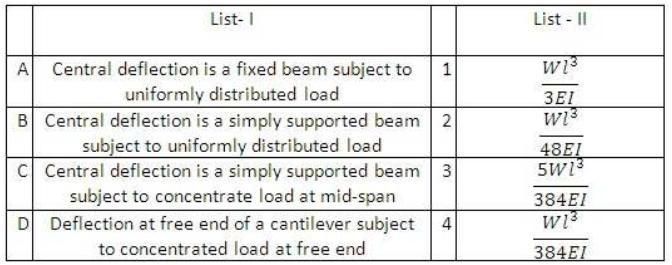
Q29 : Match list I (deflection) with list II (expression) for deflection in different types of beams of span ‘l’ subjected to total load ’w’ and select the correct answer using the loads given below the lists:

A

B

C

D

Answer Key: D

Q30 : In a composite construction

A Interface slipping is prevented by using shear connector
B Differential shrinkage is overcome by using the same grade of concrete for both the components.
C Precast member is always designed to carry the weight of in-situ concrete without props.
D The in-situ concrete cannot be prestressed.

Answer Key: A

Q31 : For a standard 45o fillet weld, the ratio of size of fillet to throat thickness is

A 1:1
B 1:
C :1
D 2:1

Answer Key: C

Q32 : In PERT analysis, the time estimates of activities and probability of their occurrence follow

A Normal distribution curve
B Poisson’s distribution curve
C – distribution curve
D Binomial distribution curve

Answer Key: C

Q33 : If the optimistic time, most likely time and pessimistic time or activity A are 4, 6 and 8 weeks. Respectively and for activity B are 5, 5.5 and 9 weeks respectively, then

A Expected time of activity A is greater than the expected time of activity B
B Expected time of activity B is greater than the expected time of activity A
C Expected time of both activities A and B are same
D Data too inadequate to compute expected times of activities

Answer Key: C

Q34 : The reduction in project time normally results in

A Decrease in the direct cost and increase in the indirect cost
B Increase in the direct cost and decrease in the indirect cost
C Increase in both direct and indirect costs
D Decrease in both direct and indirect costs

Answer Key: B

Q35 : Mobilisation advance up to certain percentage of cost of work is given to a contractor

A On commencement of work at site for payment of loan taken by him
B For the purchase of construction materials
C For the payment of advances to labour and other staff
D For all activities required to start the work at site on finalization of the contract documents

Answer Key: D

Q36 : Cost – benefit studies are essential to 

A Assess the total cost of the work
B Ascertain the relevant escalation in price
C Monitor the expenditure
D Evaluate the viability and worthwhileness of taking up the project

Answer Key: D

Q37 : If the expected time for completion of a project is 10 days with a standard deviation of 2 days, the anticipated time of completion of the project with 99.9% probability is

A 16 days
B 12 days
C 10 days
D 6 days

Answer Key: A

Q38 : With the usual notations, capital recovery factor is given by

A

B

C

D


Answer Key: A

Q39 : A burst event is represented by

A

B

C

D

Answer Key: B

Q40 : Which of the following is not the function of fastner?

A To hold rails in proper positions
B To join rail with sleepers
C To join adjacent rails
D To join sleeper with ballast

Answer Key: D

Q41 : Geometric design of highway includes (i) Horizontal alignment, (ii) vertical alignment, (iii) arbouri-culture, (iv) Cross section.

Choose the right combination.

A (i), (ii) and (iii)
B (i), (ii) and (iv)
C (ii), (iii) and (iv)
D (i), (ii), (iii) and (iv)

Answer Key: B

Q42 : On a circular curve, the rate of super elevation is ‘e’ while negotiating the curve, vehicle comes a stop. It was observed that the stopped vehicle is sliding inwards in radial direction. If the coefficient of friction is ‘f’ which of the following is true?

A e > f
B e < f
C e < 2f
D None of these is correct

Answer Key: A

Q43 : Three runways are constructed parallel to each other at an angle of 260o with respect to magnetic north. A pilot is landing from east side while heading west. Which of the following best represents runway designations as seen by pilot (from leftmost to rightmost)

A 26L, 26C, 26R
B 26R, 26C, 26L
C 8L, 8C, 8R
D 8R, 8C, 8L

Answer Key: A

Q44 : Stripping of asphalt pavement is primarily due to

A Excessive asphalt content in mixture
B Moisture damage
C Fatigue damage
D Use of less tougher aggregate

Answer Key: B

Q45 : Dowel bars in concrete pavement are placed

A Along 45o to direction of traffic
B Perpendicular to direction of traffic
C Along direction of traffic
D Can be placed in any direction

Answer Key: C

Q46 : The number of potential conflict points at an intersection of two lane national highway with another two-lane national highway (assuming both are two-way) is

A 8
B 16
C 24
D 32

Answer Key: C

Q47 : The ruling design speed on a national highway in plain terrain as per IRC recommendation is

(Paper) MPPSC: Online Examination of State Engineering Service (Pre.) Exam - 2014 Second Paper (Agricultural Engineering)

(Paper) MPPSC: Online Examination of State Engineering Service (Pre.) Exam - 2014 Second Paper (Agricultural Engineering)


Q1 : Geologic erosion is also called as

ANormal erosion
B Natural erosion
C Chemical erosion
D None of these is correct

Answer Key: A

Q2 : Source of Soil detachment in splash erosion is -

A Run off
B Rain drop
C Soil particle size
D None of these is correct

Answer Key: B

Q3 : The hygrometer measures

ATemperature
B Isotherms
C Isohyets
D Contours

Answer Key: A

Q4 : The lines joining the places having equal rainfall are called

AIsobaths
B Isotherms
C Isohyets
D contours

Answer Key: C

5 : The life of reservoir is decided based upon

A Run off volume only
B Sediment concentration of runoff volume only
C Both (Run off volume only & Sediment concentration of runoff volume only)
D None of these is correct

Answer Key: B

Q6 : The furrow irrigation in which furrows are constructed with a little slope on contour is called

A Contour furrow irrigation
B Flat-planted basin
C Wild flooding
D Sloping furrow irrigation

Answer Key: A

Q7 : The average annual rainfall of India is

A 120 cm
B 150 cm
C 180 cm
D 210 cm

Answer Key: A

Q8 : The following watershed gives highest peak discharge for the same area

AFern shaped
B Fan shaped
C Square shaped
D None of these is correct

Answer Key: B

Q9 : The ratio of crop evaportranspiration and reference evaportransperation is called

ACrop coefficient
B Pan factor
C Crop factor
D Stress factor

Answer Key: A

Q10:The lysimeter measures -

A Humidity
B Temperature
C Evapotranspiration
D Wind velocity

Answer Key: C

Q11 :The surveying is basically conducted for preparing a

A Map
B Cross section
C Sketch
D Drawing

Answer Key: A

Q12 :Sprinkler irrigation system performance is considered satisfactory when the minimum value of the uniformity coefficient

A 65 percentage
B 75 percentage
C 85 percentage
D 95 percentage

Answer Key: C

Q13 : Centrifugal pumps discharge the water from the suction head of-

A 5 to 6m
B 10 to 15m
C 15 to 20m
D 20 to 25m

Answer Key: A

Q14:The following is considered as agronomic measures for soil and water conservation

ATerracing
B Bunding
C Contour Cropping
D Trenching

Answer Key: C

Q15: The following is not the in-situ water harvesting practice

A Contour Bunding
B Farm ponds
C Nala Plugging
D Drop Inlet structure

Answer Key: D

Q16: The length of a chain is measured from

A Center of one handle to centre of other handle
B Outside of one handle to inside of other
C Outside of one handle to outside of other handle
D Inside of one handle to inside of other

Answer Key: C

Q17: A network of gully is called as-

A Gullied area
B Ravine area
C Hilly area
D None of these is correct

Answer Key: B

Q18: A Cross staff is an instrument used for

A Setting our right angles
B Measuring approximate horizontal angles
C Measuring bearings of the lines
D None of these is correct

Answer Key: A

Q19 : The grassed water way is used to

ACarry irrigation water
B Safe disposal of excess runoff
C Grow quality grasses
D None of these is correct

Answer Key: B

Q20 : An imaginary line joining the points of equal elevation on the surface of the earth represents the

A Contour line
B Contour surface
C Contour gradient
D Level line

Answer Key: A

Q21:SCS curve number method is used for estimation of

A Runoff
B Rainfall amount
C Rainfall intensity
D Cumulative infiltration

Answer Key: A

Q22 : The accuracy of measurement in chain surveying does not depend upon

A Length of the offset
B General layout of the chain lines
C Scale of the plotting
D Importance of the features

Answer Key: B

Q23 :Satellite data contains

A Colour
B Symbology
C Patterns
D Digital numbers

Answer Key: D

Q24 : Remote sensing techniques can not be employed for the purpose of

A Improving natural resource management
B Land use
C Protection of environment
D To identify the gender of the population

Answer Key: D

Q25 : The method of plane surveying can be used when the extent of area is less than

A 250 sq. km
B 500 sq. km
C 2500 sq. km
D 5000 sq. km

Answer Key: A

Q26 : Doubling the diameter of screen in the tube well the increase in discharge is about

A 0-5%
B 5-10%
C 10-15%
D 15-20%

Answer Key: B

Q27 : The curvature of the earth is considered in

A Plane surveying
B Geodetic surveying
C Hydrographic survey
D Aerial survey

Answer Key: B

Q28 : The alignments of the canals are generally taken along

A The ridge line
B Across the contour line
C Valley line
D None of these is correct

Answer Key: A

Q29 : Engineering measures to control the soil erosion is

A Vegetative barrier
B Inter cropping
C Contour and graded bunding
D None of these is correct

Answer Key: C

Q30 : In drip Irrigation design, the design criteria is based on an emitter flow variation of -

A 5%
B 10%
C 15%
D 20%

Answer Key: B

Q31: Darcy law is valid when flow is

A Turbulent
B Transient
C Laminar
D Quasi steady

Answer Key: C

32 : The discharge rates of drip emitters usually ranges from

A 2-10 litres/day
B 2-10 litres/hr
C 2-10 litres/min
D 2-10 litres/sec.

Answer Key: B

Q33 : Almost all natural ground water motion has Reynolds number

A Less than 1
B 1 – 10
C 10 – 500
D More than 500

Answer Key: A

Q34 : Which crop can withstand the highest water table

A Wheat
B Lucerne
C Rice
D Cotton

Answer Key: C

Q35 : For given values of top width and water depth of water surface in a channel, in which section seepage will be maximum

A Triangular
B Rectangular
C Trapezoidal
D None of these is correct

Answer Key: B

Q36 : Leaching is the process to reduce the salts from

A Deep aquifer
B Water course
C Root zone
D Canal

Answer Key: C

Q37 : Drip irrigation system performance is considered satisfactory when the minimum value of the uniformity coefficient is

A 5%
B 75%
C 85%
D 95%

Answer Key: D

Q38 : lkaline soils are best reclaimed by

A Leaching
B Addition of gypsum to soil
C Providing good drainage
D Addition of gypsum to soil and leaching

Answer Key: D

Q39 : Soil moisture content

A Decreases with soil moisture tension
B Increases with soil moisture tension
C Does not change with soil moisture tension
D None of these is correct

Answer Key: A

Q40 : Drainage coefficient is the depth of water drained from the area in -

A 06 hours
B 12 hours
C 24 hours
D 72 hours

Answer Key: C

Q41 : The detachability of which of the following soil is the lowest

A Clay
B Silt
C Sand
D Sandy loam

Answer Key: A

Q42 : The Transportability of which of the following soil is the lowest

A Clay
B Silt
C Sand
D Sandy loam

Answer Key: C

Q43 : The 2 hour unit hydrograph is having 50 hours base period. To derive constant discharge in the S- curve, following numbers of 2 hour unit hydrograph has to be added by respective lagging -

A 48
B 52
C 25
D 50

Answer Key: C

Q44 : For the stream gauging following instrument can be useful -

A Pan evaporimeter
B Current meter
C Sediment load sampler
D None of these is correct

Answer Key: B

45 : Graded terrace is recommended in -

A High rainfall area
B Steep hills
C Low rainfall area
D Soil having high permeability

Answer Key: A

46 : Wind erosion is most common in-

A Humid region
B Semi arid region
C Arid region
D None of these is correct

Answer Key: C

Q47 : Silvi pasture system involves -

A Growing trees only
B Growing trees and grasses
C Growing grasses only
D None of these is correct

Answer Key: B

Q48 : Salinity in irrigation water is measured by

A SAR value
B Electrical conductivity value
C pH value
D None of these is correct

Answer Key: B

Q 49 : Which one of the following is supplemental structure for drainage system

A Pump outlet
B Lateral drain
C Water course
D vertical drainage

Answer Key: A

Q50 : Mole drains are used in -

A Sub Surface drainage
B Surface drainage
C Sub Surface drainage and Surface drainage
D None of these is correct

Answer Key: A

Q51 : Firing sequence of 6 cylinder engine in which no two adjacent cylinder have power stroke -

A 1-2-3-4-5-6
B 1-5-3-6-2-4
C 1-5-4-6-3-2
D 1-4-2-5-6-3

Answer Key: B

Q52 : Implement used to break hard pan of soil is -

A M.B. Plough
B Disc Harrow
C Rotavator
D Subsoiler

Answer Key: D

Q53 : When piston is at the top of its stroke, it is said to be -

A TDC
B TLC
C BDC
D BLC

Answer Key: A

Q54 : Compression ratio of diesel engine varies from -

A 13:1 to 28:1
B 12:1 to 24:1
C 14:1 to 22:1
D 10:1 to 15:1

Answer Key: C

Pages

Subscribe to RSS - Iasguru's blog