Iasguru's blog

UPSC Mains General Studies Solved Paper (2014) - "Paper-4 : Technology, Economic Development, Bio diversity, Environment, Security and Disaster Management"


UPSC Mains General Studies Solved Paper (2014) - "Paper-4 : Technology, Economic Development, Bio diversity, Environment, Security and Disaster Management"


Q1. Normally countries shift from agriculture to industry and then later to services, but India shifted directly from agriculture to services. What are the reasons for the huge growth of services vis-a-vis industry in the country? Can India become a developed country without a strong industrial base?

Answer.

The reasons behind India shifting directly from agriculture to services sector have roots in several domestic and external factors.

(1) Industrial growth in India has been slower due to inadequate infrastructure, Licence Raj, red taprism, lack of competition, lack of capital and dependence of India on other countries for its energy needs.
(2) On the other hand services sector grew on account of growth in sectors like IT sector in wake of liberalization of Indian economy in 1990s. India became a top IT services outsourcing destination.
(3) People from agriculture did not shift to industries because of lack of jobs in the sector. Rather they shifted to unorganized and informal services sector.

It will be very difficult for India to become a developed country without a strong industrial base because:-

(1) The surplus labour in agriculture cannot be absorbed by services sector. Service sector is less labour intensive. Only a strong industrial base can create a large number of jobs thereby absorbing surplus labour force from agriculture.
(2) Absence of a strong industrial base will make India dependent on other countries for its needs. It will increase import bill as well as current account deficit leading to imbalance in India's trade.
(3) There will be supply side constraints in absence of a strong industrial base leading to high inflation.

Thus a strong industrial sector is imperative for India to become a developed country.

Q2. "While we flaunt India's demographic dividend, we ignore the dropping rates of employability." What are we missing while doing so? Where will the jobs that India desperately needs come from? Explain. (for Answer Join Online Coaching for IAS Mains Exam)

Q3. There is also a point of view that Agricultural Produce Market Committees (APMCs) set up under the State Acts have not only impeded the development of agriculture but also have been the cause of food inflation in India. Critically examine. (for Answer Join Online Coaching for IAS Mains Exam)

Q4. "In the villages itself no form of credit organization will be suitable except the cooperative society."- All India Rural Credit Survey.
Discuss this statement in the background of agricultural finance in India. What constraints and challenges do financial institutions supplying agricultural finance face? How can technology be used to better reach and serve rural clients? (for Answer Join Online Coaching for IAS Mains Exam)

Q5. The Right to Fair Compensation and Transparency in Land Acquisition, Rehabilitation and Resettlement Act, 2013 has come into effect from 1st January, 2014. What are the key issues which would get addressed with the Act in place? What implications would it have on industrialization and agriculture in India?

Answer.

The Right to Fair Compensation and Transparency in Land Acquisition, Rehabilitation and Resettlement Act, 2013 has replaced the archaic Land Acquisition Act of 1894. The new Act will address several issues which are as follows:-

(1) Unlike the old Act, the new Act will provide for rehabilitation and resettlement of people displaced by land acquisition.
(2) Earlier there was no requirement for prior consent. The new Act makes it necessary to obtain consent of 80% land owners required for private projects and 70% land owners required for Public-Private Partnership Projects.
(3) The compensation issue has been resolved by increasing the compensation value.
(4) The earlier Act did not take into account the impact of land acquisition on different sections of society. This issue has been addressed by introducing social impact assessment prior to land acquisition.
(5) There is restriction on land acquisition of irrigated multi-cropped land. It addresses the issue of shrinking agricultural land.
(6) Special safeguards for tribal communities is expected to solve the issue of tribal displacement.

Impact on Industrialization and agriculture

(1) The requirement of a social impact assessment for every acquisition can delay the completion of industrial projects.
(2) High rates of compensation can make industries and infrastructure projects economically unviable.
(3) Consent clause may also delay infrastructure projects that are required for industrialization.
(4) There is restriction on acquisition of irrigated multi-crop land. This will have positive effect on agriculture.
(5) The Act provides that when acquiring agricultural land, the state has to cultivate an equivalent area of land elsewhere as agriculture land. This provision will also undermine the adverse impact of land acquisition on agriculture.
(6) The delay in infrastructure projects needed for agriculture sector may affect the agriculture adversely.

(Final Result) UPSC: Combined Defence Services Examination (I), 2015

(Final Result) UPSC: Combined Defence Services Examination (I), 2015

1. The following are the lists, in order of merit of 190 candidates who have qualified on the basis of the results of the Combined Defence Services Examination (I)-2015 conducted by the Union Public Service Commission in February, 2015 and SSB interviews held by the Services Selection Board of the Ministry of Defence for admission to the 140th Course of Indian Military Academy, Dehradun; Indian Naval Academy, Ezhimala, Kerala and Air Force Academy, Hyderabad (Pre-Flying) Training Course i.e. 199/ 16F/PC.

2. There are some common candidates in the three lists for various courses.

3. The number of vacancies, as intimated by the Government is 200 for Indian Military Academy [including 25 vacancies reserved for NCC ‘C’ Certificate (Army Wing) holders], 45 for Indian Naval Academy, Ezhimala, Kerala -[ General Service] including 06 vacancies reserved for NCC ‘C’ Certificate holders](Naval Wing) and 32 for Air Force Academy, Hyderabad.

4. The Commission had recommended 4787, 2921 and 595 as qualified in the written test for admission to the Indian Military Academy/ Indian Naval Academy and Air Force Academy respectively. The number of candidates finally qualified are those after SSB test conducted by Army Head Quarters.

Formation of Indian Skill Development Service


Formation of Indian Skill Development Service


The Union Government has approved formation of "Indian Skill Development Service". This Service will be shortly notified after proper consultation with the UPSC and other concerned Departments.

This information was given by the Minister of State for Personnel, Public Grievances and Pensions and Minister of State in the PMO Dr. Jitendra Singh in a written reply to a question by Shri T.Rathinavel in the Upper House.

General Knowledge for IAS Exams (Jurisdiction and Seat of High Courts)

General Knowledge for IAS Exams (Indian Polity and Governance)

JURISDICTION AND SEAT OF HIGH COURTS

India has unified judiciary system and S.C. is at the apex. It is the final interpretor of the constitution. The Supreme Court of India consists of 31 Judges (including the Chief Justice of India). The judges hold office until they attain the age of 65 years. The Supreme Court of India has original jurisdiction in any dispute arising:

(a) between the Government of India and one or more States or
(b) between the Government of India and any State or States on the one side and one or more states on the other or
(c) between two or more States.

There are 21 High Courts in the country, three having jurisdiction over more than one State. Among the Union Territories, Delhi alone has a High Court of its own. Each High Court, comprises a Chief Justice and such other Judges as the President may, from time of time appoint. The Chief justice of a High Court is appointed by the President in consultation with the Chief Justice of India and the Governor of the State. They hold office upto 62 years of age. To be eligible for appointment as a judge, one must be a citizen of India and should have held a judicial office in India for 10 years or must have practiced as an advocate of a High Court or two or more such courts in succession for a similar period.

Jurisdiction and Seat of High Courts

  • Originally known as Assam High Court, renamed as Guwahati High Court in 1971.
  • Originally known as Mysore High Court, renamed as Karnataka High Court in 1973.
  • Originally known as Punjab High Court, renamed as Punjab and Haryana High Court in 1966

General Knowledge for IAS Exams (Union, State and Concurrent List)

General Knowledge for IAS Exams (Indian Polity and Governance)

UNION, STATE AND CONCURRENT LIST

Union List (List-I)

1. Defence of India
2. Naval, military and air forces; any other armed forces of the Union
2A. Deployment of any armed force of the Union in any state in aid of the civil power
3. Cantonment areas and local self-govermment in such areas
4. Naval, military and air force works
5. Arms, firearms, ammunition, and explosives
6. Atomic energy and mineral resources necessary for its production
7. Defence Industries
8. Central Bureau of intelligence and investigation
9. Preventive detention for reasons connected with defence, foreign affairs, or the security of India
10. Foreign affairs
11. Diplomatic, consular and trade representation
12. United Nations Organisation
13. International conferences, associations and other bodies
14. Treaties, agreements and conventions with foreign countries
15. War and peace
16. Foreign jurisdiction
17. Citizenship, naturalisation and aliens
18. Extradition
19. Passports and visas
20. Pilgrimages to places outside India
21. Piracies and crimes committed on the high seas or in the air and offences against the law of nations.
22. Railways
23. National highways
24. Shipping and navigation on national waterways
25. Maritime shipping and navigation
26. Lighthouses for the safety of shipping and aircraft
27. Major ports
28. Port quarantine, seaman and marine hospitals
29. Airways; aircraft and air navigation; provision of aerodromes
30. Carriage of passengers and goods by railway, sea, air or national waterways
31. Posts and telegraphs; telephones, wireless, broadcasting and other like forms of communication
32. Property of the Union
33. Courts of wards for the estates of rulers of Indian states
34. Public debt of the Union
35. Currency, coinage and legal tender; foreign exchange
36. Foreign loans
37. Reserve Bank of India
38. Post office savings bank
39. Lotteries organised by the Union or state
40. Trade and commerce with foreign countries
41. Inter-state trade and commerce
42. Trading corporations, including banking, insurance and financial corporations but not including co-operative societies
43. Corporations, whether trading or not, with objects not confined to one state
44. Banking
45. Bills of exhange, cheques, promissory notes and other like instruments
46. Insurance
47. Stock exchange and futures markets
48. Patents, inventions and designs; copyright; trade-marks and merchandise marks
49. Establishment of standards of weight and measure
50. Establishment of standards of quality for goods to be exported out of India or transported from one state to another
51. Industries, the control of which by the public interest
52. Oil fields and mineral oil resources; petroleum and petroleum products; other liquids and substances which are inflammable
53. Regulation of mines and mineral development in the public interest
54. Regulation of labour and safety in mines and oil fields
55. Regulation of development of inter-state rivers and river valleys
56. Fishing and fisheries beyond territorial waters
57. Manufacture, supply and distribution of salt by Union and other agencies
58. Cultivation and manufacture of opium and its export
59. Sanctioning of cinematograph films for exhibition
60. Industrial disputes concerning Union employees
61. National Library, the Indian Museum, the Imperial War Museum, the Victoria Memorial and the Indian War Memorial, and any other like institution of national importance
62. Banaras Hindu University, the Aligarh Muslim University and the Delhi University, any other instutution of national importance
63. Scientific or technical education institutions of national importance
64. Union agencies and institutions for training research or detection of crime
65. Standards in institutions for higher education or research and scientific and technical institutions
66. Ancient and historical monuments and records, and archaeological sites and remains of national importance
67. The Survey of India, the geological, botanical, zoological and anthropological surveys of India, meteorological organisations
68. Census
69. Union Public Services; All-India Services; Union Public Service Commission
70. Union Pensions
71. Elections to Parliament, the legislatures of states and the offices of President and Vice-President; the Election Commission
72. Salaries and allowances of members and presiding officers of parliament
73. Powers, privileges and immunities of each House of Parliament and of the members and the committees of each House
74. Emoluments and service conditions of the president, governors, the ministers for the Union and the Comptroller and Auditor General
75. Audit of the accounts of the Union and of the states
76. Organisation, jurisdiction and powers of the Supreme Court
77. Organisation of the high courts
78. Extension of the jurisdiction of a high court to any union territory
79. Extension of the powers and jurisdiction of members of a police force belonging to any state to any area outside that state
80. Inter-state migration; inter state quarantine
81. Taxes on income other than agricultural income
82. Duties of customs including export duties
83. Duties of excise on tobacco and other goods except alcoholic liquours for human consumption and opium, indian hamp and other narcotic drugs and narcotics, but including medicinal and toilet preparations containing alcohol
84. Corporation tax
85. Taxes on the capital value of the assets (exclusive of agricultural land) of individuals and companies; taxes on the capital of companies
86. Estate duty in respect of property other than agricultural land
87. Duties in respect of succession to property other than agricultural land
88. Terminal taxes on goods or passengers, carried by railway, sea or air; taxes on railway fares and freights

The Gist of Yojana: November + December 2015


The Gist of Yojana: November + December 2015


MSMEs in the Inclusive Growth Agenda: A Perspective

The concept of ‘inclusive growth’ is an add-on in the global debate on “growth vs distribution”. The consensus of the late- 20th century, and early 21st century is that, rather than ‘growth’ and ‘distribution’ being treated separately, there needs to be an approach where the two aspects meet each other. Thus comes the discussion on the so -called ‘inclusive growth’. While the global consensus and the level of polemics has settled down on the above lines, the practice among countries tell a different story. Depending upon the particular situation of countries, the theory, practice and common understandings of ‘inclusive growth’ vary.

The concern with the role of micro, small and medium enterprises (MSMEs) in India has significant political and social overtones. It began with the ‘Freedom Struggle’ in the country, wherein, the role of self reliant political units of administration and a decentralised economy that is based on local resources, business opportunities, and markets was articulated. In the model developed by economist Mahalanobis, the small enterprise sector in India was “ visualised as an engine of growth; but playing a subsidiary role to tile ‘core sectors of the economy, Though. the perception on ‘inclusive growth! Was there, from the days’ of the second Five Year Plan; the word was coined much later.

lrrespective of the rates, growth and diversification have significantly taken place in the Indian economy over the past several decades. While growth is a hard core economist’s concern, it is the challenge of policy to ensure that the fruits of growth are made felt to the majority of the people. It is in this context that social cushions are needed. Traditionally, this essentially social role has been visualised in the context of the MSMEs.

While, traditionally, this social role was perceived to be performed through an automatic route, the situation has changed drastically in the recent past. While the economy changes structurally, there are likely to be leaders and laggards in such a change. Strategy becomes all the more important in a discussion on inclusiveness. India’s strategy of MSME development has broadly undergone three generations of strategies: First, there was the traditional strategy of protection and reservation. This was followed by a strategy which was closer to a rights- based approach. Thirdly, and more recently, the country follows a capabilities approach. Under this approach, it is assumed that, given proper capabilities, the country can take its MSME sector into the mainstream of the development agenda.

The more recent policy announcement of the Government of India provides indication on this. On one hand, there are the flag-ship programmes that are meant for meeting the objectives of national policy. On the other hand, as a corollary, there is a focus on skilling and entrepreneurship creation. The synergy of these two aspects is capable of ensuring that the creativity and energies of the people of this country, are channelized into productive and socially meaningful activities.

The new public policy approach in India which distinguishes between ‘government’ and ‘governance’, has much significance against the debates on the policy process in the country.

Studies have shown that, public policy-making in India has frequently been characterized by a failure to anticipate needs, impacts, or reactions which could have reasonably been foreseen, thus impeding economic development.

According to Agarwal and Somanathan (2005), a “good policy-making process” would meet the following criteria:-

(i) The problems and issues confronting a sector are subjected to expert analysis;
(ii) Information on overlaps and trade-offs with other sectors is systematically gathered and made available to policy-makers;
(iii) Opposing points of view within and between sectors , are properly articulated, analyzed and considered and those likely to be benefited or harmed are identified and their reactions anticipated.
(iv) Those responsible for implementation are systematically involved in the process, but are not allowed to take control of it.
(v) Policy-makers and/or their advisers have the honesty, independence, intellectual breadth and depth to properly consider and integrate multiple perspectives and help arrive at optimal policy choices within a reasonable time.

The record of MSME development initiatives in the country over the last 6 years demonstrates the presence of varied programmes, targeting functional areas, subsectors and social groups. However, there is a general perception that the benefits of the programmes did not actually reach the intended beneficiaries in the manner and time they were envisage.

While there has been an accepted model of start-up promotion around the world today, India, with its significant demographic dividend, needs to give top priority on harnessing the motivational skills of the young people, than equipping them as wage earners. As indicated by the Union Budget and the Economic Survey, a beginning has been made in this direction by putting forward an integrated approach to start-up.

Thrust on Local Manufacture

India’s backlash on the manufacturing front ,over the last two decades, has caught significant policy attention. The National Manufacturing Competitiveness Programme (NMCP) and the National Manufacturing Policy were a response to that. However, an assertion on positioning the country as the world’s manufacturing hub, with clear milestones, is a remarkable development.

A New Understanding on Skill Development

Even against the major initiatives on technical and vocational education, the Indian economy suffers from a serious skill-gap. However, the dimensions of the problem have not been holistically understood and translated into policy interventions. Until recently, the policy approach was essentially one of strengthening vocational education one of strengthening vocational education infrastructure, and to provide add-ons to it.

A major departure from the above approach was introduced by the Union Budget 2014. The Budget has an integrated view of skill development. Beyond modular skills, it unravelled an integrated approach by which modular and motivational skills are harnessed side by side. The flagship programme, ‘Skill India’, if properly organised, can go a long way in triggering a vigorous start-up movement in the country.

Selected Articles from Various News Paper: Civil Services Mentor Magazine - November + December 2015


Selected Articles from Various Newspapers & Journals


A last chance for Syria

In early August, the Foreign Ministers of Iran (Mohammad Javad Zarif) and Syria (Walid Muallem) and Russia’s Deputy Foreign Minister (Mikhail Bogdanov) met in Tehran to discuss the Syrian war. The Iranians, now emboldened by the nuclear deal, presented a plan for a solution to the fratricidal Syrian war. Iran’s plan has four steps: 1. Forge an immediate cease-fire; 2. Create a national unity government; 3. Rewrite Syria’s Constitution with a more expansive inclusion of minorities; 4. Hold national elections under international supervision. These points are not new. The call for a ceasefire has been on the agenda since 2011, and the other steps have been discussed in the United Nations and in various regional gatherings over the past four years. What is novel is that the proposal comes from Iran, with Russian and Syrian backing. The idea of a national unity government implies that President Bashar al-Assad would not have to withdraw from politics. But it does suggest that Damascus has softened in its view that President Assad must be allowed to serve out his new term in office.

Western capitals should look at this proposal as an olive branch. This proposal does not roll out a complete path toward peace, but it does open the door to negotiations. Other Western approaches toward Syria have failed. The most recent attempt to create a moderate rebel force to take on both the Islamic State (IS) and the Assad government collapsed. The al-Qaeda affiliated Jabhat al-Nusra easily trounced Western-trained Division 30, seizing its arms and killing many of its fighters. That Western intelligence believed that Division 30 and its predecessors could hold their own on the dangerous battlefields of Syria, shows how out-of-touch they have become. The U.S. has now decided not to spend the $500 million it had allocated for the creation of a new rebel army. Western diplomatic attempts to isolate Damascus have also not borne fruit. Confounded by the resilience of IS, even Saudi Arabia has opened discussion with the Assad government — Syrian intelligence chief Ali Mamlouk visited the kingdom in early August to discuss, among other things, the new proposals for a ceasefire. Saudi intelligence cables released by Wikileaks show the kingdom obsessed with Iranian power. But the fear of IS remains greater than their paranoia over Iran. This has come as a surprise to the West, which assumed that Saudi Arabia would be the least liable to alter its Syria strategy.

The IS remains in control of its swathe of territory across northern Iraq and Syria. Neither the Western air strikes nor the Iraqi military advances have been able to break through and clear IS from its major urban centres. Along the spinal cord of western Syria, the main advances are being made by al-Qaeda backed insurgents, such as Jabhat al-Nusra, Ahrar al-Sham and Jund al-Aqsa. Western strategy to contain and defeat the growth of IS and al-Qaeda in Syria has utterly failed. Matters are so poor that Washington’s military and intelligence community has now taken to debate which is more of a threat — IS or al-Qaeda.

Amendments to the Arbitration and Conciliation Bill, 2015: Civil Services Mentor Magazine - November + December - 2015


Amendments to the Arbitration and Conciliation Bill, 2015


The amendments to this Bill are based on the Law Commission’s recommendations and suggestions received from stakeholders. Law Commission of India (LCI) in its 246th Report had recommended various amendments in Arbitration and Conciliation Act, 1996 in order to pave way for India to become a hub of International Commercial Arbitration.

Law commision observed in its 246th report that the Act the enacted withanaim to consolidate and amend the law relating to domestic arbitration and international commercial arbitration. Statement of objects andreasons in the Arbitration and conciliation bill, 1995 are as follows.

  • Comprehensively coverr inrternational commercial arbitration and domestic arbitration;
  • Minimise the supervisory role of courts in the arbitral process;
  • ensure that final arbitral award is enforced in the same manner as the decree of court.

Aggrevied party from the arbitration decision has the power to go to court under the section 34 of the act. Law commission believes that the power given under this section to the courts should not be excessively used otherwise it undermines the whole process of arbitration. Award from arbitration should be set aside only in the following cases.

  • if it is against the fundamental policy of India;
  • against the justice and morality;
  • if the award is illegal, illegality should not be mere a technical illegality;

In light of this government has come up with the changes to the Arbitration and conciliation act. The salient features of the amendments are as under:

(i) In order to ensure neutrality of arbitrators, it is proposed to amend Section 12 to the effect that when a person is approached in connection with possible appointment of arbitrator, he shall disclose in writing about existence of any relationship or interest of any kind, which is likely to give rise to justifiable doubts. Further, if a person is having specified relationship, he shall be ineligible to be appointed as an arbitrator.

(ii) Insertion of a new provision that the Arbitral Tribunal shall make its award within a period of 12 months. Parties may extend such period up to six months. Thereafter, it can only be extended by the Court, on sufficient cause. The Court while extending the period may also order reduction of fees of arbitrator(s) not exceeding five percent for each month of delay, if the court finds that the proceedings have been delayed for reasons attributable to the arbitral tribunal. If the award is made within a period of six months, arbitrator may get additional fees if the parties may agree.

(BREAKING NEWS) UPSC aspirants appeared in between 2012-14 need not be given an additional chance


(BREAKING NEWS) CS aspirants appeared in between 2012-14 need not be given an additional chance


The UPSC aspirants who took the civil services examination in the last three years (2012-14) need not be given an additional chance this year, the Centre has decided.

"After analysing all facts, it has been decided that these candidates do not deserve to be given additional chance to appear in civil services examination", an order issued by Department of Personnel and Training (DoPT) said.

The move comes following a directive by Central Administrative Tribunal (CAT) to the Department of Personnel and Training (DoPT) to examine whether candidates who were eligible to take civil services examination 2011, or had taken 2012, 2013 or 2014 examination should be given another chance to take 2015 test with changed pattern.

The Union Public Service Commission (UPSC) conducts the prestigious examination annually to select IAS, IFS and IPS officers, among others, in three stages--preliminary (having two papers), main and interview.

UPSC Mains General Studies Solved Paper (2014) - "Paper-2: Indian Heritage, History and Geography"


UPSC Mains General Studies Solved Paper (2014) - "Paper-2: Indian Heritage, History and Geography"


Q1. To what extent has the urban planning and culture of the Indus Valley Civilization provided inputs to the present day urbanization?

Answer.

Following features of urban planning and culture of Indus valley civilization (IVC) can be considered as inputs to the present day urbanization:

(1) IVC had a well developed town planning characterized by grid system of roads, use of burnt-bricks well developed drainage system. These features are also important components of present day urban centres.
(2) Like present day urban centres, IVC laid emphasis on sanitation and hygiene.
(3) Economic activities include trade with other civilization like Mesopotamia in IVC similar to modern cities where trade and commerce play an important role.
(4) Economic and social inequality in IVC as evidenced by structures like citadel can be compared with economic stratification in modern cities evidenced by high rise buildings on one side and slums on the other side.
(5) Use of granaries in IVC is akin to present day godowns and warehouses in cities.
(6) There were well developed urban centres in IVC but most people still depended on agriculture. This is similar to modern day urbanization where fast paced urbanization has not reduced dependence on agriculture in similar proportion.
(7) Findings like jewelries and dancing girl statue point out that people in IVC were fond of fashion and entertainment similar to present day cities and towns.

While the above features of IVC are still important in present day urban centres, these centres are dissimilar to IVC with respect to their diversity of economic activities, sophisticated governance system, developed transport mechanism, use of electricity and machines, connectivity with outside world etc.

Q2. Gandhara sculpture owed as much to the Romans as to the Greeks. Explain.

Answer.

Gandhara school of art and sculpture developed during the reigns of Kushanas. It is also known as Indo-Greek or Indo-Roman art because of its influences from Roman and Greek cultures. The sculptures built under this school of art are mainly related to Buddha.

Greek influence on Gandhara sculpture

(1) Buddha is depicted as Greek Sun God Apollo in many sculptures.
(2) Graceful face, wavy hair, beard and moustache, large forehead and large ears are some of the Greek features of Gandhara sculpture.
(3) Some examples of Gandhara art depict both Buddha and Greek God Hercules.
(4) Stucco plaster, which was commonly used in Greek art, was widely used in Gandhara artwork.

UPSC Mains General Studies Solved Paper (2014) - "Paper-3 : Governance, Constitution, Polity, Social Justice and International relations"


UPSC Mains General Studies Solved Paper (2014) - "Paper-3 : Governance, Constitution, Polity, Social Justice and International relations"


Q1. Starting from inventing the 'basic structure' doctrine, the judiciary has played a highly proactive role in ensuring that India develops into a thriving democracy. In light of the statement, evaluate the role played by judicial activism in achieving the ideals of democracy. (for Answer Join Online Coaching for IAS Mains Exam)

Q2. Though the federal principle is dominant in our Constitution and that principle is one of its basic features, but it is equally true that federalism under the Indian Constitution leans in favor of a strong Centre, a feature that militates against the concept of strong federalism. Discuss. (for Answer Join Online Coaching for IAS Mains Exam)

Q.3. The 'Powers, Privileges and Immunities of Parliament and its Members' as envisaged in Article 105 of the Constitution leave room for a large number of un-codified and un-enumerated privileges to continue. Assess the reasons for the absence of legal codification of the 'parliamentary privileges'. How can this problem be addressed?

Answer.

The Indian Constitution provides for the privileges and rights of the Member of Parliaments in Article 105. However, most of these rights and privileges have not been codified and enumerated legally. The reasons for the absence of legal codification of these rights and privileges are:

(1) For an effective functioning of democracy, it is essential that the people's representatives are given the maximum amount of freedom of speech and expression, so as to communicate the opinion and demands of the various sections of the society.
(2) To protect the "separation of powers" as envisaged in the constitution between judiciary and the legislature. In case the privileges are codified then such codification would invite undue judicial interference.
However, absence of codification has led to misuse of many of these rights and privileges leading to hateful speeches, derogating remarks, unnecessary stalling of the houses, etc.

This problem can be addressed by one or more of the following initiatives:-

(1) The chairperson of the house can be obliged to submit a report to the president about sanctions that should be put against members.
(2) An independent body can be formed to scrutinize the proceedings of the house on regular basis and submit a report before the president.
(3) Appropriate provisions can be made to empower the president to take independent action against the unruly members.
(4) More visitors from among common people can be allowed. It will lead to public scrutiny of behavior of the members in the house.

4. What do you understand by the concept "freedom of speech and expression"? Does it cover hate speech also? Why do the films in India stand on a slightly different plane from other forms of expression? Discuss. (for Answer Join Online Coaching for IAS Mains Exam)

Q.5. Instances of President's delay in commuting death sentences has come under public debate as denial of justice. Should there be a time limit specified for the President to accept/reject such petitions? Analyse.

Answer.

Article 72 of the Indian Constitution empower the President to pardon, suspend remit or commute the sentence of any person convicted of any offence including the case of death sentence. However, in many cases there is inordinate delay in commuting death sentence. Such delays raise several important issues.

It is said that justice delayed is justice denied. So, delay in death commutation is considered as denial of justice by many. Even in Shatrughan Chauhan v. Union of India case, the Supreme Court held that inordinate delay in deciding a petition of a convict sentenced to death by the president can be considered torture and inhuman punishment to the convict.

The court also held that a convict sentenced to death has a constitutional right to petition the president for relief against his sentence and the consideration of his petition is not an act of grace or mercy by the president but a necessary relief provided by the Constitution.

Such delays not only deprive a convict of his constitutional rights but also create adverse physical conditions and psychological stresses on him and his family.

Considering the high status of the office of the president, stipulating any time limit for disposing the mercy petitions will not be a good idea. However, there should not be any inexplicable delay while considering the mercy petitions.

6. The size of the cabinet should be as big a governmental work justifies and as big as the Prime Minister can manage as a team. How far the efficacy of a government then is inversely related to the size of the cabinet? Discuss. (for Answer Join Online Coaching for IAS Mains Exam)

7. Though 100 percent FDI is already allowed in non-news media like a trade publication and general entertainment channel, the Government is mulling over the proposal for increased FDI in news media for quite some time. What difference would an increase in FDI make? Critically evaluate the pros and cons. (for Answer Join Online Coaching for IAS Mains Exam)

Q.8. The setting up of a Rail Tariff Authority to regulate fares will subject the cash strapped Indian Railways to demand subsidy for obligation to operate non-profitable routes and services. Taking into account the experience in the power sector, discuss if the proposed reform is expected to benefit the consumers, the Indian Railways or the private container operators.

Answer.

Rail Tariff Authority has been formed as an independent body to advise the government on fixing of freight and passenger fares.

At present, Indian Railways face chronic financial crunch. The annual rate of increase in cost has overtaken that of revenues during the last few years. This is because of several factors important among which are cross-subsidization over the years and not raising fares due to populist reasons. In this context rationalization of fares has become imperative.

Setting up a Rail Tariff Authority to regulate fares is expected to lead on era of rationalization of fares and freight structures for improving the fare-freight ratio and gradually bringing down cross subsidization between different segments.

Similar problems in power sector were solved with such an approach. The power distribution companies were incurring heavy losses due to low rates which were not being revised upwards due to populist reasons. Setting up of Electricity Regulating Commission aimed of rationalizing rate solved the financial problem to a considerable extent.

The proposed reform will, to some extent, burden the consumers financially, but financially sound Indian Railways will be able to provide them a much better service. It will also lead to reduction in rails for freight leading to increase in freight as preferred mode of transport. Finally, it will go a long way towards improving the financial health of the national transporter.

9. National Human Rights Commission (NHRC) in India can be most effective when its tasks are adequately supported by other mechanisms that ensure the accountability of a government. In light of the above observation assess the role of NHRC as an effective complement to the judiciary and other institutions in promoting and protecting human rights standards. (for Answer Join Online Coaching for IAS Mains Exam)

Q.10. The penetration of Self Help Groups (SHGs) in rural areas in promoting participation in development programmes is facing socio-cultural hurdles. Examine.

Answer.

The mushrooming of SHGs in the countryside is fast changing the development landscape. They are fast becoming a catalyst of inclusive development. But these SHGs face several challenges including socio-cultural ones. These challenges are as follows.

(1) Male domination:- Traditional role of women has been related to domestic works. Now, their participation in economic activities outside home is being challenged by patriarchal values and gender discrimination.
(2) Lack of social mobility:- Division of society into castes has become a hurdle in functioning of SHGs as teams.
(3) Lack of motivation from family members:- Family members generally do not allow women to be part of any activity outside home. In many places, this women working outside is related, with lower social status
(4) Backlash from dominant and affluent section of society:- SHGs generally bring about empowerment of people from under privileged section of society. So, they are facing backlash from dominant and affluent section of society.
(5) Lack of cooperation:- Lack of cooperation among members due to suspicious and mistrust is another major concern.

Training programmes and management skills, if provided can solve many of these problems.

Q.11. Do government's schemes for up-lifting vulnerable and backward communities by protecting required social resources for them, lead to their exclusion in establishing businesses in urban economies?

Answer.

To do away the discrimination and provide equal footing, government executes various schemes for their upliftment and by reserving required social resources such as quota in educational institutions and government jobs.
At one hand, these welfare schemes have played a positive role in the upliftment of vulnerable communities, on the other hand these schemes have also inhibited the entrepreneurial ability in these communities.

Incentives like reservation are considered to be panacea by many in backward communities. So, going after these incentives has eluded the backward communities from reaping the benefits from plenty of opportunities available in urban economies.

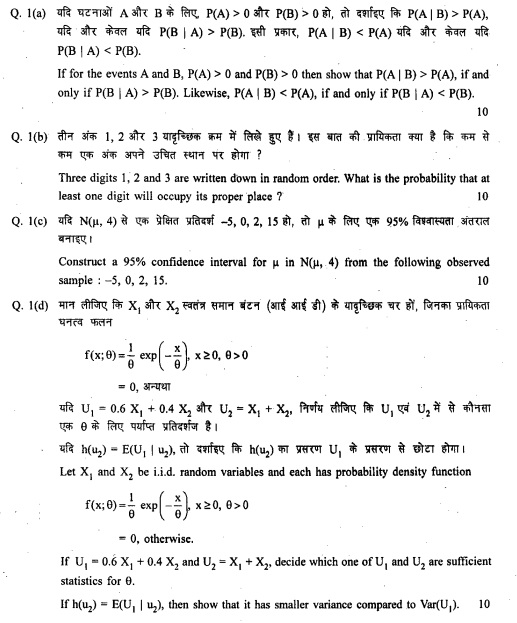
(Download) UPSC Mains 2014 Optional Exam Paper (Statistics Paper - 1 & Paper - 2)

UPSC

(Download) UPSC Mains 2014 Optional Exam Papers (Statistics Paper - 1 & Paper - 2)

Subject: Statistics (Paper - 1 & Paper - 2)

Exam Date: 19th December 2014

File Type: PDF

General Knowledge for IAS Exams (Articles of the Constitution)

General Knowledge for IAS Exams (Indian Polity and Governance)

Articles of the Constitution:

Union and its Territory

1. Name and territory of the union
2. Admission or establishment of new states
2A. (Repealed)
3. Formation of new states and alteration of areas, boundaries or names of existing states
4. Laws made under Articles 2 and 3 to provide for the amendment of the first and the Fourth Schedules and supplemental, incidental and consequential matters

Citizenship

5. Citizenship at the commencement of the constitution
6. Rights of citizenship of certain person who have migrated to India from Pakistan
7. Rights of citizenship of certain migrants to Pakistan
8. Rights of citizenship of certain person of indian origin residing outside India
9. Persons voluntarily acquiring citizenship of a foreign state not to be citizens
10. Continuance of the rights of citizenship
11. Parliament to regulate the right of citizenship by law

Fundamental Rights

12. Definition of state
13. Laws inconsistent with or in derogation of the fundamental rights
14. Equality before law
15. Prohibition of discrimination on grounds of religion. race, caste, sex or place of birth
16. Equality of opportuity in matters of public employment
17. Abolition of untouchability
18. Abolition of titles
19. Protection of certain rights regarding freedom of speech, etc.
20. Protection in respect of conviction for offences
21. Protection of life and personal liberty
21.A Right to elementary education
22. Protection against arrest and detention in certain cases
23. Prohibition of traffic king in human beings and forced labour
24. Prohibition of employment of children in factories, etc.
25. Freedom of conscience and free profession, practice and propagation of religion
26. Freedom to manage religious affairs
27. Freedom as to payment of taxes for promotion of any particular religion
28. Freedom as to attendance at religious instruction or religious worship in certain educational institutions
29. Protection of interests of minorities
30. Right of minorities to establish and administer educational institutions
31. (Repeated) Saving of laws providing for acquisition of estates, etc.
31A. Validation of certain acts and regulations
31B. Saving of laws giving effect to certain directive principles
31C. (Repeated)
32. Remedies for enforcement of fundamental rights including writs
32A. (Repeated)
33. Power of Parliament to modify the fundamental rights in their application to forces, etc.
34. Restriction on fundamental rights while martial law is in force in any area
35. Legislation to give effect to some of the provisions of fundamental rights

Directive Principles of State Policy

36. Definition of State
37. Application of the directive principles
38. State to secure a social order for the promotion of welfare of the people
39. Certain principles of policy to be followed by the state
39A. Equal justice and free legal aid
40. Organisation of village panchayats
41. Right to work, to education, and to public assistance in certain cases
42. Provision for just and humane conditions of work and maternity relief
43. Living wage, etc. for workers
43A. Participation of workers in management of industries
44. Uniform civil code for the citizens
45. Provision for early childhood care and education to children below the age of six years
46. Promotion of educational and economic interests of scheduled castes, scheduled tribes and other weaker sections
47. Duty of the state to raise the level of nutrition and the standard of living and to improve public health
48. Organisation of agriculture and animal husbandary
48A. Protection and improvement of environment and safeguarding of forests and wild life
49. Protection of monuments and places and objects of national importance
50. Seperation of judiciary from executive
51. Promotion of international peace and security

(Download) Old NCERT e-Books "Economics - Class - 10"

(Download) Old NCERT e-Books

Economics " Class - 10"

Subject: Economics

Class: 10

(e-Admit Card) UPSC Civil Services (Main) Examination, 2015

(e-Admit Card) UPSC Civil Services (Main) Examination, 2015

Exam Name: Civil Services (Main) Examination, 2015

Year: 2015

Admit Card Issue Date: 02-12-2015

Admit Card End Date: 23-12-2015

Union Public Service Commission will be conducting Civil Services (Main) Examination, 2015 at 23 Centres from 18.12.2015 to 23.12.2015. The Commission has uploaded the e-Admit Cards on its website at http://www.upsc.gov.in. The candidates are advised to download their e-Admit Cards and take a printout thereof. The candidates will have to produce the printout of their e-Admit Cards at the allotted venue for appearing in the examination. In case the photograph is not visible or available on the e-Admit Cards, candidates are advised to carry identical photograph for each session along with proof of identity such as valid Identity Card, Aadhar Card, Voter Identity Card, Driving License, Passport etc. to the venue of the examination. No paper Admit Card will be issued for this examination by the Commission.

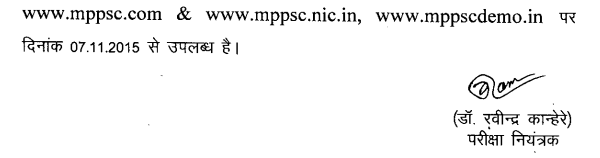
(Paper) MPPSC: Online Examination of State Engineering Service (Pre.) Exam - 2014 (1st Paper) - Evening Shift
(Paper) MPPSC: Online Examination of State Engineering Service (Pre.) Exam - 2014 (1st Paper) - Evening Shift
 

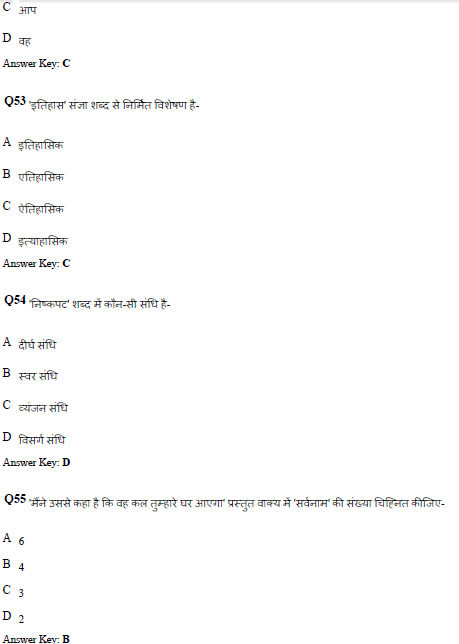
Q1 : For which of these biodiversity assessment is not required :

A Highway construction through forest land
B Cement factory establishment on forest land
C Operation of coal mines in Sidhi district
D Papad manufacturing through small scale industry

Answer Key: D

Q2 : In which of the following districts maximum number of wind mills are installed :

A Bhopal
B Gwalior
C Ratlam
D Dewas

Answer Key: D

Q3 Bhimbetka is associated with :

A Ramayan
B Mahabharat
C Veda
D Kadambari

Answer Key: B

Q4 : Author of the book 'Raha Kinare Baith' is :

A Makhanlal Chaturvedi
B Harishankar Parsai
C Sharad Joshi
D Gyan Chaturvedi

Answer Key: C

Q5 : Chitrakoot is situated in which district :

A Rewa
B Satna
C Tikamgarh 
D Panna

Answer Key: B

Q6 : World environment day is celebrated on :

A 05 June
B 05 February
C 05 March
D 16 June

Answer Key: A

Q7 : The first state in the country to establish a three layered 'Panchayati Raj' is :

A Gujrat
B Maharashtra
C Rajasthan
D Madhya Pradesh

Answer Key: D

Q8 : Chachai waterfall is in which district :

A Sidhi
B Rewa
C Satna
D Datia

Answer Key: B

Q9 : Dr. Shankar Dayal Sharma did not hold the post of :

A President
B Vice President
C Central Minister
D Prime Minister

Answer Key: D

Q10 : Dashpur is the ancient name of the city of Madhya Pradesh :

A Shivpuri
B Sheopur Kalan
C Mandsaur
D Jabalpur

Answer Key: C

Q11 : The first municipal corporation of Madhya Pradesh is :

A Jabalpur
B Bhopal
C Indore
D Gwalior

Answer Key: A

Q12 : State Bird of Madhya Pradesh is :

A Peacock
B Sparrow
C Dhudhraj
D Pigeon

Answer Key: C

Q13 : The first "lady leader of the opposition" in legislative assembly of Madhya Pradesh :

A Vijaylaxmi Sadho
B Jamuna Devi
C Kusum Mehdele
D Uma Bharti

Answer Key: B

Q14 : Satpura thermal electricity unit is situated at -

A Sarni (Betul)
B Babai (Hoshangabad)
C Khandwa
D Mandla

Answer Key: A

Q15 : 'Kalpataru Yojna' in Madhya Pradesh is associated with :

A Forestry
B Horticulture
C Agriculture
D Tissue culture

Answer Key: B

Q16 : The first News paper of Madhya Pradesh is :

A Gwalior Akhabar
B Indore Samachar
C Sagar Express
D Vidisha Akhabar

Answer Key: A

Q17 : 'Kamayani eak Punarvichar' is written by :

A Jayashankar Prasad
B Gajanand Madhav Muktibodh
C Subhadra Kumari Chouhan
D Bhawani Prasad Mishra

Answer Key: B

Q18 : Ozone layer is damaged due to :

A Chlorofloro carbon
B Hydrogen gas
C Nitrogen gas
D Cold air

Answer Key: A

Q19 : In which district Orchha Utsav is celebrated :

A Tikamgarh
B Chhatarpur
C Khandwa
D Sidhi

Answer Key: A

Q20 : What is the year of establishment of Atal Bihari Bajpai Hindi Vishwavidyalaya ?

A 2000
B 2014
C 2011
D 1990

Answer Key: C

Q21 : Kandariya temple is situated at :

A Khajuraho
B Hoshangabad
C Jabalpur
D laxmanbag Rewa

Answer Key: A

Q22 : 'Vishwamitra Puruskar' is associated with -

A Sports
B Science
C Literature
D Agriculture

Answer Key: A

Q23 : Which of the following rocks are oldest according to their geological structure :

A Gondwana rocks
B Archian rocks
C Cretaceous rocks
D Tertiary rocks

Answer Key: B

Q24 : Famous for fossil remains is :

A Ghughua
B Sohagi hills
C Bhimbetaka
D Maiher

Answer Key: A

Q25 : NGT is :

A National Green Tribunal
B Nature graphite track
C National green track
D Nature green technology

Answer Key: A

Q26 : 'World Yoga Day' is celebrated on :

A 5 June
B 22 June
C 1 June
D 21 June

Answer Key: D

Q27 : Where is headquarter of western central railway :

A Bhopal
B Janakpur
C Jabalpur
D Rewa

Answer Key: C

Q28 : In which city the 'Simhastha' of 2016 will be held :

A Ujjain
B Allahabad
C Nashik
D Haridwar

Answer Key: A

Q29 : BT cotton crop is a :

A Hybrid crop
B Transgenic crop
C Selected crop
D Special crop

Answer Key: B

Q30 : Excellent timber producing tree is :

A Teak
B Sal
C Haldu
D Babool

Answer Key: A

Q31 : 'Ladli Laxmi Yojna' was initiated by chief minister :

A Arjun Singh
B Digvijay Singh
C Uma Bharti
D None of these is correct

Answer Key: D

Q32 : Smallest sanctuary of Madhya Pradesh is :

A Gandhisagar
B Ratapani
C Ralamandal
D Orchha

Answer Key: C

Q33 : Acharya Vinoba Bhave is known for :

A Congress
B 1857 revolution
C Sarvodaya
D Rastriya Svayam Sevak Sangh

Answer Key: C

Q34 Where are the Shankaracharya caves located :

A Ujjain
B Pachmarhi
C Omkareshwar
D Betul

Answer Key: A

Q35 : The 'Seva Vivah' marriage tradition is in which tribe :

A Gond
B Bheel
C Kol
D Korku

Answer Key: A

Q36 : In the administrative hierarchy of the state secretariat of Madhya Pradesh the top position is occupied by -

A Cabinet Secretary
B Chief Secretary
C Principal Secretary
D Special Secretary

Answer Key: B

Q37 : When was Madhya Pradesh Hindi Granth Academy established in Bhopal-

A 1969
B 1956
C 1959
D 1961

Answer Key: A

Q38 : Study of applications of technology and engineering in biology is termed as -

A Microbiology
B Physiology
C Biotechnology
D Genetics

Answer Key: C

Q39 : The office of Lokayukt was established in Madhya Pradesh in :

A 1980 
B 1990
C 1985
D 1981

Answer Key: D

Q40 : 'Nirmal Gram Puruskar' is associated with :

A Gram Vikas Yojna
B Samagra Swachhata Abhiyan
C Gaon Sudhar Yojna
D Gram Safai Yojna

Answer Key: B

Q41 : 'Patalkot' famous for Bharia tribe is situated in :

A Dhar district
B Bhind district
C Mandla district
D Chhindwara district

Answer Key: D

Q42 : The birth place of Bharat Ratna Shri Atal Behari Bajpai is:

A Delhi
B Lucknow
C Gwalior
D Bhopal

Answer Key: C

Q43 : Hot spot of biodiversity is associated with :

A Hot climate
B Area with rich biodiversity
C Area with rich biodiversity with threat of human activities
D Area devoid of biodiversity

Answer Key: C

Q44 : The district having maximum number of literate people in Madhya Pradesh is :

A Bhopal
B Jabalpur
C Indore
D Ujjain

Answer Key: C

Q45 : Tijanbai is famous for :

A Thumari
B Pandwani
C Dadra
D Koldahaka

Answer Key: B

Q46 : Fossilized eggs of Dinosaur are found in :

A Bhopal district
B Indore district
C Dhar district
D Ratlam district

Answer Key: C

Q47 Which is not a neighboring state of Madhya Pradesh :

A Chhatishgarh
B Orissa
C Gujrat
D Maharashtra

Answer Key: B

Q48 : In which district of Madhya Pradesh opium poppy is not cultivated :

A Mandsaur
B Neemuch
C Ratlam
D Sagar

Answer Key: D

Q49 : Gandhisagar hydroelectric project on river Chambal is a joint project of :

A Madhya Pradesh and Uttar Pradesh
B Madhya Pradesh and Gujrat
C Madhya Pradesh and Rajasthan
D Madhya Pradesh and Maharashtra

Answer Key: C

Q50 : Which city of Madhya Pradesh is called as city of Joy :

A Chanderi
B Orchha
C Khajuraho
D Mandoo

Answer Key: D


Q76 : Choose the appropriate synonym of the underlined word:

Do you know about the traditional attire of Japan?

A New
B Conventional
C Logical
D Beautiful

Answer Key: B

Q77 : Choose the appropriate synonym of the underlined word:
Many politicians are candid.

A Vague
B Experienced
C Outspoken
D Anxious

Answer Key: C

Indian Satellite System: Civil Services Mentor Magazine - November + December - 2015


Indian Satellite System


Indian satellite missions have a long history from 1975. In 1975 Aryabhatta, first Indian satellite was launched by soviet union. This satellite was built by ISRO and named after the fifth century astronomer and mathematician from India. SLV-3 was India’s first experimental satellite launch vehicle. SLV-3 was successfully launched on July 18, 1980 from Sriharikota Range (SHAR), when Rohini satellite, RS-1, was placed in orbit, thereby making India the sixth member of an exclusive club of space-faring nations. The successful culmination of the SLV-3 project showed the way to advanced launch vehicle projects such as the Augmented Satellite Launch Vehicle (ASLV), Polar Satellite Launch Vehicle (PSLV) and the Geosynchronous satellite Launch Vehicle (GSLV).

The PSLV is one of world’s most reliable launch vehicles. It has been in service for over twenty years and has launched various satellites for historic missions like Chandrayaan-1, Mars Orbiter Mission, Space Capsule Recovery Experiment, Indian Regional Navigation Satellite System (IRNSS) etc. PSLV remains a favourite among various organisations as a launch service provider and has launched over 40 satellites for 19 countries. In 2008 it created a record for most number of satellites placed in orbit in one launch by launching 10 satellites into various Low Earth Orbits. The Geosynchronous Satellite Launch Vehicle was primarily developed to launch INSAT class of satellites into Geosynchronous Transfer Orbits. GSLV is being used for launching GSAT series of satellites. GSLV is a three stage launcher that uses one solid rocket motor stage, one Earth storable liquid stage and one cryogenic stage. The most recent flight of GSLV, the GSLV-D5, placed GSAT-14 into its planned orbit and marked the first successful flight of the indigenous cryogenic stage. Earlier, GSLV had launched various communication satellites among which EDUSAT is notable, being India’s first satellite built exclusively to serve the educational sector through satellite based distance education.

Agricultural Problems and Action Taken: Civil Services Mentor Magazine - November + December - 2015


Agricultural Problems and Action Taken


India is one of the youngest nations in the world with more than 62% of its population in the working age group (15-59 years), and more than 54% of its total population below 25 years of age. Skill building is absolutely necessary for such population to the increase in productivity of any nation, skill development also helps in improving the quality of products. Skill development will also lead to increase in growth rate of economy. At the individual level skill development helps in economic as well as social empowerment of the citizens. Focus on skill development in India is necessary from the very reason that it has greater proportion of working population vis-à-vis China, Western Europe, and North America. Based on data from the 68th Round of NSSO, it is estimated that only 4.69 percent of India’s total workforce has undergone formal skill training, compared with 52 percent in the USA, 68 percent in the UK, 75 percent in Germany, 80 percent in Japan and 96 percent in South Korea. This demographic profile provides unique opportunity to India for 20 to 25 years’ to reap the benefits which arre called as “demographic dividend”. The demographic dividend is essentially due to two factors

(a) declining birth rates and
(b) improvement in life expectancy.

The declining birth rate changes the age distribution and makes for a smaller proportion of population in the dependent ages and for relatively larger share in the productive labor force. The result is low dependency ratio which can provide comparative cost advantage and competitiveness to the economy. The “demographic dividend” accounts for India having world’s youngest work force with a median age way below that of China and OECD Countries.

Demographic dividend can only be made if the economy or state has place to ansorb them. As per estimates global economy is expected to see a shortage of manpower to the extent of around 56 million by 2020, this will nicely compliment the skill development initiatives of India. Thus, the “demographic dividend” in India needs to be exploited not only to expand the production possibility frontier but also to meet the skilled manpower requirements of in India and abroad. Skill development is also necessary to bring the connection between the education institutes and the working atmoshphere. In order to develop the skills of the people governments have taken various initiatives like opening ITI’s, Creating a seperate ministry for skill development etc. Recently government has launched a skill development mission to make the initiatives time bound.

Pages

Subscribe to RSS - Iasguru's blog