Iasguru's blog

(Download) UPSC Mains 2014 Optional Exam Paper (Mathematics Paper - 2)

UPSC

(Download) UPSC Mains 2014 Optional Exam Papers (Mathematics Paper - 2)

Subject: Mathematics Paper - 2

Exam Date: 19th December 2014

File Type: PDF

(Download) UPSC Mains 2014 Optional Exam Paper (Mathematics Paper - 1)

UPSC

(Download) UPSC Mains 2014 Optional Exam Papers (Mathematics Paper - 1)

Subject: Mathematics Paper - 1

Exam Date: 19th December 2014

File Type: PDF

(Article) Winter session of Parliament : Bills for consideration and passing


Winter session of Parliament : Bills for consideration and passing


Given Parliament’s importance in deliberating the legislation and scrutinising the work of the government through debates, one hopes the washed out monsoon session was an aberration.

The winter session of Parliament that starts follows a monsoon session that did not see any work being done in the Rajya Sabha and only a few discussions in the Lok Sabha. This session starts with two days being dedicated to discussing the contributions of B.R. Ambedkar before moving on to routine business .

The government has listed 20 bills for consideration and passing. These include the Constitution Amendment Bill, to enable the introduction of the Goods and Services Tax (GST); the Electricity (Amendment) Bill; the Real Estate (Regulation and Development) Bill; the Child Labour (Prohibition and Regulation) Amendment Bill; the Juvenile Justice (Care and Protection of Children) Bill; the Whistle Blowers Protection (Amendment) Bill, and the Prevention of Corruption (Amendment) Bill.

The GST Constitution Amendment Bill is just the first step in the legislative process to introduce this tax. The Constitution Amendment needs to be passed by both Houses by a two-thirds majority — it has been passed by the Lok Sabha but will be referred back to that House if the Rajya Sabha amends it. Then it needs to be ratified by 15 State Legislatures before it gets the President’s assent. This would set the stage for the introduction of the Bill in both Parliament and the State Legislatures to impose the tax, and repeal various other tax laws such as excise acts, sale tax acts, and so on.

Finding a mutually agreeable position :

Given the supermajority requirement, the GST Bill will require the support of most of the opposition parties. This Bill was referred by the Rajya Sabha to a select committee. The dissent note given by the members of the Congress indicates that they support the idea of GST with some changes in the Bill. These include setting a cap of 18 per cent on the tax rate, creating a dispute settlement authority for implementation issues by the Centre or the States, removing the 1 per cent tax on inter-State sale of goods, and inclusion of tobacco, alcohol and electricity in the GST. The success of the government in getting this Bill passed will depend on its ability to find a mutually agreeable position on many of these issues.

The Electricity Bill is a significant move towards greater competition in the sector. The Electricity Act 2003 trifurcated the sector into generation, transmission and distribution. The distribution companies purchase power from the generating companies, carry it using the networks of the transmission companies, and have a distribution system through which they supply electricity to the final consumer. This Bill further bifurcates distribution by enabling supply companies. This means that distribution companies will maintain the last mile network while supply companies will purchase electricity from the generators, pay the transmission and distribution companies for using their networks, and supply to the end consumer. The Bill envisages multiple supply companies in a geographical area which would compete for business and lead to improved customer service and lower tariffs.

The Real Estate Regulation Bill seeks to regulate the transactions between developers of residential property and buyers. It recognises the information and power asymmetry between developers and customers, and establishes various norms for developers. These include registering all projects, disclosure on websites of the layout plan and completion date, separate bank account for each project and ensuring that 70 per cent of the funds collected are used for construction of the project.

General Knowledge for IAS Exams (Governor-General and Viceroys)

General Knowledge for IAS Exams (History of India and World)

Governor-General and Viceroys

Governors of Bengal (1757–74)

  • Robert Clive: Governor of Bengal during 1757–60 and again during 1765–67 and established Dual Government in Bengal from 1765–72. (True founder of British Political dominion in India).
  • Vanisttart (1760–65): The Battle of Buxar (1764).
  • Cartier (1769–72): Bengal Famine (1770).

Governor-Generals of Bengal (1774–1833)

  • Warren Hastings (1772–1785): Brought the Dual Governmnet of Bengal to an end by the Regulating Act, 1773. Became Governor-General in 1774 through the Regulating Act, 1773; Wrote introduction to the first English translation of the ‘Gita’ by Charles Wilkins; Founded the Asiatic Society of Bengal with William Jones in 1784.
  • Revenue Reforms: Auctioned the right to collect land revenue to the highest bidder; Divided Bengal into districts and appointed collectors and other revenue officials.
  • Judicial Reforms: Started Diwani and Faujdari adalats at the district level and Sadar diwani and Nizamat adalats (appellate courts) at Calcutta; Redefined Hindu and Muslim laws.
  • Wars: Rohilla War (1774); 1st Anglo-Maratha War (1776–82): 2nd Anglo-Mysore War (1780–84).

Note: Sir John Macpherson was made the acting Governor General from 1785 to 1786.

  • Lord Cornwallis (1786–93): First person to codify laws in 1793. The code separated the revenue administration from the administration of justice; Created post of district judge; Introduced permanent Settlement in Bengal (1793); Cornwallis is called ‘the father of civil service in India’.
  • Police Reforms: Each district was divided into 400 sq. miles and placed under a police superintendent assisted by constables.
  • Wars: 3rd Anglo-Mysore War (defeat of Tipu and the Treaty of Serinagpatanam, 1792).
  • Sir John Shore (1793–98): Introduced the 1st Charter Act (1793).
  • Wars: Battle of Kharda between Nizam and the Marathas (1795).
  • Lord Wellesley (1798–1805): Started Subsidiary Alliance system to achieve British paramountcy in India. Madras Presidency was formed during his tenure.
  • Wars: 4th Anglo-Mysore War (1799)-defeat and the death of Tipu Sultan; 2nd Anglo-Maratha War (1803–05)-defeat of the Scindia, the Bhonsle and the Holkar; Treaty of Bassein (1802).

George Barlow (1805–1807): Vellore Mutiny (1806).

Lord Minto I (1807–1813): Concluded Treaty of Amritsar with Ranjit Singh (1809); Charter Act of 1813 was passed.

Lord Hastings (1813–1823): Adopted the policy of intervention and war.

  • Wars: Anglo-Nepalese War (1813–23); 3rd Anglo-Maratha War (1817–18). Hastings forced humiliating treaties on Peshwa and the Scindia; Introduced the Ryotwari settlement in Madras by Thomas Munro, the Governor.

Lord Amherst (1823–28): Wars: I Burmese War (1824–26). Acquisition of territories in Malay Penisula; Capture of Bharatpur (1826).

Lord W. Bentick (1828–33): Most liberal and enlightened Governor-General of India; Regarded as’ the Father of Modern Western Education in India’; Abolished Sati and other cruel rites (1829); Annexation of Mysore (1831). Concluded a treaty of perpetual friendship with Ranjit Singh (1831); Passed the Charter Act of 1833, which provided that no Indian subject of Company was to be debarred from holding an office on account of his religion, place of birth, descent and colour. On recommendation of Macaulay Committee made English the medium of higher education in India.

Governor-Generals of India (1833–58)

Lord W. Bentick (1833–35): First Governor-General of India. Macaulay’s minutes on education were accepted declaring that English should be the official language of India; Abolished provincial courts of appeal and circuit set up by Cornwallis, appointment of Commissioners of revenue and circuit.

Wars: Annexed Coorg (1834), Central Cachar (1834) on the plea of misgovernment.

Sir Charles Metcalfe (1835–1836): Passed the famous Press Law, which liberated the press in India (called Liberator the Press).

Lord Auckland (1836–42): 1st Anglo-Afghan War (1836–42)—great blow to the prestige of the British in India.

General Knowledge for IAS Exams (Important Foreign Travellers/Envoys)

General Knowledge for IAS Exams (History of India and World)

Important Foreign Travellers/Envoys

  • Megasthenes (302–298 BC): An ambassador of Selecus Nikator, who visited the court of Chandragupta Maurya and wrote an interesting book ‘Indica’ in which he gave a vivid account of Chandragupta Maurya’s reign.
  • Fa-Hien (405–411 AD): He came to India during the reign of Chandragupta II Vikramaditya. He was the first Chinese pilgrim to visit India to collect Buddhist texts and relics.
  • Hiuen-Tsang (630–645 AD): He visited India during the reign of Harshavardhana.
  • I-tsing (671–695 AD): A Chinese traveller, he visited India in connection with Buddhism.
  • Al-Masudi (957 AD): An Arab traveller, he has given an extensive account of India in his work ‘Muruj-ul-Zehab’.
  • Al-beruni (1024–1030 AD): He came to India along with Mahmud of Ghazni during one of his Indian raids. He travelled all over India and wrote a book ‘Tahqiq-i-Hind’.
  • Macro Polo (1292–1294 AD): A Venetian traveller, visited South India in 1294 A.D. His work ‘The Book of Sir Marco Polo’ gives an account of the economic history of India.
  • Ibn Batuta (1333–1347 AD): A Morrish traveller, his book ‘Rehla’ (the Travelogue) throws a lot of light on the reign of Muhammad-bin-Tughlaq and the geographical, economic and social conditions of that time.
  • Shihabuddin al-Umari (1348 AD): He came from Damascus and gives a vivid account of India in his book, ‘Masalik albsar fi-mamalik al-amsar’.
  • Nicolo Conti (1420–1421 AD): A Venetian traveller, gives a comprehensive account of the Hindu kingdom of Vijaynagar.
  • Abdur Razzaq (1443–1444 AD): He was a Persian traveller, came to India and stayed at the court of the Zamorin at Calicut. He has given a vivid account of the Vijaynagar empire.
  • Athanasius Nikitin (1470–1474 AD): He was a Russian merchant, describes the condition of the Bahmani kingdom under Muhammad III (1463–82).
  • Durate Barbosa (1500–1516 AD): He was a Portuguese traveller, has given a valuable narrative of the government and the people of the Vijaynagar empire.
  • Dominigo Paes (1520–1522 AD): He was Portuguese traveller, visited the court of Krishnadeva Raya of the Vijaynagar Empire.
  • Fernao Nuniz (1535–1537 AD): A Portuguese merchant, wrote the history of the empire from its earliest times of the closing years of Achyutdeva Raya’s reign.
  • John Hughen Von Linschotten (1583 AD): He was a Dutch traveller, has given a valuable account of the social and economic life of South India.
  • William Hawkins (1608–1611 AD): He was an English ambassador of British King James I to the court of Jahangir (1609).
  • Sir Thomas Roe (1615–1619 AD): He was an ambassador of James I (King of England), at the court of Jahangir, (the Mughal Emperor).
  • Fransciso Palsaert (1620–1627 AD): He was a Dutch traveller, stayed at Agra and gave a vivid account of flourishing trade at Surat, Ahmedabad, Broach Cambay, Lahore, Multan, etc.
  • Peter Mundy (1630–34 AD): He was an Italian traveller to the Mughal empire in the reign of Shahjahan, gives valuable information about the living standard of the common people in the Mughal Empire.
  • John Albert de Mandesto (1638 AD): He was German traveller, who reached Surat in 1638.
  • Jeen Baptiste Travernier (1638–1663 AD): He was a French traveller, his account covers the reign of Shahjahan and Aurangzeb.
  • Nicolao Manucci (1653–1708 AD): He was an Italian traveller, got service at the court of Dara Shikoh.
  • Francois Bernier (1656–1717 AD): He was French physician and philosopher. Danishamand Khan, a noble of Aurangzeb, was his patron.
  • Jean de Thevenot (1666 AD): He was French traveller, has given a good account of cities like Ahmedabad, Cambay, Aurangabad and Goloconda.
  • John Fryer (1672–1681 AD): He was an English traveller, has given a vivid account of Surat and Bombay.
  • Gemelli Careri (1693 AD): He was an Italian traveller, his remarks on the Mughal emperor’s military organisation and administration are important.

(Download) UPSC Mains 2014 Optional Exam Paper (Medical Science Paper - 1 & Paper - 2)

UPSC

(Download) UPSC Mains 2014 Optional Exam Papers (Medical Science Paper - 1 & Paper - 2)

Subject: Medical Science (Paper - 1 & Paper - 2)

Exam Date: 19th December 2014

File Type: PDF

General Knowledge for IAS Exams (Indian History – Important Dates)

General Knowledge for IAS Exams (History of India and World)

INDIAN HISTORY – IMPORTANT DATES

I. ANCIENT

BC

  • 2300–1750: Indus Valley Civilization.
  • From 1500: Coming of the Aryans.
  • 1200–800: Expansion of the Aryans in the Ganga Valley.
  • 600: Age of the 16 Mahajanapadas of northern India.
  • 563–483: Buddha’s Life-span.
  • 540–468: Mahavir’s Life-span.
  • 362–321: Nanda dynasty.
  • 327–326: Alexander’s invasion of India. It opened a land route between India and Europe.
  • 322: Accession of Chandragupta Maurya.
  • 305: Defeat of Seleucus at the hands of Chandragupta Maurya.
  • 273–232: Ashoka’s reign.
  • 261: Conquest of Kalinga.
  • 145–101: Regin of Elara, the Chola king of Sri Lanka.
  • 58: Beginning of Vikram era. AD
  • 78: Beginning of Saka era.
  • 78-101: Kanishka’s reign.
  • 319–320: Commencement of Gupta era.
  • 380: Accession of Chandragupta II ‘Vikramaditya’
  • 405–411: Visit of Chinese traveller Fahien.
  • 415: Accession of Kumargupta I.
  • 455: Accession of Skandagupta.
  • 606–647: Harshavardhan’s reign.

DOWNLOAD UPSC MAINS HISTORY 11 YEARS SOLVED PAPERS PDF

DOWNLOAD UPSC MAINS HISTORY 10 Years Categorised PAPERS

Study Noted for UPSC MAINS HISTORY Optional

General Knowledge for IAS Exams (The Gandhian Era (1917-47)

General Knowledge for IAS Exams (History of India and World)

THE GANDHIAN ERA (1917-47)

FACTS ABOUT GANDHI

  • Birth: October 2, 1869 at Porbandar, Gujarat. [Note: UNO declared October 2 as ‘International Non-violence Day’ (Antarrashtriy Ahimsa Diswas)]
  • Father: Karamchand Gandhi.
  • Mother: Putali Bai.
  • Political Guru: Gopal Krishna Gokhale.
  • Private Secretary: Mahadev Desai.
  • Literary Influence on Gandhi: John Ruskin’s Unto the Last, Emerson, Thoreau, Leo Tolstoy, the Bible and the Gita.
  • Literary Works: Hind Swaraj (1909), My Experiments with Truth (Autobiography, 1927)—reveals events of Gandhi’s life upto 1922.
  • As an Editor: Indian Opinion: 1903–15 (in English & Gujarati, for a short period in Hindi & Tamil),
  • Harijan: 1919–31 (in English, Gujarati and Hindi), Young India: 1933–42 (in English gujarati-named Navjeevan).
  • Other Names: Mahatma (Saint) by Rabindranath Tagore, 1917; Malang Baba/ Nanga Faqir (Naked Saint) by Kabailis of Noth-West Frontier, 1930; Indian Faqir/Traitor Faqir-byWinston Churchill, 1931; Half-naked Saint by Franq Mores, 1931; Rashtrapita (the Father of the Nation) by Subhash Chandra Bose, 1944.

(Download) Civil Services Mentor Magazine, November + December 2015 - FREE PDF

Click Here to Buy Hard Copy of This Magazine from Our Online Store

Click Here to Buy Hard Copy of This Magazine from Amazon

Free Digital Magazine: Civil Services Mentor, November + December 2015

Issue : November + December 2015
Size: 3.98 MB
File Type: PDF
Publisher : IASEXAMPORTAL.COM 

Table of Contents:

Articles:

  • Sustainable Development Goals
  • Smart Cities
  • Agricultural Problems and Action Taken
  • Indian Satellite System
  • Amendments to the Arbitration and Conciliation Bill, 2015
  • Selected Articles from Various Newspapers & Journals
  • MOCK PAPER For GS Paper-II Preliminary Examination 2016
  • Current Affairs Objective Question

Current Affairs:

  • National Issues
  • International Issues
  • Economy
  • India & The World
  • Science & Technology
  • Sports
  • Awards & Prizes
  • Persons in News

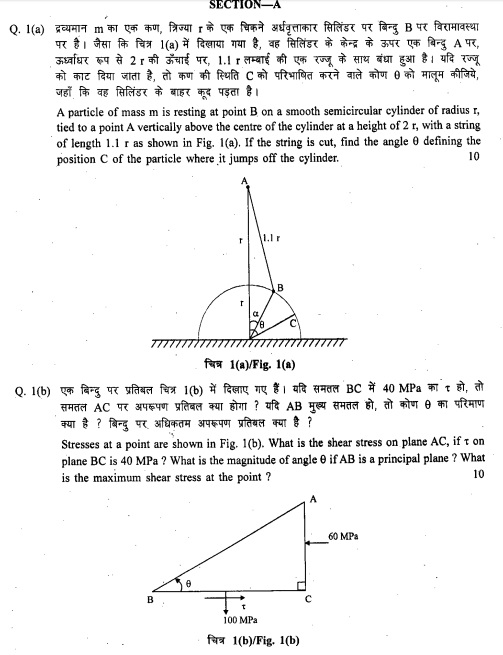
(Download) UPSC Mains 2014 Optional Exam Paper (Mechanical Engineering Paper - 1 & Paper - 2)

UPSC

(Download) UPSC Mains 2014 Optional Exam Papers (Mechanical Engineering Paper - 1 & Paper - 2)

Subject: Mechanical Engineering (Paper - 1 & Paper - 2)

Seventh Pay Commission Report, 2015


Seventh Pay Commission Report, 2015


In a resolution dated 28th February, 2014, Government of India has appointed the Seventh Central Pay Commission comprising

  • Justice Shri Ashok Kumar Mathur as Chairman,
  • Shri Vivek Rae as full time Member,
  • Dr. Ratin Roy as part time Member and
  • Smt. Meena Agarwal as Secretary.

Following are the highlights of the recommendations made by the 7th Central Pay Commission, headed by Justice A K Mathur, which submitted its report to Finance Minister Arun Jaitley : -

Recommended Date of implementation: 01.01.2016

Minimum Pay: Based on the Aykroyd formula, the minimum pay in government is recommended to be set at ₹18,000 per month.

Maximum Pay: ₹2,25,000 per month for Apex Scale and ₹2,50,000 per month for Cabinet Secretary and others presently at the same pay level.

Financial Implications:

The total financial impact in the FY 2016-17 is likely to be ₹1,02,100 crore, over the expenditure as per the ‘Business As Usual’ scenario. Of this, the increase in pay would be ₹39,100 crore, increase in allowances would be ₹ 29,300 crore and increase in pension would be ₹33,700 crore.

Out of the total financial impact of ₹1,02,100 crore, ₹73,650 crore will be borne by the General Budget and ₹28,450 crore by the Railway Budget.

In percentage terms the overall increase in pay & allowances and pensions over the ‘Business As Usual’ scenario will be 23.55 percent. Within this, the increase in pay will be 16 percent, increase in allowances will be 63 percent, and increase in pension would be 24 percent.

The total impact of the Commission’s recommendations are expected to entail an increase of 0.65 percentage points in the ratio of expenditure on (Pay+Allowances+ Pension) to GDP compared to 0.77 percent in case of VI CPC.

New Pay Structure: Considering the issues raised regarding the Grade Pay structure and with a view to bring in greater transparency, the present system of pay bands and grade pay has been dispensed with and a new pay matrix has been designed. Grade Pay has been subsumed in the pay matrix. The status of the employee, hitherto determined by grade pay, will now be determined by the level in the pay matrix.

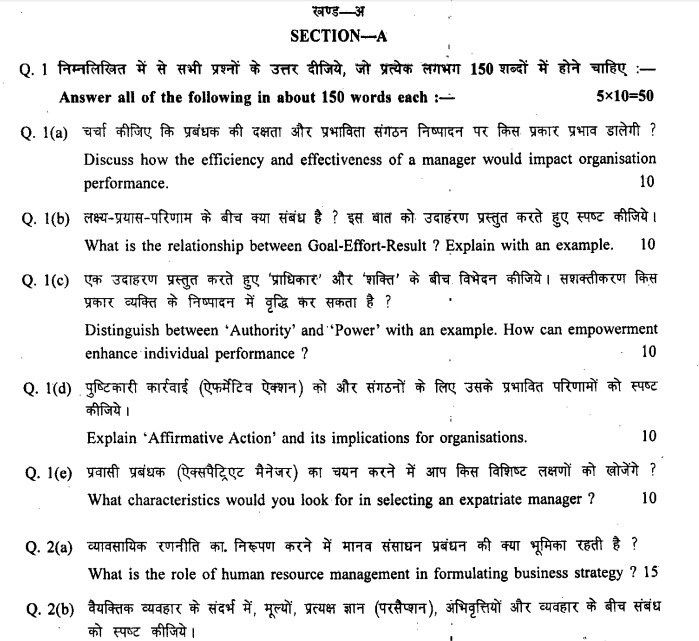
(Download) UPSC Mains 2014 Optional Exam Paper (Management Paper - 1 & Paper - 2)

UPSC

(Download) UPSC Mains 2014 Optional Exam Papers (Management Paper - 1 & Paper - 2)

Subject: Management (Paper - 1 & Paper - 2)

Exam Date: 19th December 2014

File Type: PDF

(Download) UPSC Mains 2014 Optional Exam Paper (Law Paper - 1 & Paper - 2)

UPSC

(Download) UPSC Mains 2014 Optional Exam Papers (Law Paper - 1 & Paper - 2)

Subject: Law (Paper - 1 & Paper - 2)

Exam Date: 19th December 2014

File Type: PDF

Paper – I

Section – A

1. Answer the following (each answer should be in about 150 words):

(a) What do you think the form/nature of our Constitution – Federal, Unitary or Quasi-federal? The Members of the Drafting Committee call it federal, but many others would this title. Critically examine the statement. 10
(b) What is ‘Constitutionalism’? Explain the said concept both in its negative and positive aspects in the context of India’s tryst with ‘Constitutionalism’ and ‘Constitutional Governance.’ 10
(c) Article 13 makes the judiciary, and especially the Apex Court, as a guardian, protector and the interpreter of the fundamental Rights. It confers a power as well as imposes an obligation on the Courts to declare a low void if it is inconsistent with a Fundamental Rights. Discuss. 10
(d) Explain the scope of the ‘Special Leave Jurisdiction’ of the Supreme Court as expounded by it. 10

2.

(a) The concept of ‘Reasonable Opportunity’ being a constitutional limitation on the doctrine of ‘Tenure Pleasure’, Parliament of State Legislature can make a law defining the content of ‘Reasonable Opportunity’ and prescribing procedure for affording the said opportunity to the accused government servant. Explain the concept with reference to leading cases.20
(b) Explain and elucidate the meaning of the ‘Right to personal liberty’ as interpreted by the Supreme Court in Papanasam Labour Union v. Madura Coat Ltd. AIR 1995 S.C. 2200. Analyse critically the guidelines prescribed by the Hon’ble Supreme Court in this respect.
(c) Define the term ‘public servant’. Also discuss the recruitment procedure of public servants in India. 15

3.

(a) Examine the elucidate the constitutional scope of the Ordinance making power of the President and the Governors in India. 20
(b) A backward class cannot be identified only and exclusively with-reference to economic criterion. A backward class may, however, be identified on the basic of occupation-cum-income without any reference to caste. There is not constitutional bar in the State categorizing the backward classes as ‘backward’ and ‘more backward’. Do you agree with the statement? Give reasons. 15
(c) What is ‘Public Interest Litigation’? What are the major facets of this form of ligation? Also discuss the limitations of this type of litigation. 15

4.

(a) Define the distinguish between ‘Constituent power’, ‘Amending power’ and ‘Legislative power’. Give illustrations. 20
(b) Do you agree with the statement that “all human rights are fundamental rights protected and recognized by the Constitution of India”. Discuss with reference to statutory provisions and case laws. 15
(c) Enumerate the fundamental duties as provided in the Constitution of India. Also discuss the rationale behind the incorporation of fundamental duties in the Constitution of India later on. 15

DOWNLOAD UPSC MAINS LAW OPTIONAL PAPERS PDF

DOWNLOAD UPSC MAINS GS 10 Year PAPERS PDF

DOWNLOAD UPSC MAINS GS SOLVED PAPERS PDF

DOWNLOAD UPSC PRE GS 10 Year PAPERS PDF

Section B

5. Answer the following (each answer should be in about 150 words):

(a) It is impossible to fix a precise data or period in history to mark the beginning of International Law as it predates recorded history. Critically examine the history, nature, scope and relevance of International Law in Contemporary International Society. 10
(b) International Law set little or no limitation on the jurisdiction which a particular State may arrogate to itself. Explain the nature and scope of ‘State Jurisdiction’. Critically examine the principles of ‘State Jurisdiction’. 10
(c) Recognition confers the legal status of a State under International Law upon the entity seeking recognition. Important legal effects are being derived from recognition. Critically examine the statement. 10
(d) International Treaties are agreement of contractual character between Status or organization of States creating legal rights and obligations between the parties. Examine the statement critically and explain the growing importance of Treaties in Modern International Law. 10
(e) What do you understand by the concept ‘Diplomacy Immunity’? What rules are provided under International Law in this respect? Discuss. 10

6.

(a) Explain the concept of ‘International Humanitarian Law’. How can it be achieved? Critically examine the role of ‘The Hague’ and ‘The Geneva Convention’ in the development of Modern International Humanitarian Law. 15
(b) ‘In several respect the TRIPS Agreement goes beyond the traditional GATT approach and further develops the ‘law of International Trade’. Examine the important achievement of the Agreement on Trade Related Aspects of Intellectual Property Rights (TRIPS). 15
(c) What is ‘fishery zone’? How it is different from ‘Exclusive Economic Zone’? Do you agree with the statement that ‘a coastal state has a special interest in the maintenance of the productivity of the living resources in any area of the high seas adjacent to its resources in any area of the high seas adjacent to its territorial sea’? Elucidate. 15

7.

(a) What are the objectives, structure and functioning of World Trade Organization? Does signing and ratifying WTO undermine the Parliamentary Autonomy of India? Discuss. 20
(b) Trace the development of International Law relating to sovereignty over air-space. Critically examine the scope of legal control of use and abuse of outer space. 15
(c) Define intervention and mention the grounds under which it is justified. Also throw light on the violations of this principle of International Law. 15

8.

(a) Define the concept of ‘opposability’ in the context of relationship between International Law and Municipal Law. Also discuss the relevance of this concept in modern times with special reference to India. 15
(b) What is the importance and meaning of ‘Base Line’ under UN convention of Law of Sea 1982? How is it determined? 15

Paper II

Section – A

1. Answer the following in about 150 words each. Support your answers with legal provisions and judicial pronouncements: 10 × 5 = 50

(a) What is meant by right of private defence? What are the general principles which form the basis of right of private defence? 10
(b) Discuss various stage of crime. How is the stage of attempt punishable under the Indian Penal Code? 10
(c) “The maxim is ‘volenti non fit injuria’ and not ‘scienti non fit injuria’.” Explain. 10
(d) “A tort is a specie of civil wrong.” Examine the definition and ad other feature s to make it comprehensive. 10
(e) “Prevention of Corruption Act, 1988 is an important legislation to safeguard democracy in India.” Discuss. 10

2.

(a) What are the constituent elements of crime? Elaborately discuss mens rea with relevant case law. 20
(b) ‘A’ assaulted his wife kicking her repeatedly on non-vital parts or her body. She felt down and became unconscious. In order to create an appearance that she had committed suicide he took up the unconscious body and thinking it to be a dead body hung it up by a rope. The post mortem examination showed that death was due to hanging. With the help of decided cases determine the culpability of A. 20
(c) “The abetment of the illegal omission of an act may amount to an offence although the abettor may not himself be bound to do that act.” Explain and illustrate. 10

3.

(a) “Criminal breach of trust and cheating are two distinct offences generally involving dishonest intention but mutually exclusive and different in basic concept.”
Explain with the help of decided cases. 20
(b) “Distinction between death caused by rash or negligent act under section 304-A and culpable homicide not amounting to murder section 304 of the Indian Penal Code is fine, but if overlooked, can result in grave injustice.” Discuss. 20
(c) “The age of a child must be considered in deciding whether it has been guilty of contributory negligence.” Discuss and refer to case law. 10

4.

(a) “Although the decision of the Supreme Court in Kasturi Lal v. State of U.P. has not been overruled as such, yet for all practical purposes its forces has been considerably reduced.” Elucidate. 20
(b) W, wife of A was diagnosed to be suffering from toxic Epidermal Necrolysis. Doctor D was consulted who prescribed a long acting Cortico steroid ‘Depomedrol’ injection at a dose of 80 mg twice daily. Despite administration of this medicine her condition deteriorated rapidly and she died within a week. On expert opinion, it was found that the line of treatment followed by D is not supported by any school of medical thought and is in sheer ignorance of a basic hazard relating to use of steroids. A files a complaint in Consumer Forum claiming Rupees 75 lakhs as damages for death of his wife W. D objects to the jurisdiction of the Consumer Forum and also plead lack of negligence on his part. Decide. 20
(c) “It is not necessary that in all cases of tort of defamation there must be a loss of reputation of the plaintiff.” Explain and illustrate. 10

Section – B

5. Answer the following (answer to each part must not exceed 150 words). Support your answer with relevant legal provisions and decided cases: 10 × 5 = 50

(a) If a contract is broken, the law will endeavor so far as money can do it, to place the injured party in the same position as if the contract had been performed.
Explain the above statement and discuss the principle court follows for assessment of damages. 10
(b) “The procedure and qualifications for appointment of chairperson and members of Cyber Appellate Tribunal have been introduced to keep up the standards of Justice.” Comment. 10
(c) Arbitration, as an alternate method of adjudication is acceptable to parties largely irrespective of the fact that access to court by the parties has been curbed drastically under the Arbitration and Conciliation Act, 1996. Explain. 10
(d) The actual concept of partnership from ‘people sharing to the profit’ to ‘mutual responsibility’ was the outcome of the decision in Cox V. Hickman case. Elaborate. 10
(e) “The liability of sub-agent towards principal is not direct, except in case of fraud and willful wrong.” Explain giving reasons. 10

6.

(a) X and Co. in its prospectus represented that A, B and C would be the direction of the company. This was true and on the basis of this P and Q applied for shares. However, before the allotment took place, there were changes in directions. Is the allotment of P and Q subject to their choice or it stands cancelled due to change in directions? Discuss. 10
(b) A, stands as surety for the good conduct of B, who is employed in a Bank on a monthly salary of Rs. 1600. Three months after the financial position of the bank deteriorated B, agreed to accept a monthly salary of Rs. 1500. Two months after, it is discovered that B has been misappropriating cast all through. What is the liability of A as surety under the Indian Law? 20
(c) Judiciary in India is impartial, hence cannot be influenced by internal or external factors. In the light of this discus how far media transgresses its limit and attempts to influence the judicial process. 20

7.

(a) “Copyright is the right of the artist, author, producer of a film who have created a work by use of their artistic skills.” Examine infringement of copyright particularly relegating to video piracy and the remedies available under the law. 20
(b) The doctrine of “Public Trust” as propounded by Supreme Court has worked as an instrument for protection of Environment in India. Discuss. 15
(c) Explain the scope of rule of “Caveat Emptor” in the expanding law of consumer protection. 15

8.

(a) “Right not to complete” is aright meant for promoting business through small groups called firms. Explain. 20
(b) “By and large Lok-Adalats have failed in achieving the objects for which they were created.” Comment. And also suggest some measures to make this institution more effective. 10
(c) Cyber-terrorism is a well organized transborder criminal act, hence a combined domestic law supported by a Global law may help to address the problem. Discuss. 20

100 Most Important Topics for UPSC GS Mains 2015


100 Most Important Topics for UPSC GS Mains 2015


1. Clash between executive & judiciary
2. Geo- political situation in Indian ocean
3. Middle east crisis
4. Sino-India relation
5. Indo-US relation
6. Reform in UN
7. Land Acquisition & farmers
8. Electoral reforms
9. Secularism in Indian politics
10. Terror Attack
11. Niti Aayog & federalism
12.Contribution of Indian diaspora
13.Indo-Nepal relation
14.India-Bangladesh relation
15.GM foods
16.Global warming
17.Freedom of expression
18. Foreign trade policy 2015-20
19. Social security schemes
20. National health policy
21. Environmental democracy index
22. Labour reforms
23. Investment of EPF in share market
24. P-notes
25. Gold monetization scheme
26. Black money
27. BRICS Bank
28. Prevention of child labour
29.Waste management
30. Make in india programme

Pages

Subscribe to RSS - Iasguru's blog