Iasguru's blog

(Premium) Gist of Press Information Bureau: November 2013

Premium - Gist of Press Information Bureau: November 2013

CABINET DECISION

The Union Cabinet approved the proposal for review of Foreign Direct Investment (FDI) caps and routes in various sectors.

The Government has decided to amend the provisions relating to the FDI caps and routes in various sectors as under:

1. Petroleum & Natural Gas

(Petroleum refining by the Public Sector Undertakings (PSU), without any disinvestment or dilution of domestic equity in the existing PSUs.)

(Premium) Gist of Kurukshetra Magazine: November 2013

Premium - Gist of Kurukshetra Magazine: November 2013

GOVERNMENT INITIATIVES TO EMPOWERMENT WOMEN-AREAS OF CONCERN

The Asian and Pacific· Centre for Women and Development [APCWD] defines “Empowerment as a process that aims at creating the conditions for the self-determination of a particular people at creating the conditions for the selfdetermination of a particular people or group”.

“Empowerment with women” is the central issue that has been pervading the development debate after the 81s. Improving their status and empowering them would go a long way in accomplishing egalitarian gender relations in society. Women who are hitherto constrained by their social structure for their self-expression constitute the target of most of the development programmes, which aim at bringing them into the mainstream of the development.

The Constitution of India guarantees to all women equality [Article 14]; no discrimination by the State [Article 15 (l)]: equality of opportunity [Article 16]; equal pay for equal work [Article 39(dl]; renounce practices derogatory to the dignity of women [Article 51 (a) (c)] The Constitution also allows the State to make special provision in favor of women and children [Article 15(3)]; and securing just and humane conditions of work and maternity relief [Article 42]. Acknowledging the world-wide significance of women empowerment the Government of India declared 2001 as the “Year of Women’s Empowerment” and the National Policy for the Empowerment of Women came into force from 2001. Draft Country Paper of India for the 4th World Conference on women held in Beijing in 1995 proposed certain qualitative and quantitative indicators for evaluating women’s empowerment. The qualitative aspects included self-esteem and self-confidence, articulation, leisure time, workloads, roles and responsibilities, domestic violence, women economic contribution .and ‘decision’ making Quantitative .aspects included. demographic trends, number of women in participation, access and control over resources, physical health status, literacy levels and political participation at the local level.

(Premium) Gist of The Hindu: November 2013

Premium - Gist of The Hindu: November 2013

NUCLEAR DETERRENCE IS OVERRATED

The Indian Navy has figured in three recent, global news items. The launch of the indigenously developed aircraft carrier, INS Vikrant , expected to be operational by 2018, makes India only the fifth country after the
United States, Russia, the United Kingdom and France to have such capability. The diesel-electric submarine Prime Minister Manmohan Singh and his wife, Gursharan Kaur, launched the 6,000- tonneArihant in Visakhapatnam on July 26, 2009.

In time, it was said, with a fleet of five nuclearpowered submarines and three to four aircraft carrier battle groups, a 35-squadron air force and land-based weapons systems, India would emerge as a major force in the Indian Ocean, from the Middle East to Southeast Asia.

The strategic rationale is to acquire and consolidate the three legs of land, air and seabased nuclear weapons to underpin the policy of nuclear deterrence. Unfortunately, however, the whole concept of nuclear deterrence is deeply flawed.

Desensitised

Nuclear weapons are uniquely destructive and hence uniquely threatening to our common security. There is a compelling need to challenge and overcome the reigning complacency on the nuclear risks and dangers, to sensitise policy communities to the urgency and gravity of nuclear threats and the availability of non-nuclear alternatives as anchors of national and international security.

Limited India-Pakistan war

The putative security benefits of nuclear deterrence have to be assessed against the real risks, costs and constraints, including human and system errors. Modelling by atmospheric scientists shows that a limited, regional India- Pakistan nuclear war using 50 Hiroshima-size bombs each would, in addition to direct blast, heat and radiation deaths, severely disrupt global food production and markets and cause a nuclear warinduced
famine that kills up to a billion people around the world.

The extra caution induced by the bomb means that the subcontinent’s nuclearisation raised the threshold of tolerance of Pakistan’s hostile mischief, like provocations on the Line of Control and cover for cross-border terrorism. Yet, India did not need to buy deterrence against China. The best available evidence shows that China’s nuclear weapons, doctrine, posture and deployment patterns are designed neither to coerce others nor to fight a nuclear war with the expectation of winning, but solely to counter any attempt at nuclear blackmail.

The role of nuclear weapons in having preserved the long peace of the Cold War is debatable. How do we assess the relative weight and potency of nuclear weapons, west European integration, and west European democratisation as explanatory variables in that long peace? There is no evidence that either side had the intention to attack but was deterred from doing so by the other side’s nuclear weapons. Moscow’s dramatic territorial expansion across eastern Europe behind Soviet Red Army lines took place in the years of U.S. atomic monopoly, 1945–49. Conversely, the Soviet Union imploded after, although not because of, gaining strategic parity.

Historical Evidence

To those who nonetheless profess faith in the essential logic of nuclear deterrence, a simple question: are you prepared to prove your faith by supporting the acquisition of nuclear weapons by Iran in order to contribute to the peace and stability of the Middle East, which presently has only one nuclear-armed state?

It is equally contestable that nuclear weapons buy immunity for small states against attack by the powerful. The biggest elements of caution in attacking North Korea — if anyone has such intention — lies in uncertainty about how China would respond, followed by worries about the Democratic People’s Republic of Korea’s conventional capability to hit populated parts of South Korea. Pyongyang’s puny arsenal of useable nuclear weapons is a distant third factor in the deterrence calculus. Against the contestable claims of utility, there is considerable historical evidence that we averted a nuclear catastrophe during the Cold War as much owing to good luck as wise management. The 1962 Cuban missile crisis is the most graphic example of this. Australia’s most respected strategic analyst, former Deputy Defence Secretary Paul Dibb, argues that Moscow and Washington also came close to a nuclear war in 1983. Frighteningly, Washington was not even aware of this scare at the time and any nuclear war then would have used much more destructive firepower than in 1962.

Compared to the sophistication and reliability of the command and control systems of the two Cold War rivals, those of some of the contemporary nuclear-armed states are dangerously frail and brittle. Nor do nuclear
weapons buy defence on the cheap: the Arihant cannot substitute for the loss of theSindhurakshak . They can lead to the creation of a national security state with a premium on governmental secretiveness and reduced public accountability. In terms of opportunity costs, heavy military expenditure amounts to stealing from the poor. Nuclear weapons do not help to combat India’s real threats of Maoist insurgency, terrorism, poverty, illiteracy, malnutrition and corruption. Across the border especially, there is the added risk of proliferation to extremist elements through leakage, theft, state collapse and state capture.

NPT

  • The Nuclear Non-proliferation Treaty (NPT) has kept the nuclear nightmare at bay for 45 years. The number of countries with nuclear weapons is still, just, in single digit.
  • There has been substantial progress in reducing the numbers of nuclear warheads.
  • But the threat is still acute with a combined stockpile of 17,000 nuclear weapons, 2,000 of them on high alert.
  • The NPT’s three-way bargain between non-proliferation, disarmament and peaceful uses is under strain. The Conference on Disarmament cannot agree on a work plan.
  • The Comprehensive Test-Ban Treaty has not entered into force. Negotiations on a fissile materials cut-off treaty are no nearer to starting. The export control regime was damaged by the India–U.S. civil nuclear agreement.

CO2 EFFECT: FOCUS ON MARINE FAUNA

The oceans absorb more than a quarter of carbon dioxide in the atmosphere, which dissolves in the water to form carbonic acid. This way, the oceans act as a carbon dioxide sink. However, as the amount of greenhouse gas increases in the atmosphere, so does the amount of carbonic acid in the waters, leading to ocean acidification (OA).

  • The studies have found varying levels of adaptability among different organisms. Scientists from the Helmholtz Centre for Polar and Marine Research have found that corals and echinoderms (like starfish) face endangerment and extinction, respectively, by 2100.

  • Their findings are more pertinent because they are based on the same emission scenarios used by the Intergovernmental Panel on Climate Change (IPCC) to prepare its Fifth Assessment Report, due out in September.
  • Corals spend their entire life in one place and cannot efficiently compensate for higher acidity as they lack the necessary physiological mechanisms.
  • These organisms also secrete calcium carbonate to create the most productive ecosystems known: coral reefs. Higher OA and warmer climes could interfere with the formation of reefs, with the scientists believing they could face extinction by the end of the century.

(Premium) Gist of Yojana: November 2013

Premium Gist of Yojana: November 2013

TOWARDS HOLISTIC PANCHAYATI RAJ

It is not by coincidence that this article carries the same title as our Report, for this is by way of an introduction to a Report that we believe should be essential reading for all those who would like to see the fulfillment of Gandhiji’s dream for independent India. Replying to a query on his “Dream for Independent India”, he wrote in his journal, Young India, 10 September 1930:

“I shall work for an India in which the poorest will feel it is his country, in whose making he has an effective voice”

This vision is inscribed on the cover of the Report and constitutes its leitmotif. There is no way in which the aam admi, let alone the poorest Indian, can have a sense of belonging in a Parliament in which his MP represents 15-20 lakh others, or an effective voice in decisions are taken in remote State capitals or Delhi, let alone even in the inaccessible reaches of the Collector’s of five 65 years after. Independence almost every Indian feels alienated from the political and administrative process, the sense of alienation being the greater the lower down the economic scale and social hierarchy that person finds himself or herself in, and also the more distanced he or she is geographically from the imposing Bhawans where his or her future is decided. Six and a half decades of democracy leave most individuals as distant from having an “effective voice” in the making of their country as their parents and grandparents were under colonial rule.

The one ray of hope is a return to Gandhian first principles. Gandhiji wanted our democratic institutions to be built on the foundations of Panchayat Raj, as evidenced in the 1946 publication by Shriman Narayan Agarwal, A Gandhi Constitution for Independent India that Gandhiji himself endorsed in entirety in the Foreword he wrote to the book.

After many travails, Parliament eventually incorporated key elements of the Gandhian vision in our scheme of government, by passing, virtually unanimously, the 73rd and 74th amendments to the Constitution in December 1992 followed by The Provisions of the Panchayats (Extension to Scheduled Areas) Act, 1996 [PESA] in December 1996, as required by Part IX (The Panchayats) of the Constitution. The Constitution describes PRIs as “institutions of self-government”, not self-governance, a distinction vital to the effective empowerment of the Panchayats.

(Premium) Gist of The Hindu: October 2013

Premium - Gist of The Hindu: October 2013

DEMANDING TRANSPARENCY IN POLITICAL FINANCE

Throughout the world, political parties collect funds to build and sustain the organisation, to train party cadres and fight elections. Recognising that they are the main link to the citizens (as voters) and, by implication, the mainstay of democracy, many countries, including India, have helped cushion their expenses at public cost. But the major share of funding still comes from voluntary contribution. Undeniably the sources of such funding influence voting behaviour and that is why the subject impacts directly on democratic rights. Surprisingly when all important institutions of governance, including Parliament, the judiciary and certainly the executive, have attracted intense public attention, the financing of political parties has been left relatively untouched. Until recently.

CIC order

In 2011, two resolute RTI querists — the Association for Democratic Rights, an NGO, and an individual, Subhash Aggarwal — appealed to the Central Information Commission since political parties had refused to share information although by all accounts they were public bodies. The appeals were upheld in an order dated June 3, issued by the full bench of CIC, which ruled that six national political parties needed to provide information as sought by establishing the RTI apparatus as required. The logic: they were recipients of valuable state resources in the form of land, accommodation, and tax exemptions which amounted to “substantial funding” by the public exchequer. Accordingly, they were to be treated as public bodies and made answerable as such.

The day the order was announced, everyone knew that most political parties would come together to annul the damage done by the CIC. They would either seek judicial intervention or introduce fresh legislation to overturn the CIC’s order. Knowing this, the applicants forthwith filed a caveat to forestall the grant of a stay against the order. All newspapers have since reported that a bill has even been kept in readiness to be introduced in the forthcoming session of Parliament seeking to exclude political parties from the ambit of RTI.

The major points of discord are: first, unfurling the RTI umbrella over political parties has implications for political strategy and functioning as once conceded, even information on the distribution or denial of ticket can be
sought — clearly a situation that is untenable given the competitiveness, secrecy and intricacy of political decision-making. Second, political parties do not maintain the documentation needed to respond to wide-ranging RTI queries and they cannot be expected to establish a new organisation only to fulfil the sweeping questions that will come under the RTI. Third, if the argument that political parties received “substantial funding” is applied equitably, it would apply to all similarly placed NGOs. The ensuing demands for information from all such bodies would explode the scope of CIC’s functions and belie the prime objective of the RTI which was to provide information on government functioning. Fourth, when it is well known and publicly admitted that most political funding comes from black money sources and in cash, it is impossible to declare whose contribution it was
without first cleaning up the “number two” monopoly.

(Premium) Gist of Yojana: October 2013

Premium Gist of Yojana: October 2013

PSB: WHOLESOME ENTERTAINMENT EDUCATION TRANSMEDIA STORYTELLING

Public Broadcasting systems all over the world face an existential crisis, caught in the dialectical vortex of serving the public and private good, as an agendasetter and democratizer, through technologies of broadcasting andnarrowcasting, while implementing programming that entertains and educates. Whether it is the BBC in United Kingdom, HK in Japan, Public Broadcasting Corporation in the U.S., the Kenyan Broadcasting Corporation in Kenya, or the Prasar Bharati Corporation of India, public broadcasters must question their meaning and purpose in a world run amuck by bits and bytes, big screens and handhelds, technological convergence and consumptive fragmentation. Digitization, privatization, globalization, localization, customization, democratization, are all here. And, to stay!

(Schedule) UPSC: Personality Test Programme For IFS Main Exam, 2013

Union Public Service Commission

Personality Test Programme For Indian Forest Service (Main) Examination, 2013

1. The Personality Test / Interview for the candidates for Indian Forest Service (Main) Examination , 2013 has been scheduled from 16th December to 20th December,2013.

UPSCPORTAL Daily Dose in Hindi (रोजाना समाचार, वस्तुनिष्ठ प्रश्न, ऑडियो नोट्स) "05 दिसंबर, 2013"

UPSCPORTAL Daily Dose in Hindi

दैनिक खुराक (दैनिक समसामयिकी, वस्तुनिष्ठ प्रश्न, ऑडियो नोट्स) "05 दिसंबर, 2013"

समसमायिक रोजाना ऑडियो नोट्स:

  • चर्चा का विषय: पाँच राज्यों मे विधानसभा चुनाव
  • सहभागी: प्रो0. सुब्रतो मुखर्जी (पूर्व संकाय सदस्य - दिल्ली विश्वविद्यालय), के. वी. प्रसाद (सहायक संपादक - द ट्रिब्यून)

अधिक जानकारी के लिए यहां क्लिक करें

Download Free Gist of The Hindu, Yojana, Kurukshetra, PIB & Science Reporter (October 2012)

https://static.upscportal.com/images/2012/UPSCPORTAL-The-Gist-Cover.jpg

Download Free Gist of The Hindu, Yojana, Kurukshetra, Press Information Bureau & Science Reporter (October 2012)

THE GIST DETAILS:

Medium: English

Price: Free

No. of Booklets: 1 (October 2012)

Publisher: UPSCPORTAL.COM

TOPICS OF THE GIST

  • Gist of The Hindu

  • Gist of Yojana

  • Gist of Kurukshetra

  • Gist of Press Information Bureau

  • Gist of Science Reporter

(Premium) Gist of Science Reporter Magazine: October 2013

Premium - Gist of Science Reporter: October 2013

HOW CLOUD SEEDING WORKS

Schoaefer published an article on these experiments in the 1 5 November 1946 issue of Science magazine with the statement: “It is planned to attempt in the near future a large scale conversion of super cooled clouds in the atmosphere to ice crystal clouds, by scattering small fragments of dry ice into the cloud from a plane,”

In November 1946, Dr. Bernard Vonnegut discovered that microscopic crystals of Silver Iodide (Agl) - commonly used in silver-based photography - nucleate water vapour to form ice crystals, Vonnegut chose silver iodide crystals because there is nearly the same distance between molecules in the crystal lattice for both ice and Agl, making Agl the optimum material to nucleate ice, Vonnegut also invented a practical way of generating tiny silver iodide particles to serve as nuclei for ice crystals, He dissolved a mixture of Agl and another iodide in acetone, sprayed the solution through a nozzle to make droplets, and then burned the droplets, In this way, one gram of Silver Iodide can produce 1016 nuclei for ice crystals, Till now, Vonnegut’s method continues to be the most common way to seed clouds, Apart from dry ice (solid carbon dioxide), liquid propane and recently hygroscopic materials such as salt are also being used, Liquid propane can produce ice crystals at higher temperatures than silver iodide.

Some of the popular applications of artificial weather modification have been cloud seeding to increase the rain or snow fall and hurricane seeding to mitigate its effects or turning its course, The methods to achieve these have been developed over the years and researchers continue to look for more efficient and reliable methods to perform these phenomenon, One of the main Challenges in performing weather modifications is to minimize any longterm effects on the global climate, The scientific community has long sought safer ways to achieve weather modification successfully and with minimal uncertainty.

(Premium) Gist of Press Information Bureau: October 2013

Premium - Gist of Press Information Bureau: October 2013

NATIONAL FOOD SECURITY MISSION STRATEGIES BEING FINE-TUNED TO ACHIEVE HIGHER TARGETS IN 12TH PLAN

Shri Pawar Calls for Greater Research Paertnerships, Technologies to Mitigate Impact of Climate Change The strategies adopted by the National Food Security Mission (NFSM) for increasing productivity and production of major crops are being further fine-tuned so that the momentum gained by the Mission in the 11th Plan is used for achieving 25 million tonne per year additional foodgrain production by 2017.

Addressing the General Council Meeting of NFSM here today, Agriculture and Food Processing Industries Minister, Shri Sharad Pawar proposed that new partnerships be forged with research organizations and innovative approaches adopted for developing effective technologies. He also appreciated the role being played by international research organizations, besides ICAR institutes and universities, in
supporting various technology initiatives under the Mission.

Shri Pawar recalled the monsoon situation in many parts of the country last year and its impact on agriculture. Though farm technologies developed by ICAR and other research organizations have to some extent are mitigating the impact of changing climatic factors, the efforts need to be accelerated ‘to develop more effective ways to address various abiotic and biotic stresses faced by crops’, he said. This was the 9th Meeting of the General Council of NFSM. The Council is the apex policy making body of NFSM. It is chaired by Agriculture Minister and has representatives from various Departments and research organizations.

(Premium) Gist of Kurukshetra Magazine: October 2013

Premium - Gist of Kurukshetra Magazine: October 2013

MICRO CREDIT-THE ENGINE OF INCLUSIVE GROWTH

The Self Help Groups (SHGs) methodology was first developed in Karnataka in 1992 to link rural population to the formal financial sys. Now about 8.6 crore households have access to banking through SHGs.

Linking SHGs with bank finance has been identified as a key tool towards achievement of holistic inclusive growth. Despite the vast expansion of the formal credit system in the country, marginal farmers, landless labourers, petty traders and rural artisans belonging to socially and economically backward classes and tribes whose propensity to save is limited or too small to be mopped up by the banks, continues to depend on money lenders.

In order to minimize the dependence on money lenders, NABARD, APRACA and ILO have carried out a study and brought out the concept of SHGs and launched a pilot project supported by refinance. The criteria would broadly be adopted by NABARD for selecting SHGs:

  • Membership of the group could be between 10 to 20 persons.

  • The group should be in existence for at least six months.

  • The group should have actively promoted the savings habit.

  • Groups could be registered or unregistered.

What is Micro Credit?

Foreseeing the need of sustainable development for the improvised; Muhammad Yunus, the father of microfinance, popularized the concept of micro credit. Micro credit, being part of financial inclusion, is defined as the provision of thrift, credit and other financial services and products of very small amount to the poor in rural, semi-urban and urban areas for enabling them to raise their income levels and improve their living standards (as per RBI Master Circular, 2008). In India, the most flourishing testing ground of social entrepreneurship has been in the area of micro credit, and more recently microfinance. Culling from international literature empirical features of micro credit are:

  • Quantum of loans is small,

  • No collaterals are required,

  • Rural and urban poor are the major borrowers, Ideally loans are used for income-generation through market-based self-employment,

  • Loans are administered through borrower groups,

  • Owing to NGOs’ controlling disbursement as well the basic terms and conditions for sanction, they sometimes become private transaction.

  • Less than 15 per cent of the households have any kind of insurance.

  • Bankers feel that it is fraught with risks and uncertainties.

  • High transaction costs.

  • Unfavourable policies like caps on interest rates which effectively limits the viability of serving the poor.

  • Lack of an appropriate legal vehicle.

Framework for Micro Credit

In India, there are two routes through which micro credit is provided to borrowers. The first is the “Bank-SHGs linkage programme” by which National Bank for Agriculture and Rural Development (NABARD) and commercial banks promote the formation of SHGs. Banks lend directly to SHGs, which, in turn, open group savings accounts in the banks. The second route is the “Micro Finance Institute (MFI) model”, is the most important institution in the chain.

Why Micro Credit?

Providing credit is in the top priority for policy makers to achieve inclusive growth. Unless we are able to meet the credit needs of our people, we can never hope to grow in a sustainable way. Despite multiple agencies giving credit to the rural sector, the critical gap in rural credit still exists resulting in the exploitation of the rural masses by money lenders. The status of micro credit is as follows:

  • Considerable gap between demand and supply for all financial services.

  • Majority of poor are excluded from financial services.

  • About 56 per cent of the poor still borrow from informal sources.

  • 70 per cent of the rural poor do not have a deposit account.

  • 87 per cent have no access to credit from formal sources.

The SHGs-8ank Linkage Programme

In 1991-92, a pilot project for linking about 500 SHGs with banks was launched by NABARD in consultation with the Reserve Bank of India. Since launching it as pilot project, it has proved its efficacy as a mainstream programme forbanking by the poor who mainly comprise the marginal farmers, landless labourers, artisans and craftsmen and other engaged in small business like hawking and vending in the rural areas.

(Premium) Gist of Press Information Bureau: September 2013

Premium - Gist of Press Information Bureau: September 2013

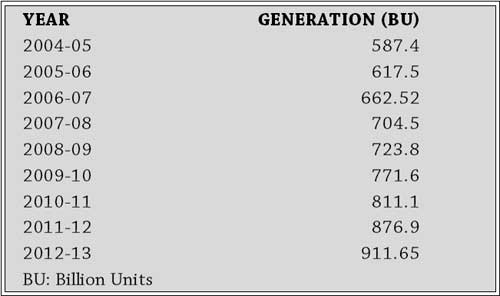
Target for power generation is fixed on an annual basis. As against the power generation target of 930 BU for the year 2012-13, 911.65 BU has been achieved, which is 98% of the target. The overall electricity generation in power utilities in the country as well as import from Bhutan since the beginning of 9th Plan is as under:

The total All India Installed Capacity of electric generating stations as on 31st March, 2013 was 2,23,343.60 MW and the demand was 1,35,453 MW.

The following steps have been taken / are being taken by the Government to achieve the electricity generation target during 2013-14:

  • Renovation and Modernization of old power plants.
  • Efforts are being made to make coal and gas available for power sector.
  • Review of progress of power projects is being done at the highest level by the Minister of State for Power (Independent Charge), Secretary, Ministry of Power and Chairperson, Central Electricity Authority, to identify the constraint areas and facilitate their faster resolution, so that the projects are commissioned on time.

Power sector has grown positively over the 11th Plan period. It registered a growth rate of 3.96% in 2012-13. The peak deficit in the year 2012-13 was 9% against the deficit of 10.6% in the year 2011-12. The decision to add generation capacity of 88,537 MW, import 82 Million Tonnes of coal, reduction in transmission and distribution losses etc. is expected to bridge the gap between peak demand and peak met.

As per Planning Commission, capacity addition of 88,537 MW is planned from conventional sources for the 12thFive Year Plan on an all-India basis. Steps taken to meet the power requirement in the country inter-alia are:

  • Rigorous monitoring of capacity addition of the on-going generation projects.
  • Review meetings are taken by Ministry of Power regularly with CEA, equipmentmanufacturers, State Utilities/ CPSUs/Project developers, etc. to identify the bottlenecks in capacity addition and resolve the issues.
  • In view of the increasing requirement of capacity addition to meet the demand, the capacity building of main plant equipment has been carried out in the country with the formation of several joint ventures for manufacture of main plant equipments in the country.

  • Thrust to make coal and gas available for power sector.
  • Thrust is being given to power generation from renewable sources. As per MNRE, grid interactive renewable capacity addition likely during 12th Plan is about 30,000 MW.

Steps taken by the Government to bridge the gap between demand and supply of power in the country which inter-alia include the following:-

  • Planned Capacity addition of 88,537 MW during 12th Plan period (2012-2017).
  • Rigorous monitoring of capacity addition of the on-going generation projects.
  • Development of Ultra Mega Power Projects of 4,000 MW each.
  • Augmentation of domestic manufacturing capacity of power equipment through Joint Ventures.
  • Coordinated operation and maintenance of hydro, thermal, nuclear and gas bases power stations to optimally utilize the existing generation capacity.
  • Thrust to import of coal by the power utilities to meet the shortfall in coal supplies to thermal power stations from indigenous sources.
  • Renovation, modernization and life extension of old and inefficient generation units.
  • Strengthening of inter-state and interregional transmission capacity for optimum utilization of available power.

(Premium) Gist of Kurukshetra Magazine: September 2013

Premium - Gist of Kurukshetra Magazine: September 2013

TECHNOLOGY INNOVATIONS TO INCREASE PRODUCTIVITY IN AGRICULTURE

Agriculture has to match the pace of the population growth to counter hunger and poverty in the world particularly in the developing countries. Cereals are the dominant part of our food security and world cereal output in 2012 was 2.309 billion tones. It is estimated that the world population will be 9.1 billion persons by 2050, up from the current population of 7 billion. More importantly, income growth will increase the quantity and change the composition of agricultural commodity demand. Demand for energy will also compete with the food security as parts of our agricultural commodities are going for the production of bio-fuels which will also continue to grow. Thus, significant increases in production of all major crops, livestock and fisheries will be required. According to the estimates of the Food and Agricultural Organization (FAD), agricultural production would need to grow globally by 70 per cent by 2050 and more specifically by almost 100 per cent in developing countries, to feed the growing population alone. This excludes additional demand for crops as feedstock and the demand for bio-fuel sector.

Today, agriculture is in serious constraint due to the challenge of hunger, malnutrition, poverty and climate change. Some recent estimates suggest that total factor productivity (TFPJ, the most comprehensive measure of productivity reflecting the efficiency to turn all inputs into outputs, grew at an average rate of around 2 per cent per year since 2000 across major world regions. The most popular indicator of land productivity is crop yield. This is a worrying factor as the average global rates of growth in yield of most of the major cereals are declining. Since the 1980s, growth in wheat and rice yields fell from 2.5-3 to around 1 per cent. Maize yields showed growth of slightly less than 2 per cent over the last decade. This is the major concern due to the lack of technology transfer. The gap between farmers’ yields and technical potential yields reflects the largely suboptimal use of inputs and insufficient adoption of most productive technology. According to FAD, this yield gap was approximately 11 per cent in East Asia and with unequal access to resources and inputs could raise total agricultural output in developing countries by 2.5-4 per cent which can lead to a reduction of 12-17 per cent in the number of undernourished globally.

Indian Scenario

Sustainable agriculture growth is important to check the hunger and poverty in the vulnerable population of the country as for 1 per cent growth in agriculture sector there would be a 2-3 per cent reduction in poverty. India’s population is expected to reach 1.5 billion by 2025, making food security most important social issue and food production will have to be increased considerably, to meet needs of growing population. The farm
sector achieved 3.6 per cent growth during the 11th Five Year Plan (2007-12) which was much higher than growth of 2.5 and 2.4 per cent during 9th and 10th Plans. Food grains production in India has shown remarkable improvement in recent years. The production of food grains in 2011-12 was at a record high of 259.32 million tones.

While focusing on increasing productivity in agriculture, innovative technologies should be infused to lower production costs, conserve biodiversity, more efficient use of external inputs for more sustainable agriculture and
environment, increase stability of production to lessen suffering during droughts due to abiotic and biotic stresses. Indian agriculture has all capabilities in the form of technology and management to accelerate the growth.

The Planning Commission has targeted an annual growth rate of 4 per cent for the agriculture sector in the Twelfth Five-year Plan. This is evident from the statistics as the production of food grains has increased by 4 times, horticultural crops by 6 times, fish by 9 times (marine 5 times and inland 17 times), milk 6 times and eggs 27 times since 1950-51. Green Revolution is our biggest success which resulted in an increase in food production from 800 million tonnes to more than 2.2 billion tonnes between 1961 and 2000. Indian Council of Agricultural Research (ICAR) with 99 institutes, 65 Agricultural Universities and 631 Krishi Vigyan Kendras (KVKs) spread across the country constitutes one of the largest national agricultural research systems in the world. But now, there is need for another green revolution by tapping the unexplored potential of vast tract of the country with the augmentation of irrigation and technology.

Our agriculture is still technology deficit as far as world agriculture is concerned. Yields per hectare of foodgrains, fruits and vegetables in our country are far below global averages, Our rice yields are one-third of China’s, and about half of Vietnam’s and Indonesia’s. Even India’s most productive states lag global averages. For example, Punjab’s yield of rice in 2010 was 3.8 tonnes per hectare against the global average of 4.3 tonnes. The average yield for apples in India (J&K) is about 11 tonnes per acre compared to the US, New Zealand, Israel or China, where yields range 30-70 tonnes per acre. The available data show that the productivity of kharif sorghum can be increased 3 to 4 times, rabi sorghum 1.4 to 2.3 times and bajra 1.8 to 2.3 times from their current level of productivity. Similarly, the productivity of pulses and oilseeds can be increased 2.3 to 2.5 times, through attention to seeds, soil health, pest management, crop life saving irrigation and postharvest technology. Supplemental irrigation based on rain water harvesting will help to increase yields further. A second area needing immediate attention and action’ relates to improving the productivity of wheat, rice, pulses and oilseeds in the Indo-Gangetic lairts and eastern India, particularly in Bihar, Jharkhand, Chhattisgarh, Orissa, eastern Uttar Pradesh, West Bengal and Assam. According to a report of Chambers of Indian Industries (CII) and McKinsey, the country’s agricultural output by 2030 could reach Rs 29.28 lakh crore level and food exports could jump to over Rs 7 lakh crore. Consequently, processing could grow from Rs 1.1 lakh crore to Rs 5.65 lakh crore by 2030 while India’s food exports could grow from Rs 1.4 lakh crore to Rs 7.72 lakh crore by 2030. The new Food and Agriculture Integrated Development Action (FAI DA) report focuses on mango, banana, potato, soyabean and poultry which represent categories that are likely to drive the next wave of growth.

Speech Of UPSC Chairman Mr. D. P. Agarwal on UPSC Foundation Day 2014

Speech Of UPSC Chairman Mr. D. P. Agarwal on Foundation Day

“This Lecture series serve as a forum for sharing of vision & ideas on good governance and the role of public service. This has strived to scan the full spectrum of public policy for a nation which is fast emerging as a global leader. The three lectures delivered earlier have given us new ideas and concepts on the systemic improvement in governance and service delivery to citizens.

The desire of the youth of this nation to be a part of governance is manifested in the very large number of applicants seeking selection through UPSC. They come with a dream of making a difference in the lives of fellow citizens. I am very happy to say that, because of the transparent, impartial and judicious systems and procedures adopted by the Commission many a bright, hard working and honest candidates from all sections of the society have realized their dreams. Future good governance shall be built on the platform of their dreams. Governance shall also be enriched by the role played by each stakeholder; necessitating a continual communication between the institutions of democracy and the people of the nation. Citizen engagement will be the cornerstone for the development of faith in the governance process.

If we have to meet the expectations and aspirations of our vibrant and informed nation of today, the instruments and structures of governance in vogue need to be re-evaluated, re-engineered and sharpened. Consistent with these, Commission on its part, streamlines its working and reviews its processes of selection. Notable among them are the changes brought out in the Civil Services Examination both Preliminary and Mains with the approval of the Government. The emphasis now is on testing not only the aptitude of the candidates for a demanding life in the civil service, but also on ethical and moral dimensions of decision-making to induct young and dynamic officers with appropriate skills & aptitude into the Civil Services. These steps have provided a level playing-field and equity to all the prospective candidates. In addition, it will reduce the time frame for conducting the Civil Services Examination.

The Union Public Service Commission introduced the use of Information Technology for communication with candidates, after due research. Candidates submit applications online, receive admit cards and results for all the examinations online and above all our interactive web-based communication has been a great success with the candidates in meeting their information needs. This has reduced the time for conducting various examinations and the rejection rate of applications drastically from around eight to ten percent to less than one per cent.

The Commission introduced Single Window System to receive various proposals for direct recruitment, appointment by promotion/ deputation, disciplinary cases and induction into All India Services from various State Governments, ministries and departments. Before introduction of this Scheme, all the Stakeholders were sensitized by holding workshops and training for them. This system has increased efficiency and reduced considerably the average time taken for disposal of cases in the Commission.

The Commission through its proactive approach has ensured that the backlog in the induction to the All India Services is cleared and now in most of the States, it is up to date. In order to improve this process of selection based upon merit, the Commission has suggested for an alternative approach for induction which is under the active consideration of the government.

The Government has introduced Annual Performance Appraisal Reports in the Central Services from 2008-09 onwards and the system now provides for the officer reported upon to see his APAR. Our experience has shown that these performance reports are invariably pitched at the top bracket and the selection based solely on these become difficult. Therefore Commission is of the view that the time is ripe to revisit the system of career progression based solely on APARs, at least for the top positions in the Government. This concern has already been conveyed to the Government of India.

A large number of candidates go through the rigorous examinations conducted by the Commission but only a few are recommended as the vacancies are limited. Others who are also not any less bright are left in the lurch. Commission is considering the issue as to how these talents could be utilized to the best advantage of Govt. / PSUs, etc.

(Syllabus) Prelim Examination - Syllabus (Philosophy)

Preliminary Examination Syllabus  - Philosophy

GROUP - A

GENERAL PHILOSOPHY (WESTERN AND INDIAN) :

General Studies Model Test Paper-1 for IAS Mains Exam - 2013


General Studies Model Test Paper-1 for IAS Mains Exam - 2013


1. Examine the contributions of India to the growth of science and technology in ancient times. (10 marks, 200 words)

Indians in ancient times made significant contributions to the knowledge of medicine, mathematics and astronomy, metallurgy, boat-building etc. It is evident from a number of books written on these subjects and their translations in Arabic, Persian and other languages. In medicine, the most authoritative text is Charak’s Charaksamhita which gives scientific explanations to the cause of and remedies for different diseases.

The manuscript found in western china contains a part of it. Another text is Sushruta’s Sushruta-samhita which refers to different types of surgical instruments and surgeons including plastic surgeries. It was translated as kitab-i-susrud in Arabic in the 9th century.In the fields of maths and astronomy, two most important names are Aryabhatta and Bhaskaracharya. Aryabhatt’s Aryabhattiyam covers algebra, arithmetic, trigonometry, fractions, equations and a table of sine. It also refers to pie (Π). Aryabhatt’s work was greatly used in Arabic world and is cited by Al-khwarizmi and Al-beruni.

 His discovery of zero and decimal system revolutionised the system of mathematical calculations all over the medieval world. He is also credited with the discovery of the concept that Earth moves on its axis and this explains the cause of eclipses. Bhaskaracharya is regarded as a pioneer in differential calculus which was later adopted by Leibniz and Newton. His treatise Lilavati, a part of Siddhanta Shiromani, refers to simple methods of solving mathematical calculations and was translated into Persian by Faizi during Akbar’s reign. In metallurgy, the iron pillar at Delhi is a standing example of ancient India’s iron making technology.

The Arab scholar, Al-idrisi says that Indian swords were known for their sharpness and were in great demand in the west. Bhoja’s Yuktikalptaru deals with the construction of different types of boats meant for inland water ways as well as high seas. The compass, known as Matsya yantra is also believed to have been an Indian invention and its role in the growth and navigation all over the world is well known.

2. How far is it correct to describe Shahjehan’s reign as the golden age of Mughal architecture? (10 marks, 200 words)

The Mughal architecture represents an amalgam of India as well as Persian and Turkish traditions and is remarkably symmetrical and ornamental in nature. It first developed under Akbar and reached the highest level of perfection during the reign of Shahjehan. Akbar made extensive use of red sandstone for his buildings whereas Shahjehan considered white marbles as better building material.

As against the sturdy and plain constructions of Akbar, Shahjehan’s buildings are highly delicate and ornamental. Shahjehan’s buildings are full of pietra dura and beautiful carvings in marble. The archs became more foliated, the domes became bulbous. Shahjehan even demolished some of Akbar’s simple brick sandstone structures in Agra fort and replaced them with magnificent marble buildings. But the most fabulous building of his period is the Taj Mahal. It is a logical culmination of the Persian Charbagh style of garden tomb with pathways, water channels and garden on four sides.

 The earliest example of it in India is the Humayun’s tomb in Delhi. It’s soaring dome, black inscriptions against the white marble background and jaali, the marble lattice work are the chief features. Among other monuments of Shahjehan is the city of Shahjehanabad which is one of the most systematically planned towns in the medieval period with proper laid out fort, markets, roads, sarais and hydraulic water pumping system.

3. Communalism and Nationalism in India were the outcome of British Imperialism. - Discuss. (10 marks, 200 words)

The policy of divide and rule was inaugurated right in the days of East India Company when the British were establishing themselves as rulers of India. Due to the economic backwardness of India and rampant unemployment, there was ample scope for the colonial government to use concessions, favors and reservations to fuel communal and separatist tendencies.

 Later on this became responsible for the division of the country into India and Pakistan. The sense of being oppressed under colonial rule provided a shared bond that tied different groups together. Each class and group felt the effects of colonialism differently. Their experiences were varied, and their notions of freedom were not always the same. Several other causes also contributed towards the rise and growth of Nationalism. One set of laws of British Government across several regions led to political and administrative unity. This strengthened the concept of citizenship and one nation among Indians.

4. Answer the following:
(a) Gandhi – Irwin pact was an unconditional surrender by Gandhi. Evaluate.(5 marks, 100 words)

The pact was signed between the Viceroy representing the British Indian Government and Gandhi representing Indian people in Delhi in February 1931. Terms agreed to by Irwin were

1) Immediate release of all political prisoners not convicted of violence
2) Lenient treatment of all government servants who had resigned
3) Right to make salt for personal consumption
4) Right to peaceful picketing
5) Withdrawal of emergency ordinances

Gandhi on his behalf agreed to suspend civil disobedience movement and participate in next round table conference.

The pact was criticized by many as surrender by Gandhi on the grounds of
a) refusal for public inquiry into police excesses, and
b) refusal to commute Bhagat Singh and his comrades death to life sentence.

However the pact cannot be viewed as unconditional surrender by Gandhi because
1) He agreed to suspend Civil disobedience movement because mass movements are necessarily short lived and capacity of masses to make sacrifices is limited.
2) Signs of exhaustion were seen especially among merchants and shopkeepers who were enthusiastic participants.
Gandhijis decision was based on logic and should not be viewed as surrender and most of demands were met by Irwin excluding some.

(b) Round Table conferences were basically stage shows in London by supporters of British rule. Comment. (5 marks, 100 words)

Round table conferences were the first high level talks arranged between the British and Indians as equals to decide future course of Constitutional reforms in India. First round table conference was boycotted by Congress and attended only by Muslim League and the Hindu Mahasabha and the princes. Every delegate reiterated that a constitutional discussion without the Congress was meaningless. Second round table conference: Congress agreed to attend it after Gandhi-Irwin Pact. Right wing led by Churchill opposed British Government negotiating with Congress on an equal basis.

 The Government failed to concede basic Indian demand of freedom and this led to Gandhiji’s return and revival of Civil Disobedience movement. Third round table conference was just a nominal conference Congress refused to attend it (in fact it was not invited) and the Labor party also refused to attend it. The outcome was a white paper issued by Government and on the basis of this paper Government of India Act 1935 was to be passed. Hence the purpose of discussing constitutional reforms with Indians on equal basis was never fulfilled and Congress being main representative of India was never taken into consensus. Indian demands were barely met. Hence Round Table conferences were basically stage shows in London by supporters of British rule.

5. Suppression of mass movements gave provocation to Revolutionary Terrorism in Indian freedom struggle. -Discuss. (10 marks, 200 words)

The revolutionary terrorist movement was largely the outcome of the same set of causes which gave rise to the extremist wing in the national politics. The only difference was that the revolutionaries wanted quicker results and discounted the value of moderates and applying low grade pressure on the British. The revolutionaries believed that the British rule was destructive of all that is worthwhile in national life- political liberties, religious freedom, morality and Indian culture.

 Though the political philosophy of the revolutionary terrorists in different parts of India might have differed from one another, but their one common aim was freedom from the British rule. In order to suppress popular movements and counter widespread discontent among the masses the British used several measures like gagging the press and banning public assembly. This attitude flared the already existing extremist tendencies of the youth.

The political measures of the government during Curzon’s rule and subsequent repression directed against the nationalist movement were also greatly responsible for the terrorist activities. One was the education policy illustrated by the Universities Act, 1904. Curzon`s education reforms were obviously interpreted by the nationalists as an attempt to keep the educational institutions under tight imperial control. The second and most controversial reform measure was the Partition of Bengal in the name of improving the efficiency of the traditionally neglected Bengal province.

 Activities of the Terrorists The activities mainly comprised of political assassination, generally of unpopular officials, hoping thereby to strike terror in the bureaucracy and break its will. They also thought that a campaign of political assassination when carried out on a large scale would even create a favorable atmosphere for armed insurrection. Another method was to organize armed dacoities with a view to securing money from wealthy Indians and the government, which they could use for their work such as the establishment and operation of the secret groups, laboratories to make bombs, factories to forge arms. There also sprang up revolutionary groups which had a more extensive program such as the fomenting of mutinies in the army and agrarian riots.

6. Answer the following:
(a) Sardar Patel played a great role as a maker of modern India. - Comment. (5 marks, 100 words)

Sardar Patel was a visionary and played a major role in shaping modern India.
Some of his major contributions are:

  •  Role in Independence Movement: Played an active role in Kheda Satyagraha, Dandi Salt march, Quit India movement.

  •  Role in political integration of India: A fragmented land mass of 565 princely states. This arduous task of swiftly uniting all the princely states would not have been possible if not for Patel who personally met each prince for negotiations and convinced them to accede to India.

  •  Military Policies: During his tenure of being the home minister, Patel envisioned some policies to keep India secure and develop it overall.

  •  Role in Constitution: Patel had played a dominant and decisive role in the Constituent Assembly from day one and was the motivator for the team.

  •  His role in white revolution: The idea of co-operatives for milk industry was the brainchild of Patel which led to white revolution (headed by Dr. Kurien of Amul).
    Patel was instrumental in motivating farmers to join the movement so as to break the monopoly enjoyed by private players and place the power among hands of
    the farmers/producers. Hence Sardar Patel is considered as one of the architects of modern India.

(b) J. P. movement was an unconstitutional movement. - Discuss. (5 marks, 100 words)

Post 1971 war the nation faced many problems like steep price rise and rise in discontent among people. Law and order deteriorated further in 1974-75 strikes and popular demonstrations often turned violent. Jayaprakash Narayan gave a call for “Total Revolution”. The main justification of the JP movement was that it arose to end corruption in Indian politics.

Indira Gandhi justified her action of imposing emergency on the grounds of India’s stability, need to implement rapid economic development programme for the poor and warned against intervention and subversion from abroad to weaken India. JP was considered ideologically vague as his Total Revolution concepts were unclear. JP movement came to include communal Jansangh and Jamaat-i-Islami, the RSS and the extremist left Naxalite groups. This resulted in political character of the movement also undergoing a change. The agitational methods adopted and propagated by the JP Movement were extra constitutional and undemocratic.

Going beyond demonstrations in Bihar and Gujarat the tactic was to force the governments to resign and dissolve legislatures. Thus paralyzing individual government and forcing legislators to resign. There were attempts to incite army police and civil services to rebel. Thus it can be said that JP movement was an unconstitutional movement for the sheer reason of the means they adopted.

7. Napoleon was the son of revolution. – Comment. (10 marks, 200 words)

Napoleon’s rise owed everything to the French Revolution, to its ideals of liberty and equality, the meritocracy that lay at its roots, and the huge institutional changes that it wrought. For Napoleon the changes that were being made in the name of the French people opened the door to brilliant careers and rapid social advancement. In the early period of his career, Napoleon found the desire of the revolutionary authorities to pass sweeping measures to renew the fabric of the nation refreshing and energising.

He was a convinced believer in the benefits of meritocracy and applauded the boldness of the revolutionaries in abolishing nobility, selling church lands and reforming a society rooted in privilege. In print, he mocked the corruption of the old order and lambasted the privileged idleness of many members of the nobility. He did not emigrate; he continued to serve in the army; he took the oath of loyalty to the constitution of 1791. Root-and-branch reform in the army led in 1799 to full-blown conscription and the professional background and social configuration of the troops changed dramatically, and the army, for a few short years, became predominantly French as the government relied on its own people where, previously, it had bought soldiers from other states.

 Because of the high turnover of officers – both through heavy casualty rates in battle and as a result of resignations and emigration – promotion could come rapidly and at a very young age. Recognition was there to be won for those with flair and talent, and a new generation of officers, such as Napoleon Bonaparte, sieged the initiative.The Revolution demanded not only talent from its officers, but also political loyalty.

 The political leadership had had too many painful experiences with officers who proved untrustworthy, socially conservative, or whose loyalty was to the king or to the Catholic Church before it was to the French people. Napoleon who was trustworthy, loyal to the nationalistic cause, socially moderate and firm believer in meritocracy can thus be said to be the child of revolution.

8. Cold war after 1945 was basically the outcome of fear and provocative steps of U.S.A. and U.S.S.R. - Discuss. (10 marks, 200 words)

In 1945, the United States and Soviet Union were allies but within just a few years, wartime allies became mortal enemies, locked in a struggle—military, political, economic, ideological—to prevail in a new "Cold War." Causes of the Cold War after 1945:

  • American fear of communist attack

  •  Truman’s dislike of Stalin

  •  USSR’s fear of the American's atomic bomb

  •  USSR’s dislike of capitalism

  •  USSR’s actions in the Soviet zone of Germany

  •  America’s refusal to share nuclear secrets

  •  USSR’s expansion west into Eastern Europe + broken election promises

  •  USSR’s fear of American attack

  •  USSR’s need for a secure western border

  •  USSR’s aim of spreading world communism

  •  This feeling of suspicion lead to mutual distrust and this did a great deal to deepen the Cold War

9. Fear of communism was the most important cause of aggressive nationalism in Europe. (10 marks, 200 words)

  •  The answer should clearly bring about the causes for World War II that rode on the fear of spread of communism in Italy, Germany and Spain.

  • The capitalist nations of Britain and France wanted to contain the spread of communism and thus they showed a policy of appeasement towards Germany and Italy. They did not want another Russia in the making.

  • Communist ideology was considered as a threat to the existing life and it was treated as an evil by the businessman, feudal lords in these countries and moreover all these countries that harboured an anti-communist feeling had their entire economy controlled by the state. The emphasis was on self sufficiency as it was important for the growth of the nation

  •  How this policy complemented the expansionist policy of Hitler leading to rise of a nationalistic feeling. He also envisaged a living space for all Germans across Europe and called it Lebensraum.

  •  His idea of pan-Germanism and elements of social welfare were already present in his policies to avoid any future clash with the community.

  •  Use some of the pacts signed by Germany to support the above arguments -
    1933 - Anglo German Treaty to allow Germany to maintain its Navy - A mark of
    appeasement policy by Britain towards Germany.

  • 1936 - Anti Commintern Pact between Germany and Japan.

10. Indira Gandhi’s era was one of turmoil as well as glory. - Critically analyse. (10 marks, 200 words)

Indira Gandhi, the third Prime Minister of India was a central figure of the Indian National Congress. Gandhi served from 1966 to 1977 and then again from 1980 until her assassination in 1984.

Turmoil

  •  Killing of democracy- Unnecessary declaration of emergency

  • Election irregularities

  •  Reduced role of cabinet- Authoritarian head

  •  Politicization of Judicial appointments

  •  Breaking up of Congress party and weakening of the organization

  •  Corruption

  •  Politicization of bureaucracy

  •  Economic losses of war

  •  Price rise

  •  Public unrest leading to movements like JP

Glory

  • 1971 war victory over Pakistan and creation of Bangladesh.

  •  Agreement with Soviet Union promising mutual assistance in the case of war

  •  Khalisthan movement problem solved.

  •  Brought poverty to focus - Garibi Hatao

  •  Nationalization of Banks

  •  Environmental Legislations

  •  Abolition of Privy Purse

  •  Green revolution

11. Nehru’s liberalism and faith towards China became the cause for the disaster of 1962. - Comment. (10 marks, 200 words)

  • Nehru as a Prime Minister had a towering personality and earned the status of an international statesman. Nehru's idealistic mind conjured a situation where might was not right and war had to been banished. He decided that India with its history of non-violence could play a leading role in international affairs.

  •  Nehru introduced the mantra of ‘Peaceful Co-existence’. With the signing of the Panchsheel Pact in 1954, Nehru believed that he had set a personal example in how international problems could be resolved in a peaceful manner. Through intensive diplomacy he sought to cement the friendly relations between India and

China.

  •  Nehru anticipated an Indo-Chinese conflict much earlier than 1962 but decided to follow the policy of appeasement. Nehru was under the illusion that China would never go to war with India. China's intrusion into Ladakh in 1957 or its aggressive tone post Dalai Lama's asylum in India could not shake India out of its complacency. The tragedy was that Nehru, a man of peace, disliked war.

  •  It is argued that putting faith in personal diplomacy and rejecting war as an instrument of foreign policy became the cause of war in 1962. Foreign policy was Nehru's forte as well as obsession. He had staked his all on it and found it hard to recover after the Chinese humiliation knocked out the bottom of his policy.

12. How does mining of sand damage the ecosystem of rivers in India? (10 marks, 200 words)

Sand, is the soil of the river, providing and sustaining virtually all life that exists in the river itself. Along with gravels, it forms an intermediate zone between the surface water of the river and the ground water beneath. This intermediate zone is called hyporheic zone and performs critical functions:

1. Recharging the groundwater table far beyond the river basin by slowing down the flow of water in the river and allowing for percolation, not just downwards but laterally across large areas.

2. Sand being porous serves the function of buffering agricultural lands and towns from rising water levels during floods.

3. Harbouring unique fauna and micro – organisms that filter the water due to its physical, chemical and biological conditions.

The removal of sand – and – gravel layer of the river ecosystem is inhibiting the self- cleansing mechanism of the river, even as India’s rivers receive increasing loads of toxic and sewage wastes from the urban and rural areas.

13. Discuss the various surface application methods of irrigation used in India. (10 marks, 200 words)

In this method, water is applied to the crop by flooding it on the soil surface. This method requires proper land grading for the flow of water over the land surface. It is simple in layout and operation. The overall irrigation efficiency is low. The worldwide average irrigation in canal command areas shows overall efficiency of as low as 28%. It may result in water – logging, soil salinization besides the huge amount of water losses.

More than 95% of the irrigated area in India is under surface irrigation. Surface Irrigation method may be broadly classified as: (a) Border Method; (b) Furrow Method; (c) Check Basin. Border Method: Borders are formed by dividing the field into number of strips which are separated by ridges. The strips are generally levelled along the width but may or may not have slope along the length. An irrigation channel runs along the upper end of the borders. Furrow Method: The furrow irrigation is adaptable to a great variation in slope, crops and topography.

Close growing crops, on slopes and soils that develop crust after being wet, may be irrigated with small furrows which are called corrugations or rills. The main design parameters of Furrow are: longitudinal slope, inflow stream design, furrow spacing and furrow length. The longer furrows result in more percolation losses and less run – off, and result in greater economy in handling of farm equipment, turning of farm machinery and labour requirement and vice versa. Furrow spacing should be such that the lateral water movement of the moisture wets the ridges by the time irrigation is complete.

 The lateral movement from the furrows depends on the soil type. The furrow spacing for row crops is determined by agronomic requirements of row to row spacing and machinery to be used for planting and cultivation. Check Basin: It consists of running water into relatively level plots surrounded by small ridges. The length of plot is generally less than 3 times the width. The main and lateral channels irrigate the plots.

 The main channel is aligned along the upper end of the field and checks are made on either side of the lateral channels. The check basins are especially suitable for heavy soils with low infiltration rate or highly permeable sandy soils. The key to attain high irrigation efficiency in the design of check basin is to spread water over the entire basin as rapidly as possible. Therefore, the use of large inflow stream reduces water spread time over the basin.

14. Taking the illustration of any one of the recent disasters in India, critically discuss - institutional failures, increasing human interventions and climatechange footprint. (10 marks, 200 words)

The recent widespread devastation unleashed by cloudbursts and sudden torrential rains in the hills of Uttarakhand was tragic Natural phenomena unleash disasters all the time. But natural disasters transform into national calamities only because of human action and inaction. Gross commercialization, burgeoning building and structures, and uncontrolled tourism have robbed the hills of their beauty and tranquil calm.

Mindless and unplanned development, rampant mining, blasting of hills to make way for roads, uprooting of trees, change in the soil structure, unabated expansion of hydro-power projects and an overall insensitive attitude towards the highly ecologically sensitive region has led to widespread ecological degradation of the hills. This in turn has severely compromised the carrying capacity of the hills, robbing them of their natural strength and resilience.

 The Intergovernmental Panel on Climate Change (IPCC) predicts the increased frequency of extreme weather events as a result of global warming. There is a dire need for some sense and sensitivity to prevail when it comes to drawing development plans for hilly regions with fragile ecologies. There is a need for sensitizing the political and the bureaucratic class that development at any cost and that phenomena like global warming and extreme weather are no more in the realm of fiction. Nature gives its own warnings. Heed them and only then will the drama of death and misery not play out, every time there is a natural disaster.

15. What is a shield in Geology? Discuss the major features of the shield region of India. (10 marks, 200 words)

The continental shields are large, stable, relatively flat expanses of very old rocks. They perhaps constitute the earliest “slabs” of solidification of the molten crust. The Peninsular plateau region of India is an ancient tabular block composed mostly of the Archaean gneisses and schists. It has been a stable shield which has gone through little structural changes since its formation. Ever since the dawn of geological history, the peninsula has been a land area and has never been submerged beneath the sea except in a few places where marine transgressions have been made. The entire peninsular plateau is an aggregation of several smaller plateaus and hill ranges interspersed with river basins and valleys. The important plateaus are:

1. The Marwar upland
2. The Central highlands
3. The Bundelkhand uplands
4. The Malwa plateaus
5. The Baghelkhand plateau
6. The Chhotanagpur plateau
8. The Deccan plateau. The Chhattisgarh plain is the only plain worth the name in the vast stretch of plateaus and hill ranges of the peninsular plateau.

Pages

Subscribe to RSS - Iasguru's blog